
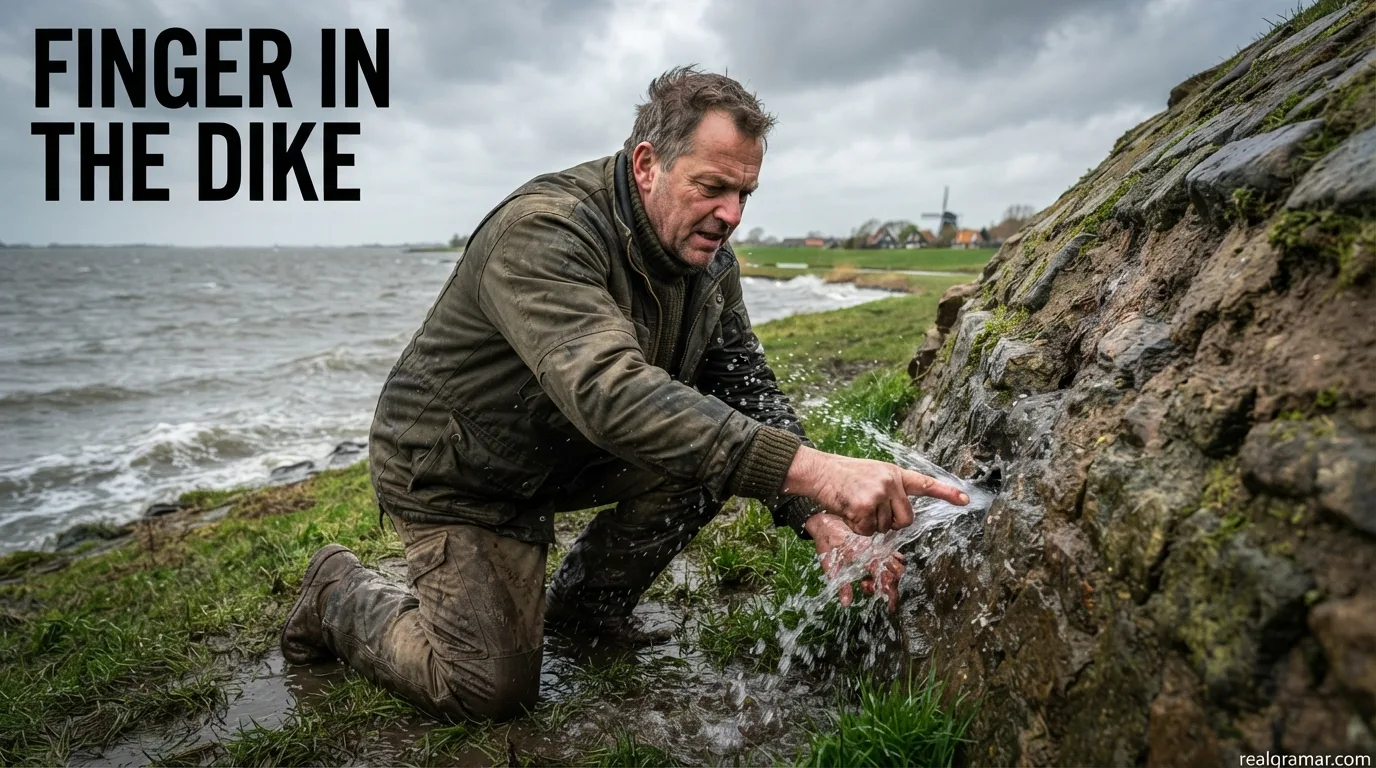
Language is filled with expressions that carry stories, history, and deeper meanings. Some phrases come from literature, mythology, or real-life events and become widely used because they represent universal human experiences. The phrase finger in the dike is one such expression that represents determination, responsibility, sacrifice, and the effort to prevent a much larger problem with limited resources.
At first glance, this phrase may seem like a simple image of someone trying to stop water from escaping through a small opening. However, its meaning extends far beyond a physical situation. Today, it is commonly used as a metaphor for attempting to hold back a growing problem, manage a crisis, or prevent disaster before it becomes uncontrollable.
Understanding this expression helps students, writers, English learners, and professionals recognize how figurative language works in communication. It also demonstrates how stories from history and culture influence modern vocabulary.
This guide explores the meaning, historical background, symbolic importance, examples, related concepts, and practical uses of this famous expression.
What Does “Finger in the Dike” Mean?
The expression refers to a situation where someone tries to stop a serious problem with a small or temporary solution.
The basic idea is:
A person uses limited effort or resources to prevent a larger failure from happening.
The image behind the phrase comes from the idea of a person placing a finger into a hole in a protective wall to stop water from leaking through. While this action may slow the problem, it is usually only a temporary measure.
In modern communication, the expression often describes:
- Trying to control a growing problem
- Managing emergencies with limited resources
- Taking personal responsibility during difficult situations
- Preventing a crisis from becoming worse
- Applying a short-term solution instead of fixing the root cause
Simple Examples:
- The manager felt like he was keeping his finger in the dike by constantly fixing small workplace issues instead of solving the main problem.
- Volunteers were putting their efforts into stopping the spread of misinformation, acting as a temporary barrier against a larger challenge.
- Repairing one broken machine part was only a short-term solution; it was like placing a finger in the dike.
Historical Origin and Background of the Expression
The phrase is connected to a famous story from Dutch culture about a young boy who saves his community by preventing a flood.
According to the traditional tale, a boy notices a small hole in a dike, a structure built to protect land from water. Understanding that the opening could eventually cause a devastating flood, he places his finger into the hole to block the water. He remains there until help arrives.
Although the story is often treated as a legend rather than a confirmed historical event, it became a powerful symbol of courage and responsibility.
The story highlights several important themes:
- Individual action can create a major impact.
- Small problems should be addressed before they become disasters.
- Responsibility sometimes requires personal sacrifice.
- Courage does not always involve dramatic actions.
Over time, the image became part of English vocabulary and developed a broader metaphorical meaning.
Literal Meaning vs Figurative Meaning
Understanding the difference between literal and figurative meanings helps English learners recognize how expressions evolve.
| Type | Meaning | Example |
| Literal meaning | Physically blocking water from escaping through a barrier | A person stopping a leak in a protective wall |
| Figurative meaning | Trying to prevent a larger problem using limited action | Managing constant issues without solving the main cause |
Literal Example:
A worker notices a small crack in a water barrier and temporarily blocks it until repairs arrive.
Figurative Example:
A teacher repeatedly handles student conflicts but lacks support to address the deeper causes.
The figurative meaning is what people usually intend when using this expression today.
Why This Expression Became a Popular Metaphor

Metaphors allow people to explain complex ideas through simple images. The idea behind this phrase is memorable because almost everyone understands the concept of trying to stop something from getting worse.
It represents situations where:
- A small action prevents a larger consequence.
- Someone takes responsibility when others do not.
- A temporary fix delays a bigger challenge.
- One person attempts to manage overwhelming circumstances.
The metaphor is effective because it combines urgency with human effort.
A person using only one finger against a powerful force like water represents both:
- Courage
- Vulnerability
This contrast makes the expression emotionally powerful.
Common Uses of the Expression in Modern Language
The phrase is used in many areas, including business, politics, education, technology, and everyday conversations.
Business and Workplace Examples
Organizations often experience situations where employees feel they are constantly reacting to problems.
Examples:
- A customer service team answering endless complaints without improving the product is acting like they are trying to hold back a flood.
- A manager solving daily emergencies without creating better systems may feel overwhelmed.
- A company repeatedly fixing software errors instead of redesigning the system may need a long-term strategy.
Workplace Lessons:
Instead of only managing symptoms, organizations should:
- Identify root causes
- Create sustainable solutions
- Improve processes
- Invest in prevention
Environmental Examples
Environmental discussions often use this concept when describing efforts to manage major challenges.
Examples:
- Cleaning polluted areas without reducing the source of pollution may only provide temporary improvement.
- Protecting one ecosystem while ignoring wider environmental damage may not solve the larger issue.
The metaphor encourages people to think about prevention rather than only emergency responses.
Examples in Everyday Life
The expression applies to many ordinary situations.
Personal Responsibilities
A parent managing constant family problems without addressing communication issues may feel overwhelmed.
Example:
She spent every day solving small arguments between her children, but it felt like she was only holding back a bigger family problem.
Education
Teachers often face situations where they handle immediate issues but lack resources for deeper solutions.
Example:
The teacher felt like she was constantly preventing classroom problems instead of receiving support to improve the learning environment.
Technology
Technology professionals frequently deal with temporary fixes.
Example:
Restarting the system every morning was just a temporary solution; the technician needed to repair the underlying software problem.
The Difference Between a Temporary Fix and a Permanent Solution
A major idea behind this metaphor is the difference between managing a problem and solving it.
| Temporary Approach | Permanent Approach |
| Addresses immediate symptoms | Solves the root cause |
| Provides short-term relief | Creates lasting improvement |
| Requires repeated effort | Reduces future problems |
| Often depends on individuals | Builds reliable systems |
Example:
Temporary:
Fixing small leaks every week.
Permanent:
Replacing the damaged structure causing the leaks.
The metaphor encourages critical thinking about problem-solving strategies.
Continue in Part 2:
- Psychological meaning and symbolism
- Leadership lessons
- Similar expressions and comparisons
- Benefits of proactive problem-solving
- Real-world case studies
- Common mistakes in usage
- 8 SEO-focused FAQs
- Final conclusion
Symbolic Meaning and Deeper Interpretation

The expression represents much more than stopping a physical problem. It reflects important human qualities such as courage, responsibility, patience, and the willingness to act when others may ignore a danger.
The image of one person attempting to prevent a disaster with limited resources creates several symbolic meanings.
1. Responsibility and Personal Action
One of the strongest ideas behind this metaphor is personal responsibility.
The person who notices the problem does not ignore it. Instead, they take immediate action.
This represents people who:
- Step forward during difficult situations
- Protect others from harm
- Accept responsibility even without recognition
- Act before problems become worse
Example:
A healthcare worker warning others about a developing health concern before it becomes widespread demonstrates this type of responsibility.
2. Courage Against Overwhelming Challenges
The image suggests someone facing a powerful force with very limited tools.
The contrast between a small human action and a massive threat creates a symbol of courage.
It teaches that:
- Small actions can matter
- Individual efforts can create change
- Waiting for perfect conditions may allow problems to grow
However, it also reminds people that courage alone is not always enough. Long-term solutions and teamwork are often necessary.
3. Sacrifice and Commitment
The traditional story connected with this phrase focuses on someone who sacrifices personal comfort for the safety of others.
The symbolic lesson is:
Protecting something valuable may require effort, patience, and personal commitment.
Examples include:
- Community volunteers helping during emergencies
- Employees working extra hours during a crisis
- Leaders making difficult decisions to protect others
The Expression in Leadership and Management
Leaders often experience situations where they must prevent problems while searching for better solutions.
A leader may feel like they are constantly “holding back the flood” when they:
- Solve repeated conflicts
- Manage unexpected failures
- Respond to emergencies
- Handle problems without enough resources
However, effective leadership requires moving beyond temporary solutions.
Strong Leaders Focus on:
Identifying Root Causes
Instead of asking:
“How can we fix this problem today?”
They ask:
“Why does this problem continue to happen?”
Building Better Systems
A sustainable approach includes:
- Clear processes
- Proper training
- Effective communication
- Preventive planning
Sharing Responsibility
One person cannot permanently manage every challenge alone.
Successful organizations encourage:
- Collaboration
- Delegation
- Team problem-solving
The Importance of Preventing Problems Before They Grow
One major lesson from this metaphor is the importance of early action.
Small issues often become major challenges when ignored.
Examples:
In Business
Small customer complaints may become:
- Reputation damage
- Lost customers
- Financial problems
Early action:
- Listening to feedback
- Improving products
- Training employees
In Personal Life
Small disagreements may become:
- Broken relationships
- Long-term resentment
- Communication problems
Early action:
- Honest conversations
- Understanding different perspectives
- Solving issues respectfully
In Technology
Small security weaknesses may become:
- Data breaches
- System failures
- Financial losses
Early action:
- Regular updates
- Security checks
- Proper maintenance
Similar Expressions and Related Concepts
Many English expressions communicate similar ideas about problems, prevention, and responsibility.
| Expression | Meaning | Example |
| Put out fires | Deal with urgent problems repeatedly | The manager spends all day putting out fires. |
| Band-aid solution | Temporary fix that does not solve the cause | The repair was only a band-aid solution. |
| Stop the bleeding | Prevent further damage | The company reduced costs to stop the bleeding. |
| Prevent a crisis | Take action before disaster occurs | Planning helped prevent a crisis. |
| Treat the symptoms | Address visible problems instead of causes | The policy treats symptoms rather than causes. |
These expressions are useful for improving vocabulary and understanding figurative language.
Difference Between a Temporary Fix and a Band-Aid Solution
Although these ideas are similar, they are not exactly the same.
A temporary solution may be necessary while waiting for a permanent solution.
A band-aid solution usually suggests that someone is avoiding the real problem.
Comparison Table:
| Concept | Meaning | Example |
| Temporary fix | Short-term action until a better solution is available | Repairing equipment until replacement arrives |
| Band-aid solution | Quick fix that ignores the deeper issue | Repeatedly repairing old equipment instead of upgrading |
| Preventive action | Stops problems before they happen | Regular maintenance checks |
Understanding these differences improves communication skills.
Real-Life Examples of the Concept
Example 1: Public Safety
Emergency workers often respond quickly during disasters. Their immediate actions may prevent greater damage, but long-term planning is needed to reduce future risks.
The first response is important, but prevention creates lasting protection.
Example 2: Education Systems
Teachers may spend significant time managing classroom disruptions.
A short-term response:
- Addressing individual incidents
A long-term response:
- Improving classroom systems
- Supporting students’ needs
- Creating better learning environments
Example 3: Personal Productivity
Many people experience a cycle of constantly reacting to tasks.
Examples:
- Answering urgent emails all day
- Fixing repeated mistakes
- Managing last-minute requests
A better approach:
- Prioritize important work
- Create systems
- Plan ahead
Benefits of Understanding This Concept

Learning this metaphor improves several important skills.
1. Better Problem-Solving
It encourages people to look beyond immediate problems.
Instead of asking:
“How do I fix this right now?”
Consider:
“What created this situation?”
2. Improved Critical Thinking
The expression teaches people to analyze:
- Causes
- Consequences
- Long-term effects
- Available resources
3. Stronger Communication Skills
Understanding figurative expressions helps English learners:
- Follow conversations
- Understand literature
- Interpret workplace language
- Write more naturally
4. Better Decision-Making
The concept encourages balanced thinking.
Sometimes immediate action is necessary.
For example:
- Emergency repairs
- Crisis management
- Quick responses
But after the immediate danger passes, deeper improvements are required.
Common Mistakes When Using the Expression
Mistake 1: Taking the Phrase Literally
Some learners may misunderstand it as only describing a physical situation involving water.
However, modern usage is usually metaphorical.
Incorrect understanding:
It only means repairing a wall.
Correct understanding:
It describes trying to prevent a larger problem with limited action.
Mistake 2: Using It for Positive Growth Situations
The expression usually describes difficult situations, risks, or problems.
Less suitable:
The company was putting a finger in the dike because sales increased.
Better:
The company was putting a finger in the dike by trying to control rising costs.
Mistake 3: Ignoring the Need for Long-Term Solutions
The phrase often suggests that a temporary response is not enough.
Example:
Fixing the same issue repeatedly without solving its cause is not sustainable.
How Writers Can Use This Metaphor Effectively
Writers can use this expression to communicate complex ideas clearly.
It works especially well in:
- Essays
- Opinion articles
- Business writing
- Speeches
- Stories
- Social commentary
Example:
Small community programs can help reduce the effects of poverty, but without broader economic changes, they may feel like temporary efforts against a much larger challenge.
The metaphor adds emotional impact while making an argument easier to understand.
Continue in Part 3:
- Advanced examples in writing
- Related vocabulary and semantic concepts
- Practical exercises
- 8 detailed FAQs
- Final SEO conclusion summarizing the topic
Advanced Examples of Using the Expression in Writing
Understanding an expression is only the first step. Skilled writers know how to apply figurative language naturally to make ideas clearer and more persuasive.
This metaphor works especially well when discussing situations where people struggle to manage growing challenges.
Example 1: In Business Writing
Basic sentence:
The company had many problems.
Improved sentence:
The management team felt as if they were constantly trying to prevent a flood of problems, addressing daily issues without enough time to create permanent solutions.
The second version creates a stronger image and helps readers understand the pressure involved.
Example 2: In Social Commentary
Basic sentence:
Governments need better solutions for pollution.
Improved sentence:
Cleaning polluted areas without reducing the causes of pollution is only a temporary response to a much larger environmental challenge.
This type of comparison helps readers understand the difference between immediate action and long-term change.
Example 3: In Personal Development Writing
Basic sentence:
People should manage stress better.
Improved sentence:
Constantly ignoring stress signals can leave people managing one problem after another instead of creating healthier habits.
The idea encourages readers to focus on prevention rather than endless reactions.
Related Vocabulary and Semantic Concepts
Learning related words improves vocabulary enhancement and helps writers express ideas more precisely.
Problem-Solving Vocabulary

| Word | Meaning | Example |
| Prevention | Stopping a problem before it happens | Prevention reduces future risks. |
| Intervention | Action taken to improve a situation | Early intervention can prevent failure. |
| Crisis management | Handling emergencies | Leaders need strong crisis management skills. |
| Root cause | The main reason behind a problem | Finding the root cause creates better solutions. |
| Sustainability | Ability to continue successfully | Sustainable strategies create lasting results. |
Similar Metaphors in English
English uses many metaphors to describe challenges and solutions.
“Putting Out Fires”
Meaning:
Handling urgent problems repeatedly.
Example:
The manager spends most of the day putting out fires instead of planning for growth.
“Opening Pandora’s Box”
Meaning:
Creating or discovering a situation that leads to many problems.
Example:
Ignoring the warning signs opened Pandora’s box for the organization.
“A Slippery Slope”
Meaning:
A situation where one problem can gradually lead to larger problems.
Example:
Poor decisions can become a slippery slope toward bigger failures.
“The Tip of the Iceberg”
Meaning:
A small visible part of a much larger hidden issue.
Example:
The complaint was only the tip of the iceberg; many deeper problems existed.
How This Expression Improves Writing Skills
Figurative expressions make writing more engaging because they transform abstract ideas into visual experiences.
Compare these sentences:
Simple:
The organization had many ongoing problems.
More Powerful:
The organization was constantly fighting new problems while deeper issues continued growing beneath the surface.
The second sentence creates a stronger emotional connection.
Effective writing often combines:
- Clear explanations
- Strong imagery
- Relevant comparisons
- Specific examples
- Meaningful vocabulary
Practical Exercise: Identify the Meaning
Choose the correct interpretation.
1.
“The small team felt like they were trying to hold back a flood of complaints.”
A) They were repairing a water system.
B) They were struggling to manage a growing problem.
Answer: B2.
“Replacing one broken part without fixing the machine was only a temporary solution.”
A) A permanent improvement
B) A short-term response
Answer: B
3.
“The leader focused on preventing problems instead of reacting to emergencies.”
A) Proactive thinking
B) Ignoring problems
Answer: A
Practice Exercise: Improve These Sentences
Rewrite the following sentences using stronger descriptive language.
Sentence 1:
Original:
The company kept solving small issues.
Improved:
The company spent months reacting to small issues while larger challenges continued developing.
Sentence 2:
Original:
The teacher had too many classroom problems.
Improved:
The teacher felt overwhelmed by constantly managing classroom issues without addressing the deeper causes.
Sentence 3:
Original:
The government needed a better plan.
Improved:
The government needed a long-term strategy instead of repeatedly responding to problems after they appeared.
FAQs
1. What does the expression mean in simple words?
It means trying to stop a large problem with a small or temporary action.
It describes situations where someone works hard to prevent damage but may not have enough resources or a permanent solution.
Example:
Fixing small issues every day without solving the main problem is like trying to stop a flood with a temporary barrier.
2. Where did this expression come from?
The phrase comes from a famous story associated with Dutch culture. In the story, a young person notices a small opening in a protective structure and blocks it to prevent flooding.
The story became a symbol of courage, responsibility, and taking action during emergencies.
3. Is this expression literal or figurative?
Today, it is mainly used figuratively.
The literal image involves physically blocking water, but the modern meaning describes managing problems, preventing disasters, or handling difficult situations.
4. Is the expression positive or negative?
It can have both meanings depending on context.
Positive meaning:
- Shows courage
- Demonstrates responsibility
- Highlights quick action
Negative meaning:
- Suggests a temporary solution
- Shows that deeper problems remain unresolved
5. Can this expression be used in professional writing?
Yes. It is often used in:
- Business articles
- Leadership discussions
- Policy analysis
- Problem-solving discussions
However, writers should ensure the audience understands the metaphor.
6. What is the difference between this expression and a permanent solution?
The expression usually describes an immediate response to a problem.
A permanent solution:
- Addresses the root cause
- Prevents repeated problems
- Creates lasting improvement
For example:
Repairing a leak is temporary. Rebuilding damaged infrastructure is a permanent solution.
7. Why are metaphors like this important in English?
Metaphors make complicated ideas easier to understand.
They help people:
- Visualize abstract concepts
- Communicate emotions
- Explain complex situations
- Create memorable messages
They are important tools in storytelling, education, business, and everyday communication.
8. How can I use this expression correctly?
Use it when describing a situation where someone is preventing a bigger problem through limited action.
Examples:
- The team was constantly managing complaints, but it felt like they were only delaying a larger issue.
- Emergency workers sometimes handle immediate dangers while waiting for permanent solutions.
Avoid using it for simple tasks or positive achievements unrelated to problem prevention.
Conclusion
Expressions based on stories and historical images add depth to the English language. This metaphor represents the human desire to protect, solve problems, and take responsibility during challenging situations.
The central lesson is that immediate action can be valuable, but lasting success requires addressing the underlying causes of problems. A person may temporarily prevent damage, but true improvement comes from building stronger systems, planning ahead, and creating sustainable solutions.
For students, writers, and English learners, understanding expressions like this improves vocabulary, reading comprehension, and communication skills. It also demonstrates how figurative language transforms ordinary ideas into powerful messages.
Whether used in business discussions, personal conversations, literature, or educational writing, this metaphor reminds us that small actions matter—but meaningful change often requires looking beyond the immediate challenge and solving the problem at its source.
