

Choosing between “a” and “an” can seem simple until a word begins with a vowel letter but does not begin with a vowel sound. This is exactly where many English learners become confused.
The phrase “a hilarious” is grammatically correct, while “an hilarious” is generally considered incorrect in modern standard English. The reason is not the spelling of the word hilarious, but the sound that begins the word.
Understanding this small grammar rule can help you write more naturally, avoid common mistakes, and choose the correct indefinite article with confidence.
In this guide, you will learn how English articles work, why the correct form is based on pronunciation, how hilarious fits the rule, and how to use the expression in everyday writing and conversation.
What Does “Hilarious” Mean?
Hilarious is an adjective used to describe something extremely funny or amusing. If something makes you laugh a lot, you can describe it as hilarious.
For example:
- “That was a hilarious joke.”
- “We watched a hilarious movie last night.”
- “Her story was absolutely hilarious.”
- “He told us a hilarious story about his first day at work.”
The word usually expresses a stronger reaction than simply saying something is funny. Calling something hilarious suggests that it caused significant amusement or laughter.
Similar words
Depending on the context, alternatives include:
- Funny
- Amusing
- Comical
- Entertaining
- Humorous
- Hysterical
- Laughable
- Side-splitting
- Comedic
However, these words are not always interchangeable. Hilarious normally communicates a particularly strong sense of amusement.
Why Is “A Hilarious” Grammatically Correct?
The important rule is that indefinite articles are selected according to sound, not simply according to the first written letter.
English has two indefinite articles:
- A
- An
Use a before a word that begins with a consonant sound.
Use an before a word that begins with a vowel sound.
The word hilarious begins with the sound /h/. The initial h is pronounced, so the word starts with a consonant sound.
Therefore, the natural construction is:
“a hilarious story”
The same pattern appears in other expressions:
- a happy child
- a helpful teacher
- a historic building
- a hilarious joke
- a huge mistake
- a horrible experience
The spelling alone does not determine the article.
Why “An Hilarious” Sounds Wrong
The incorrect construction is usually caused by looking at the vowel letters inside the word rather than listening to its opening sound.
Although hilarious contains vowels such as i and a, its first sound is the pronounced h.
Compare these two structures:
ExpressionFirst soundCorrect articlehilarious joke/h/ahappy person/h/ahelpful idea/h/ahonest personvowel soundanhour-long meetingvowel soundanhilarious story/h/a
This distinction is especially important with words beginning with h, because some words pronounce the h while others do not.
When the h is silent, an may be required:
- an honest answer
- an honorable decision
- an hour
- an heir
When the h is clearly pronounced, a is normally used:
- a hilarious joke
- a happy ending
- a helpful suggestion
- a healthy meal
The Basic Rule for A and An
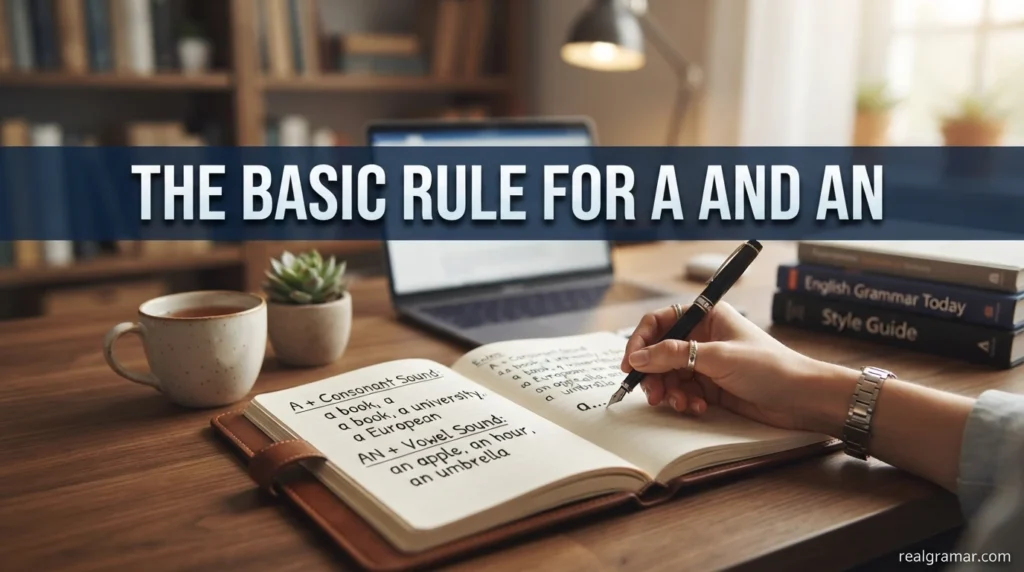
The easiest way to remember the rule is:
Choose the article based on pronunciation rather than spelling.
Use a before consonant sounds:
- a dog
- a book
- a university
- a European country
- a hilarious video
Use an before vowel sounds:
- an apple
- an orange
- an interesting story
- an unusual event
- an hour
Notice something interesting in the examples above: university begins with the letter u, but it takes a because its opening sound is similar to “you,” a consonant sound.
Likewise, some words beginning with consonant letters take an because their first consonant is silent.
This is why memorizing letters alone is not enough.
A vs. An: The Difference Between Letters and Sounds
English pronunciation creates many situations in which spelling and grammar do not appear to match.
Consider these examples:
Words beginning with a vowel letter but taking “a”
- a university
- a useful tool
- a European city
- a unique opportunity
- a one-time event
These words begin with sounds that function like consonant sounds.
Words beginning with a consonant letter but taking “an”
- an hour
- an honest person
- an honorable action
- an heir
- an MBA
In each case, pronunciation determines the article.
For abbreviations, you should also listen to how the abbreviation is pronounced. For example, MBA begins with the sound “em,” so we say:
“an MBA”
This same principle explains why the correct form before hilarious uses a.
Examples of the Correct Usage
Seeing the expression in context makes the rule easier to remember.
Everyday conversation
- “That was a hilarious story.”
- “She sent me a hilarious video.”
- “He made a hilarious comment.”
- “We had a hilarious conversation.”
- “My friend told a hilarious joke.”
Formal or professional writing
Even though hilarious is informal compared with words such as humorous or amusing, it can still appear in many types of writing.
Examples include:
- “The article describes a hilarious incident during the event.”
- “The comedian delivered a hilarious performance.”
- “The author includes a hilarious scene in the final chapter.”
Reviews and recommendations
The adjective is particularly common in entertainment-related descriptions:
- “It is a hilarious comedy.”
- “The series features a hilarious supporting character.”
- “The film contains a hilarious scene.”
- “The comedian’s latest special is a hilarious performance.”
Common Mistakes English Learners Make
Many article mistakes come from applying a spelling-based rule instead of a pronunciation-based rule.
Here are some common problems.
Mistake 1: Looking only at the first letter
A learner may see the vowel i inside hilarious and assume that the word needs an.
The correct approach is to pronounce the beginning of the word first.
The word begins with a clearly pronounced h sound, so a is appropriate.
Mistake 2: Assuming every word beginning with H takes “a”
This is also incorrect.
Some English words beginning with h have a silent h. These can require an:
- an honest person
- an hour
- an heir
Therefore, the rule is not simply “H means a.”
The real rule is:
Listen to the initial sound.
Mistake 3: Treating “a” and “an” as interchangeable
They are both indefinite articles, but they cannot normally be switched freely.
For example:
- a hilarious story
- an interesting story
The article changes because the following word begins with a different sound.
Mistake 4: Overthinking the rule
Once you understand the pronunciation principle, there is no need to memorize hundreds of individual expressions.
Ask yourself one question:
What sound do I hear at the beginning of the next word?
If it is a consonant sound, use a. If it is a vowel sound, use an.
When Should You Use “Hilarious” in a Sentence?
The word is useful when you want to emphasize that something is exceptionally funny.
Compare:
“It was a funny movie.”
This simply tells the reader that the movie made you laugh.
“It was a hilarious movie.”
This suggests a much stronger reaction.
You can use the adjective to describe:
- jokes
- stories
- movies
- television shows
- videos
- conversations
- comments
- performances
- situations
- mistakes
- characters
- people, when the context supports the meaning
For example:
“My brother made a hilarious mistake while trying to cook dinner.”
Here, hilarious tells the reader that the mistake was particularly amusing.
However, be careful when describing real people or sensitive situations. Something may be funny to one person but embarrassing or offensive to another.
A Hilarious vs. An Hilarious in Real-Life Examples
The easiest way to develop good grammar instincts is to examine complete sentences.
Incorrect or less appropriate formBetter formReasonHe told an hilarious joke.He told a hilarious joke.The “h” is pronounced.We watched an hilarious movie.We watched a hilarious movie.The word starts with /h/.She shared an hilarious story.She shared a hilarious story.Consonant sound follows the article.It was an hilarious moment.It was a hilarious moment.The initial sound is /h/.He gave a hilarious speech.He gave a hilarious speech.“H” is pronounced.
These examples demonstrate why pronunciation is more reliable than spelling.
The Importance of Pronunciation in English Grammar
English grammar and pronunciation are closely connected. Articles provide one of the clearest examples of this relationship.
Native and proficient English speakers generally choose a or an automatically based on the sound they expect to hear.
This is why reading a sentence aloud can be an effective way to catch article mistakes.
For example, say:
“a hilarious joke”
The transition between a and hilarious sounds natural.
Now say:
“an hilarious joke”
The sequence feels awkward in standard modern English because an normally prepares the listener for a vowel sound.
Pronunciation therefore acts as a practical grammar guide.
Related Grammar Concepts You Should Know
Understanding this article choice can help you learn several broader English concepts.
Indefinite articles
A and an are indefinite articles. They generally refer to one non-specific person, thing, or idea.
Examples:
- I saw a dog.
- She bought an umbrella.
- He told a joke.
The listener does not necessarily know exactly which dog, umbrella, or joke is being discussed.
Definite article
English also uses the, which is the definite article.
Compare:
- “I watched a movie.”
- “The movie was hilarious.”
The first sentence introduces a non-specific movie. The second refers to a particular movie that has already been identified.
Adjectives between articles and nouns
When an adjective appears before a singular countable noun, the article comes before the adjective.
For example:
- a funny story
- a hilarious story
- an interesting story
- an unusual story
The article therefore depends on the sound of the adjective, not the noun that comes afterward.
This is an important detail.
Consider:
a hilarious story
You do not choose the article based on story. You choose it based on the opening sound of hilarious.
How to Remember the Rule Easily

A simple three-step method can eliminate most confusion.
Step 1: Ignore the spelling
Do not immediately focus on the first letter.
Step 2: Say the word aloud
Listen carefully to its first sound.
Step 3: Choose the article
- Consonant sound → a
- Vowel sound → an
For hilarious, the first sound is /h/, so the correct construction is a hilarious.
You can use exactly the same strategy with unfamiliar words. If you are unsure, pronounce the word naturally and listen to how it begins.
Why This Small Grammar Rule Matters
Article errors may appear minor, but using them correctly makes English sound more natural and polished.
Correct article usage can help with:
- Academic writing
- Professional emails
- Blog posts
- Website content
- Social media captions
- Job applications
- Everyday conversations
- English-language exams
For learners, mastering articles also builds a stronger understanding of how English pronunciation influences grammar.
It is particularly useful to learn the principle rather than memorize one isolated phrase. Once you understand sound-based article selection, you can apply the same knowledge to many other words.
FAQs
1. Is “a hilarious” grammatically correct?
Yes. A hilarious is the standard grammatical construction because hilarious begins with a pronounced /h/ consonant sound.
2. Why does “hilarious” use “a” instead of “an”?
The choice depends on the opening sound. Hilarious starts with a clearly pronounced h, which is a consonant sound. Therefore, it takes a.
3. Is “an hilarious” ever correct?
In modern standard English, an hilarious is generally considered incorrect. Older varieties or historical texts may contain different usage, but contemporary standard English normally uses a.
4. Does the first letter determine whether I use “a” or “an”?
No. The first sound determines the article. This is why we say “a university” but “an hour.”
5. What is the difference between funny and hilarious?
Both words describe something amusing, but hilarious usually indicates a much stronger level of humor. A funny situation may make you smile or laugh, while a hilarious situation is exceptionally amusing.
6. Can I say “a hilarious joke”?
Yes. This is a completely natural expression. For example: “He told a hilarious joke at dinner.”
7. Do all words beginning with H use “a”?
No. Some words have a silent h and therefore begin with a vowel sound. Examples include “an honest person” and “an hour.”
8. What is the easiest way to remember the rule?
Remember sound, not spelling. Use a before a consonant sound and an before a vowel sound. This rule works across many common English expressions.
Conclusion
Choosing the correct indefinite article becomes much easier once you stop relying on spelling and start paying attention to pronunciation.
The word hilarious begins with a clearly pronounced h sound, so the standard form is a hilarious. The same principle applies throughout English: use a before a consonant sound and an before a vowel sound.
This rule also explains why we say “a university” but “an hour.” What matters is not necessarily the first letter you see on the page, but the sound you hear when the word is spoken.
Whether you are writing an article, sending a message, completing an English assignment, or speaking in everyday conversation, this simple sound-based approach will help you use indefinite articles more accurately and naturally.
Once you remember “listen to the first sound,” choosing between a and an becomes far less confusing.
