
Language becomes powerful when every word carries the right meaning. Whether you are a student writing an essay, a professional creating content, or an English learner improving vocabulary, choosing the correct word can completely change the message you want to communicate.
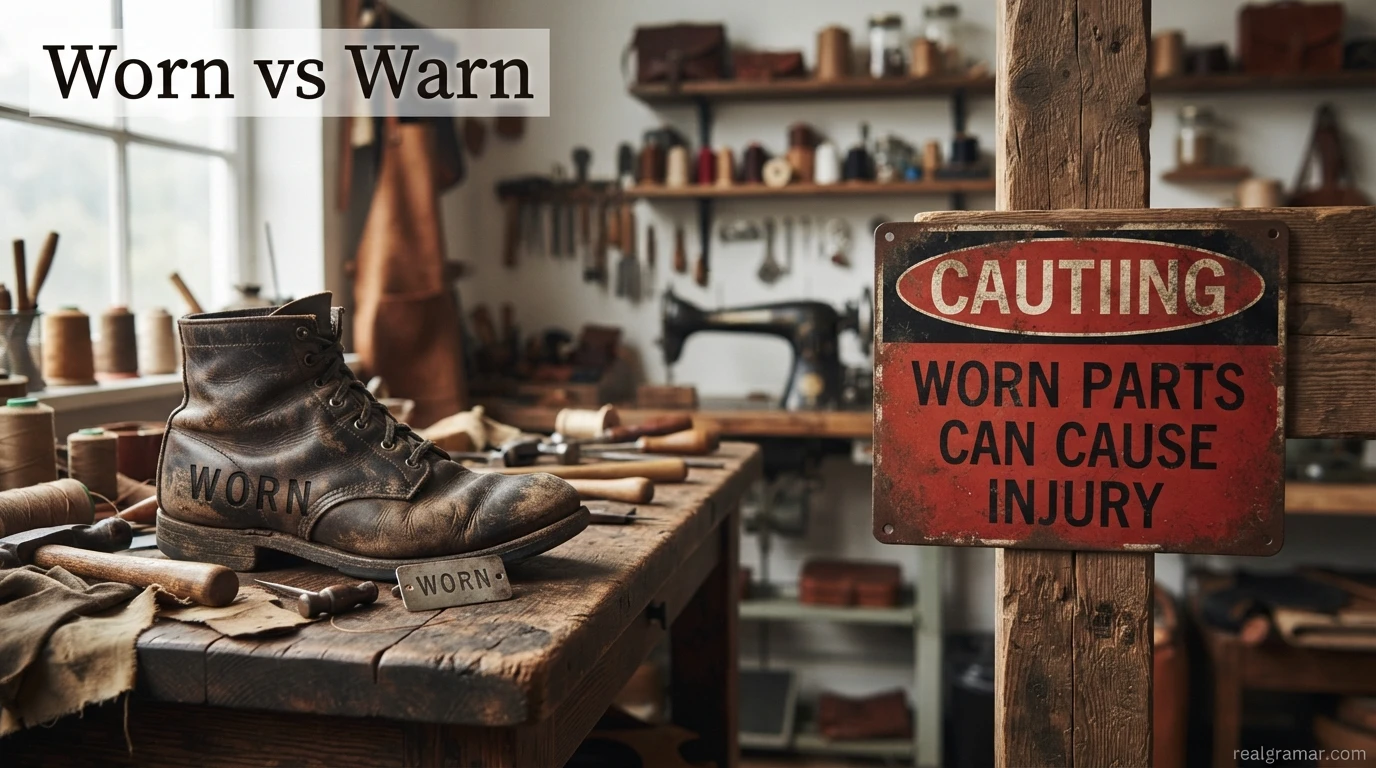
Words that look or sound similar often create confusion, and this is especially true in English. A single letter can separate two completely different ideas. The difference between worn vs warn is a perfect example. One word describes something that has been used, carried, or experienced, while the other is connected to giving advice, caution, or information about possible danger.
Understanding these differences does more than prevent grammar mistakes. It improves writing skills, strengthens communication, and helps writers create clearer descriptions. When you understand how words function, you can use figurative language, creative writing techniques, and descriptive language more effectively.
For example, writers often use words with emotional meanings to create imagery:
- A worn photograph may suggest memories, age, or nostalgia.
- A person may warn someone about a difficult journey ahead.
These small differences influence tone, emotion, and meaning. In storytelling, poetry, essays, and everyday conversations, choosing the right vocabulary creates stronger connections with readers.
This guide explains the meaning of worn and warn, their grammatical roles, comparison examples, common mistakes, sentence examples, literary uses, and practical exercises to help students and English learners master these commonly confused words.
Worn vs Warn: Quick Comparison Table
Before exploring the details, here is a simple comparison:
| Word | Meaning | Part of Speech | Main Idea | Example |
| Worn | Used, damaged, tired, or carried on the body | Past participle of “wear” | Something has experienced use or aging | She wore a worn jacket. |
| Warn | To give advice or notice about danger or problems | Verb | Giving information or caution | They warned us about the storm. |
The easiest way to remember the difference:
- Worn = wear → something used or experienced
- Warn = warning → telling someone to be careful
What Does Worn Mean?
The word worn is the past participle form of the verb wear. It describes something that has been used, placed on the body, affected by time, or made tired through effort.
The meaning depends on the context.
1. Worn Meaning: Used or Damaged Through Time
When an object becomes old because of repeated use, we describe it as worn.
Examples:
- My grandfather owns a worn leather wallet that he has kept for decades.
- The old book had worn pages because many people had read it.
- Her shoes looked worn after years of walking.
Here, worn suggests age, experience, and repeated use.
2. Worn Meaning: Clothing or Accessories Being Used
Worn can describe clothing, jewelry, or items placed on the body.
Examples:
- She has worn that dress many times.
- The necklace was worn by her grandmother.
- He had worn a blue jacket during the event.
In these examples, worn means “put on the body.”
3. Worn Meaning: Physically or Emotionally Exhausted
Worn can also describe a person who feels extremely tired.
Examples:
- After working all night, he looked completely worn.
- The long journey left the travelers worn and exhausted.
- She felt emotionally worn after dealing with constant stress.
This meaning is common in descriptive writing because it creates a strong emotional image.
Worn in Figurative Language and Creative Writing
Writers often use worn beyond its literal meaning. It can become a powerful tool for figurative language and poetic expression.
A worn object can symbolize:
- Memories
- History
- Experience
- Struggle
- Time passing
- Emotional connection
Examples of Figurative Uses
1. Worn as a Symbol of Memories
The worn photograph carried the stories of generations.
The photograph is not just old; it represents family history.
2. Worn as a Metaphor for Life Experiences
His worn hands told the story of years of hard work.
The hands represent dedication and effort.
3. Worn in Descriptive Writing
The traveler carried a worn backpack filled with forgotten dreams.
The word creates emotional depth and helps readers imagine the character’s journey.
What Does Warn Mean?
The word warn is a verb that means to inform someone about a possible danger, problem, mistake, or consequence.
When you warn someone, you provide information so they can make a safer or better decision.
Basic Meaning of Warn
Warn = to tell someone to be careful
Examples:
- The teacher warned students about the upcoming exam.
- My friend warned me about the difficult road.
- Experts warned people about the weather conditions.
Different Uses of Warn With Examples

1. Warn About Danger
The most common use of warn involves safety.
Examples:
- The sign warns drivers about sharp turns.
- The firefighter warned residents about the fire.
- Scientists warned people about rising temperatures.
2. Warn Someone About a Situation
Warn can introduce information about something that may happen.
Examples:
- She warned him about the possible consequences.
- They warned us about delays at the airport.
- The coach warned players about the strong competition.
3. Warn Someone Not to Do Something
This structure tells someone to avoid an action.
Pattern:
Warn + someone + not to + verb
Examples:
- My parents warned me not to touch the hot stove.
- The doctor warned him not to ignore the symptoms.
- The guide warned tourists not to leave the path.
Warn in Figurative Language and Literary Expression
Like worn, the word warn can appear in creative writing and storytelling.
Writers use warnings to create:
- Suspense
- Tension
- Foreshadowing
- Emotional impact
Examples:
Suspense Example
The mysterious voice warned him that the night would change everything.
The warning creates curiosity.
Foreshadowing Example
The old sailor warned them about the storm, but nobody listened.
The warning prepares readers for future events.
Metaphorical Example
Her silence warned him that something was wrong.
Silence cannot literally speak, but it communicates a message.
Worn vs Warn: Grammar Differences
Understanding grammar is one of the best ways to avoid confusion.
| Feature | Worn | Warn |
| Base Word | Wear | Warn |
| Word Type | Past participle | Verb |
| Used With | Objects, clothing, experiences | Advice, danger, information |
| Common Forms | Wear, wore, worn | Warn, warned, warning |
Verb Forms
Wear
| Form | Example |
| Present | I wear a jacket. |
| Past | I wore a jacket yesterday. |
| Past Participle | I have worn this jacket before. |
Warn
| Form | Example |
| Present | They warn people. |
| Past | They warned people. |
| Present Participle | They are warning people. |
Sentence Examples: Worn vs Warn
Worn Examples
- She has worn that necklace since childhood.
- The workers had worn gloves for protection.
- His worn shoes showed years of travel.
- The old chair looked worn but comfortable.
- The athlete felt worn after the competition.
- The book’s worn cover showed its popularity.
- Her worn expression revealed her exhaustion.
- The painting had worn colors because of sunlight.
Warn Examples
- The teacher warned students about cheating.
- The weather service warned people about heavy rain.
- My brother warned me about the difficult test.
- The sign warns visitors to stay away.
- Doctors warn people about unhealthy habits.
- She warned him not to make the same mistake.
- The guide warned travelers about wild animals.
- The manager warned employees about the deadline.
Common Mistakes When Using Worn and Warn
Many English learners confuse worn and warn because they look almost identical and have similar pronunciation. However, their meanings are completely different. Using the wrong word can make a sentence unclear or even change the entire message.
Learning the common mistakes helps improve vocabulary enhancement and prevents frequent grammar errors.
Mistake 1: Using Warn When You Mean Worn
Incorrect:
❌ She has warn the same dress many times.
Correct:
✅ She has worn the same dress many times.
Explanation:
The sentence talks about clothing being used. Since the idea is related to wearing clothes, the correct word is worn.
More examples:
❌ He looked warn after a long day.
✅ He looked worn after a long day.
Here, the meaning is tired or exhausted, so worn is correct.
Mistake 2: Using Worn When You Mean Warn
Incorrect:
❌ My parents worn me about the dangers.
Correct:
✅ My parents warned me about the dangers.
Explanation:
The sentence describes someone giving advice or information. The correct verb is warned.
More examples:
❌ The teacher worn students about the difficult assignment.
✅ The teacher warned students about the difficult assignment.
Mistake 3: Confusing Worn With the Past Tense of Wear
Some learners use “worn” incorrectly because they forget that it needs a helping verb.
Incorrect:
❌ Yesterday, I worn my new shoes.
Correct:
✅ Yesterday, I wore my new shoes.
Rule:
- Use wore for simple past.
- Use worn with helping verbs like have, has, had, or been.
Examples:
✅ I wore my jacket yesterday.
✅ I have worn this jacket many times.
Mistake 4: Confusing Warn and Warning
Although these words are connected, they are used differently.
Warn
A verb:
- The doctor warned him about the risks.
Warning
A noun or adjective:
- The warning sign was clearly visible.
- She gave me a warning before leaving.
Tone Differences Between Worn and Warn
Words do more than communicate facts. They create feelings and influence the tone of writing.
Understanding tone usage is important for creative writing, storytelling, essays, and professional communication.
Emotional Tone of Worn
The word worn often creates a feeling of:
- Age
- Experience
- Nostalgia
- Hard work
- Sadness
- Endurance
Examples:
Nostalgic Tone
She opened the worn diary filled with memories from her childhood.
The word worn creates a sense of history and emotional value.
Inspirational Tone
His worn hands represented years of dedication and determination.
Here, worn suggests effort and achievement.
Sad Tone
The worn photograph was the last memory he had of his family.
The word creates emotional depth.
Emotional Tone of Warn

The word warn usually creates a feeling of:
- Caution
- Urgency
- Fear
- Responsibility
- Preparation
Examples:
Serious Tone
Scientists warned communities about the approaching storm.
The word creates importance and urgency.
Suspenseful Tone
The stranger warned her that the house was not safe.
The warning creates mystery.
Protective Tone
Her mother warned her to be careful on the journey.
The word shows concern and care.
Worn vs Warn in Creative Writing
Strong writers understand that word choice creates imagery. Both words can strengthen descriptive language when used correctly.
Using Worn to Create Imagery
Worn often helps readers visualize objects and characters.
Examples:
Example 1: Character Description
The old man entered the room wearing a worn coat and carrying a wooden cane.
The word worn helps readers imagine a person with history and experience.
Example 2: Setting Description
The abandoned house had worn walls covered with cracks and faded paint.
The word creates a picture of age and neglect.
Example 3: Emotional Description
Her worn smile revealed years of hidden struggles.
The word suggests emotional exhaustion.
Using Warn to Build Suspense
Warnings are powerful literary devices because they create anticipation.
Examples:
Mystery Writing
The old map contained a message that warned explorers about the hidden valley.
The warning creates curiosity.
Fantasy Writing
The ancient prophecy warned the kingdom about a coming battle.
The warning introduces conflict.
Thriller Writing
A quiet voice warned him not to open the door.
This creates tension and suspense.
Worn and Warn in Idioms and Common Expressions
English contains many expressions where these words appear naturally.
Common Expressions With Worn
1. Worn Out
Meaning: Extremely tired or damaged from use.
Examples:
- After the marathon, she was completely worn out.
- My old laptop is worn out and needs replacing.
This phrase can describe both people and objects.
2. Well-Worn
Meaning: Frequently used or familiar.
Examples:
- He followed a well-worn path through the forest.
- The speaker used a well-worn phrase during the presentation.
It can be literal or figurative.
3. Battle-Worn
Meaning: Damaged or affected by difficult experiences.
Examples:
- The battle-worn soldier returned home.
- She was battle-worn after years of challenges.
This expression often appears in literature.
Common Expressions With Warn
1. Warning Sign
Meaning: Something that shows possible danger or problems.
Examples:
- A lack of communication can be a warning sign in relationships.
- The dark clouds were a warning sign of the storm.
2. Fair Warning
Meaning: A clear notice before something happens.
Examples:
- You have been given fair warning about the rules.
- The coach gave the team fair warning before the competition.
3. Warn Someone Off
Meaning: Tell someone to stay away.
Examples:
- The guard warned visitors off the restricted area.
- The farmer warned people off his private land.
Simile Examples Using Worn

Similes compare two things using “like” or “as.”
Worn can create powerful comparisons.
Examples:
- His face was as worn as an ancient map.
- The old house looked like a worn piece of history.
- Her voice sounded like a worn melody from the past.
- His hands were like worn tools shaped by years of work.
These examples show how ordinary words can become expressive through figurative language.
Metaphor Examples Using Worn
Metaphors directly compare one thing to another.
Examples:
- His heart was a worn battlefield of forgotten dreams.
- The old book was a worn doorway into another world.
- Her memories were worn photographs stored in the mind.
- The city was a worn storyteller carrying centuries of secrets.
These examples show how worn can add emotional meaning beyond its literal definition.
Metaphor Examples Using Warn
Although warn is usually practical, writers can use it symbolically.
Examples:
- The storm clouds were nature’s warning.
- Her eyes were a warning that trouble was near.
- The silence was a warning before the argument began.
- The broken clock warned him that time was running out.
These examples use warning as a symbol of upcoming change.
When to Use Worn
Use worn when talking about:
1. Clothing
Examples:
- She has worn a beautiful dress.
- He wore a black jacket.
2. Objects Showing Age
Examples:
- The table had worn edges.
- The shoes were worn from walking.
3. Physical or Emotional Exhaustion
Examples:
- The workers looked worn after the long project.
- She felt worn after the stressful week.
4. Memories and History
Examples:
- The worn letter reminded him of his childhood.
When to Use Warn
Use warn when talking about:
1. Danger
Examples:
- They warned us about the storm.
2. Advice
Examples:
- My teacher warned me to study harder.
3. Possible Consequences
Examples:
- The doctor warned him about unhealthy habits.
4. Future Problems
Examples:
- Experts warned that prices could increase.
When to Avoid Using Worn and Warn
Correct word choice depends on context.
Avoid worn when you mean:
- Giving advice
- Creating caution
- Informing someone about danger
Wrong:
❌ The sign worn drivers about the danger.
Correct:
✅ The sign warned drivers about the danger.
Avoid warn when you mean:
- Clothing
- Age
- Damage
- Exhaustion
Wrong:
❌ The old shoes were warn.
Correct:
✅ The old shoes were worn.
Advanced Comparison Examples of Worn vs Warn
Understanding simple definitions is helpful, but real mastery comes from seeing how these words work in different situations. Context determines meaning, and strong writers learn to recognize the purpose behind every word.
The following comparison examples show how worn and warn function differently in everyday communication, academic writing, and creative expression.
| Sentence | Correct Word | Why? |
| She had ___ the same shoes for years. | worn | Refers to using footwear |
| The teacher ___ students about the upcoming test. | warned | Refers to giving information |
| His face looked ___ after weeks of hard work. | worn | Means tired or exhausted |
| The sign ___ visitors about danger. | warned | Means gave a caution |
| The old bridge looked ___ because of weather damage. | worn | Means damaged by use or time |
| Doctors ___ people about unhealthy habits. | warned | Means advised about risks |
Worn vs Warn in Different Writing Styles
Different forms of writing require different vocabulary choices. Understanding how these words work in various contexts can improve communication skills.
Academic Writing Examples
In academic writing, clarity is important. Writers should avoid confusing similar-looking words.
Worn Examples:
- The researcher examined a worn manuscript from the historical period.
- The artifact showed worn surfaces caused by centuries of exposure.
Warn Examples:
- Experts warned that climate change could affect future generations.
- Researchers warned communities about possible environmental risks.
In academic contexts, worn usually describes physical conditions, while warn introduces information about risks or concerns.
Professional Writing Examples
Professional communication requires accuracy because unclear wording can create misunderstandings.
Worn:
- The equipment was worn after years of continuous operation.
- Employees should replace worn safety materials.
Warn:
- The company warned customers about possible service interruptions.
- Managers warned employees about upcoming policy changes.
Everyday Conversation Examples
In casual conversations, these words appear frequently.
Worn:
- I have worn these shoes all week.
- You look worn after your busy schedule.
Warn:
- I warned you that the road would be crowded.
- She warned me not to spend too much money.
Improving Writing Skills With Worn and Warn
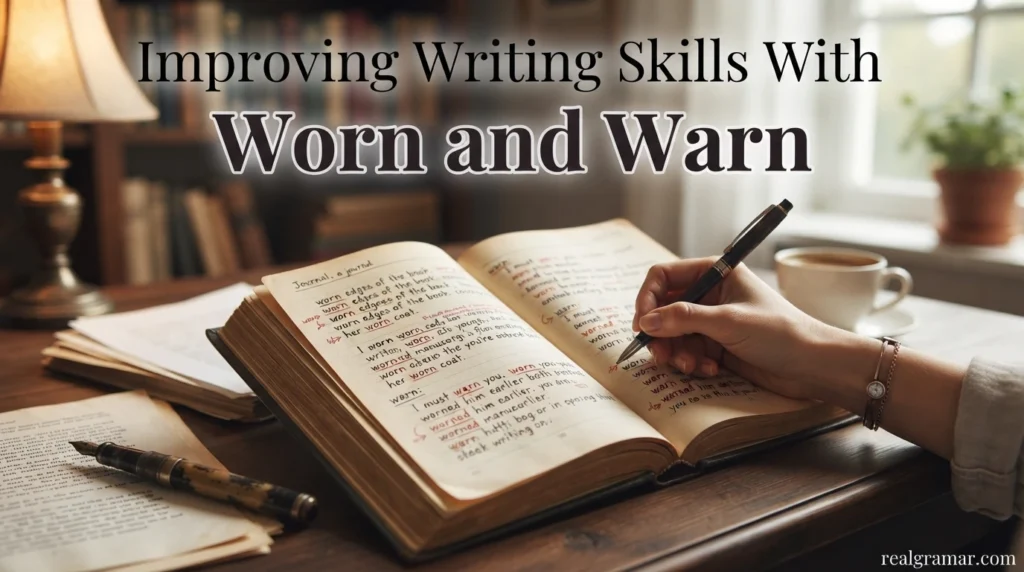
Vocabulary accuracy is an important part of effective writing. Learning words that sound similar helps writers develop stronger expression.
Here are some techniques for improving word choice.
1. Focus on the Root Word
A useful memory technique is connecting each word to its original form.
Worn → Wear
Think:
Wear → Wore → Worn
Examples:
- I wear a coat.
- I wore a coat yesterday.
- I have worn this coat many times.
Warn → Warning
Think:
Warn → Warning → Caution
Examples:
- They warn people.
- They gave a warning.
- They advised caution.
2. Look at the Meaning Before the Spelling
Many learners focus on appearance instead of meaning.
Instead of asking:
“Which word looks right?”
Ask:
“What idea am I expressing?”
If the idea is:
- Clothing → worn
- Damage → worn
- Tiredness → worn
- Danger → warn
- Advice → warn
- Caution → warn
Vocabulary Enhancement: Related Words
Learning related words makes it easier to remember differences.
Words Related to Worn
- Used
- Aged
- Old
- Damaged
- Faded
- Exhausted
- Tired
- Weary
- Weathered
Example:
The weathered and worn house stood beside the road.
Words Related to Warn
- Alert
- Advise
- Caution
- Notify
- Inform
- Signal
- Remind
- Foretell
Example:
The notice alerted and warned visitors about the danger.
Practice Exercises: Choose Worn or Warn
Test your understanding by completing these sentences.
Exercise 1
Choose the correct word:
- The firefighter ______ residents about the danger.
- She has ______ that necklace since her wedding day.
- His old boots were completely ______.
- Experts ______ people about the possible risks.
- The long journey left him feeling ______.
Answers:
- Warned
- Worn
- Worn
- Warned
- Worn
Exercise 2: Correct the Mistakes
Find and correct the incorrect word.
Sentence 1:
❌ The doctor worn patients about the side effects.
Correct:
✅ The doctor warned patients about the side effects.
Sentence 2:
❌ She has warn the same jacket for years.
Correct:
✅ She has worn the same jacket for years.
Sentence 3:
❌ The old man looked warn after working all day.
Correct:
✅ The old man looked worn after working all day.
Exercise 3: Create Your Own Sentences
Practice writing your own examples.
Use worn in sentences about:
- Clothing
- Old objects
- Tired emotions
- Memories
Examples:
- My grandfather kept a worn watch from his youth.
- The traveler looked worn after crossing the desert.
Use warn in sentences about:
- Safety
- Advice
- Future problems
- Rules
Examples:
- The guide warned tourists about the dangerous path.
- My parents warned me to be careful.
Quick Memory Tricks for Students
Remember these simple tricks:
Trick 1:
Worn has an “o” like “old.”
Worn = old, used, tired
Example:
The worn book looked old.
Trick 2:
Warn sounds like warning.
Warn = caution, advice, danger
Example:
The sign warned drivers.
Frequently Asked Questions About Worn vs Warn
1. What is the main difference between worn and warn?
The main difference is meaning.
Worn comes from the verb “wear” and describes something used, damaged, or experienced.
Warn means to give advice, information, or caution about something.
Examples:
- She wore a worn jacket.
- They warned us about the storm.
2. Is worn the past tense of wear?
No. The simple past tense of wear is wore.
Examples:
Correct:
- I wore my shoes yesterday.
Correct:
- I have worn these shoes many times.
Incorrect:
- I worn my shoes yesterday.
3. Can worn describe a person?
Yes. Worn can describe someone who is physically or emotionally exhausted.
Examples:
- After the long shift, she looked worn.
- He felt worn after dealing with many challenges.
4. Can warn be used as a noun?
No, warn itself is a verb. The noun form is warning.
Examples:
Verb:
- They warned us about the problem.
Noun:
- The warning was clear.
5. Why do writers need to understand the difference between worn and warn?
Correct word choice improves clarity, professionalism, and creativity. Writers use vocabulary carefully to create accurate descriptions, stronger emotions, and better communication.
Understanding small differences between words helps develop advanced writing skills and stronger language awareness.
Final Thoughts
The difference between worn and warn may seem small, but it represents a larger lesson about English vocabulary: similar-looking words can have completely different meanings.
Worn connects to the idea of wearing, using, aging, and experiencing. It can describe clothing, objects, emotions, and even symbolic ideas in creative writing. A worn item often carries a story, memory, or sense of history.
Warn connects to protection, advice, and awareness. It helps people communicate danger, prepare for challenges, and make better decisions.
For students, writers, and English learners, mastering these differences improves grammar accuracy, vocabulary enhancement, and overall communication skills. Words are the building blocks of expression, and choosing the right one allows your ideas to become clearer and more powerful.
Whether you are writing an essay, creating a story, improving your English, or simply having a conversation, remembering this simple rule will help:
Worn relates to wear. Warn relates to warning.
When you understand the meaning behind words, your writing becomes more precise, expressive, and effective.
