
Words are the building blocks of communication. A single verb choice can change the accuracy, tone, and clarity of a sentence. Whether you are writing a school assignment, creating a story, improving your English skills, or crafting expressive content, understanding how verbs work helps you communicate ideas more effectively.
Language becomes more powerful when writers understand subtle differences between similar-looking words. This knowledge supports better writing skills, vocabulary enhancement, and the ability to create clear descriptions. Even simple verbs can influence how readers understand time, action, and meaning.
For example, when describing a completed action, English learners often struggle with choosing the correct past form of irregular verbs. This confusion can affect sentence structure, grammar accuracy, and overall confidence.
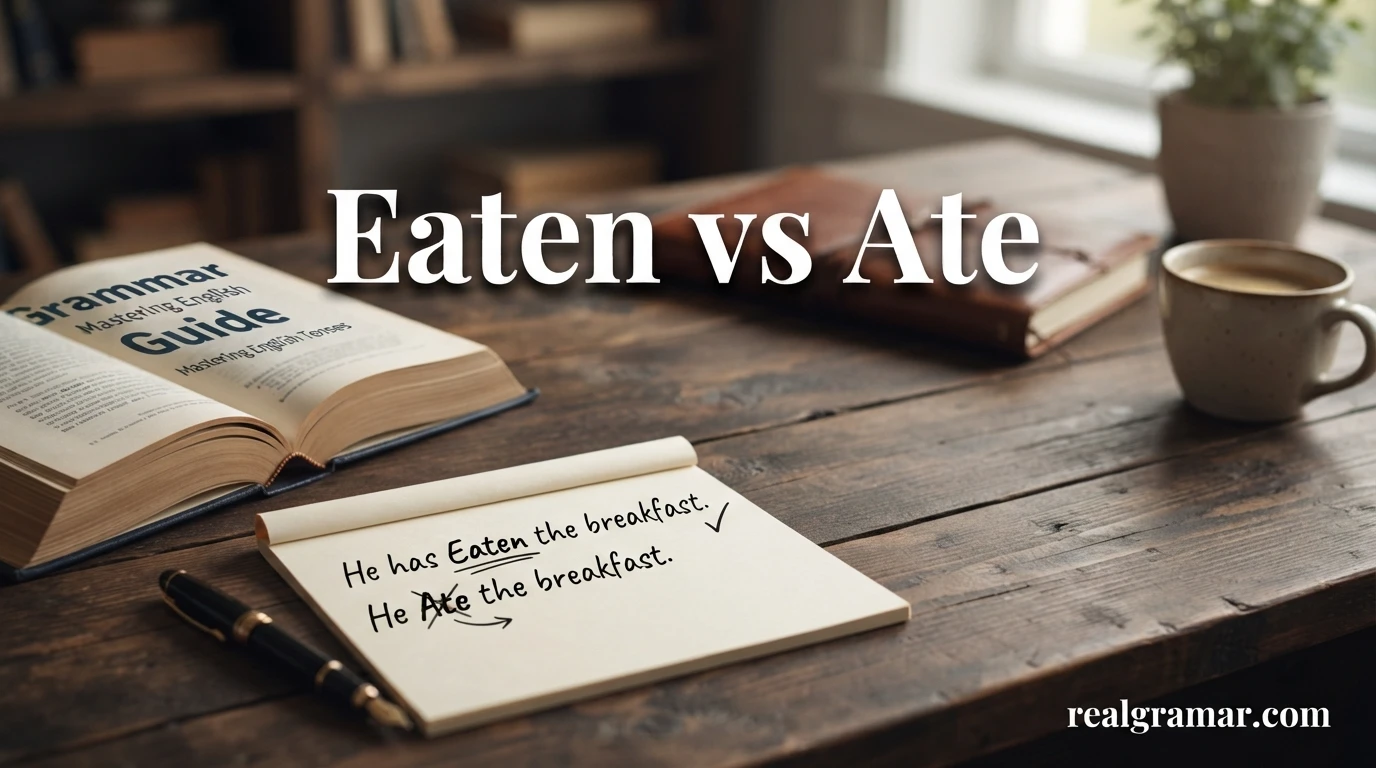
The difference between eaten vs ate is a common challenge because both words relate to the same action, but they are used in different grammatical situations. Learning when to use each form helps students avoid mistakes and improves both everyday conversations and formal writing.
Beyond grammar rules, understanding verb forms also supports creative writing. Authors use precise language choices to build scenes, express emotions, and create stronger imagery. A carefully chosen verb can make a story more vivid, add rhythm to poetic expression, and improve descriptive language.
This guide explains the meanings, differences, examples, common mistakes, and practical uses of these two important English words. Whether you are a student, writer, or English learner, mastering this distinction will strengthen your communication skills.
Understanding the Basic Meaning of “Eat”
Before comparing the two words, it is important to understand their original verb form.
The verb eat means to consume food by putting it into your mouth, chewing it, and swallowing it. It describes the action of taking nourishment from food or, in some cases, using food as part of an expression.
Basic examples:
- I eat breakfast every morning.
- She eats vegetables to stay healthy.
- They eat dinner together every evening.
- Birds eat seeds.
- Children eat snacks after school.
The word “eat” can describe a regular habit, a repeated action, or something happening in the present.
Different meanings of “eat”
Although eating usually refers to consuming food, English often uses this verb in figurative language and idioms.
Examples:
- The fire ate through the wooden door.
- He was eaten up by jealousy.
- The project ate all of our time.
In these examples, the word does not describe a person consuming food. Instead, it creates imagery or expresses another idea.
This shows how verbs can become powerful literary devices when used creatively.
The Difference Between Eaten and Ate
The main difference between these words is their grammatical function.
| Word | Verb Form | Used With | Meaning |
| Ate | Simple past tense | Completed action in the past | Someone consumed food at a specific past time |
| Eaten | Past participle form | Helping verbs like have, has, had | The action has happened or was completed |
The simplest way to remember the difference:
- Ate = past action
- Eaten = past participle that needs a helping verb
Examples with “ate”
- I ate pizza last night.
- She ate lunch before class.
- They ate all the cookies.
- He ate breakfast early.
These sentences describe a finished action that happened in the past.
Examples with “eaten”
- I have eaten pizza before.
- She has eaten lunch already.
- They had eaten before we arrived.
- He has never eaten sushi.
Notice that “eaten” usually appears with words like:
- have
- has
- had
Without a helping verb, “eaten” usually creates an incorrect sentence.
Incorrect:
- I eaten dinner.
Correct:
- I ate dinner.
- I have eaten dinner.
Quick Comparison Table: Ate vs Eaten
| Feature | Ate | Eaten |
| Verb type | Simple past | Past participle |
| Requires helping verb? | No | Usually yes |
| Talks about | A completed past event | An experience or completed action connected to another time |
| Example | She ate an apple yesterday. | She has eaten an apple already. |
| Common mistake | Using it with “have” | Using it without a helping verb |
When to Use “Ate” in a Sentence
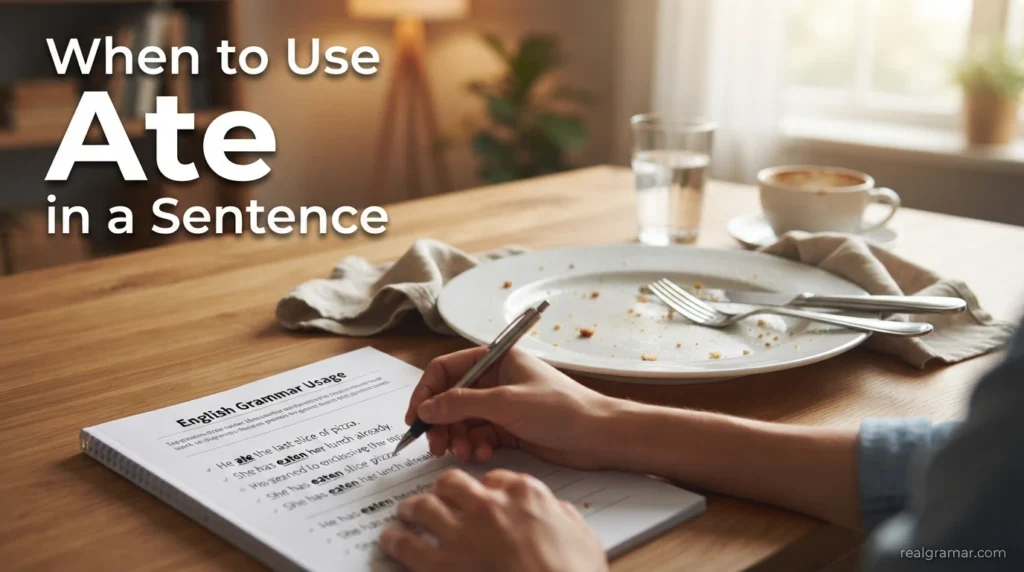
Use ate when you are talking about a specific action that happened and finished in the past.
The sentence usually answers questions like:
- When did it happen?
- What happened yesterday?
- What did someone do earlier?
Examples of “ate” in everyday situations
Daily routines
- I ate breakfast at 8 a.m.
- My brother ate cereal before school.
- We ate dinner together as a family.
Past events
- She ate cake at the birthday party.
- They ate lunch during the meeting.
- The travelers ate at a small restaurant.
Storytelling examples
Writers often use “ate” when describing events in a narrative.
Example:
Sarah entered the kitchen and ate the last piece of chocolate cake before anyone noticed.
The verb “ate” moves the story forward by showing a completed action.
Tone and Style Usage of “Ate”
The word “ate” is simple and direct. It works well in:
- casual conversations
- school writing
- storytelling
- personal experiences
- news-style writing
Neutral tone
- I ate breakfast before leaving home.
Emotional tone
- After the long journey, he ate the meal like it was the best thing he had ever tasted.
Creative writing tone
- The lonely traveler ate his simple meal beneath the silent stars.
In creative writing, surrounding details create emotion. The verb itself is simple, but descriptive language can make the sentence memorable.
When to Use “Eaten” in a Sentence
Use eaten when the action connects to another time or situation, especially with perfect tenses.
Common structures:
Have + eaten
Used for experiences or actions completed recently.
Examples:
- I have eaten at that restaurant before.
- We have eaten enough food.
- She has eaten breakfast already.
Had + eaten
Used when one past action happened before another past action.
Examples:
- They had eaten before the movie started.
- I had eaten lunch before my friend called.
- She had eaten all the cookies when we arrived.
Will have + eaten
Used for future completed actions.
Examples:
- By noon, I will have eaten breakfast and lunch.
- They will have eaten before the guests arrive.
Figurative Language and Creative Uses of “Eat”
Strong writers understand that verbs can have meanings beyond their literal definitions. The verb “eat” appears in many forms of figurative language, idioms, metaphors, and creative expressions.
Common idiom meanings
“Eat your words”
Meaning: To admit that something you said was wrong.
Example:
- He thought the team would lose, but he had to eat his words after they won.
“Eat like a bird”
Meaning: To eat very little.
Example:
- She eats like a bird because she is rarely hungry.
“Eat like a horse”
Meaning: To eat a large amount of food.
Example:
- After the marathon, he ate like a horse.
“Something is eating you”
Meaning: Something is bothering or worrying you.
Example:
- I know something is eating you. Tell me what happened.
Literary Devices Using “Eat”

Writers often use verbs creatively to create stronger images.
Metaphor examples
A metaphor directly compares two things without using “like” or “as.”
Examples:
- The flames ate the entire forest.
- Time eats away at our memories.
These examples do not mean flames or time literally consume food. They create a powerful image of destruction or gradual change.
Simile examples
A simile compares using “like” or “as.”
Examples:
- The children ate like hungry wolves after the game.
- He ate like a machine during the competition.
Similes help readers visualize actions more clearly.
Poetic expression examples
Poets may use “eat” symbolically:
- The ocean ate the shoreline.
- The darkness ate the final rays of sunlight.
These examples use personification, giving human qualities to non-human things.
Common Mistakes English Learners Make With “Ate” and “Eaten”
Learning irregular verbs can be challenging because English does not always follow predictable patterns. Many learners understand the meaning of a word but struggle with using the correct grammatical form.
The confusion between ate and eaten usually happens because both words describe the same action. The difference is not about meaning but about sentence structure.
Here are some common mistakes and how to correct them.
Mistake 1: Using “Eaten” Without a Helping Verb
A common error is using the past participle form alone.
Incorrect:
- I eaten my breakfast.
- She eaten all the cake.
- They eaten before leaving.
Correct:
- I ate my breakfast.
- She ate all the cake.
- They have eaten before leaving.
Why this mistake happens
Many learners memorize that “eaten” means “finished eating,” but they forget that English past participles usually need a helping verb.
The correct patterns are:
- have + eaten
- has + eaten
- had + eaten
- will have + eaten
Mistake 2: Using “Ate” After Have, Has, or Had
Another common mistake is placing the simple past form after a helping verb.
Incorrect:
- I have ate dinner.
- She has ate lunch.
- They had ate before the meeting.
Correct:
- I have eaten dinner.
- She has eaten lunch.
- They had eaten before the meeting.
Grammar rule
After:
- have
- has
- had
use the past participle form.
Examples:
- have written (not have wrote)
- has gone (not has went)
- had seen (not had saw)
- have eaten (not have ate)
Understanding Verb Forms: Eat, Ate, Eaten
A useful way to master these words is to learn all three forms of the verb.
| Base Form | Past Form | Past Participle |
| Eat | Ate | Eaten |
Example sentences with all forms
Present:
- I eat fruit every day.
Past:
- I ate fruit yesterday.
Perfect tense:
- I have eaten fruit already.
This pattern applies to many irregular verbs in English.
Examples:
| Base Verb | Past | Past Participle |
| Go | Went | Gone |
| See | Saw | Seen |
| Write | Wrote | Written |
| Take | Took | Taken |
| Eat | Ate | Eaten |
Understanding these patterns improves grammar accuracy and vocabulary development.
Sentence Examples: Ate vs Eaten in Different Contexts
Context is one of the best ways to understand grammar. The following examples show how these words appear naturally in different situations.
Everyday Conversation Examples
Using “Ate”
- I ate lunch at work today.
- She ate a sandwich before class.
- We ate dinner at my grandmother’s house.
- He ate the entire pizza by himself.
- They ate breakfast early in the morning.
Using “Eaten”
- I have eaten breakfast already.
- She has eaten enough food for today.
- We have eaten at that restaurant many times.
- They had eaten before arriving.
- He has never eaten seafood.
Examples in Formal Writing
In academic and professional writing, correct verb usage improves clarity and credibility.
Incorrect:
The students have ate all the snacks during the event.
Correct:
The students have eaten all the snacks during the event.
Incorrect:
The researcher ate already completed the experiment.
Correct:
The researcher had already completed the experiment.
(Note: In this example, “ate” is not needed because the action is not related to eating.)
This demonstrates why choosing the correct verb depends on meaning and context.
Examples in Creative Writing and Storytelling
Creative writers often use food-related actions to reveal personality, mood, and emotions.
Simple description
- The boy ate the apple quickly.
More descriptive version
- The exhausted boy ate the apple slowly, enjoying every sweet bite after a long day of work.
The second sentence creates stronger imagery through descriptive language.
Emotional storytelling examples
- After days without a proper meal, the travelers ate with gratitude.
- She had eaten alone for so many years that sharing dinner felt unusual.
- The family had eaten together every Sunday before life changed.
These examples show how verb choices support emotional storytelling.
Tone Differences When Using “Ate” and “Eaten”
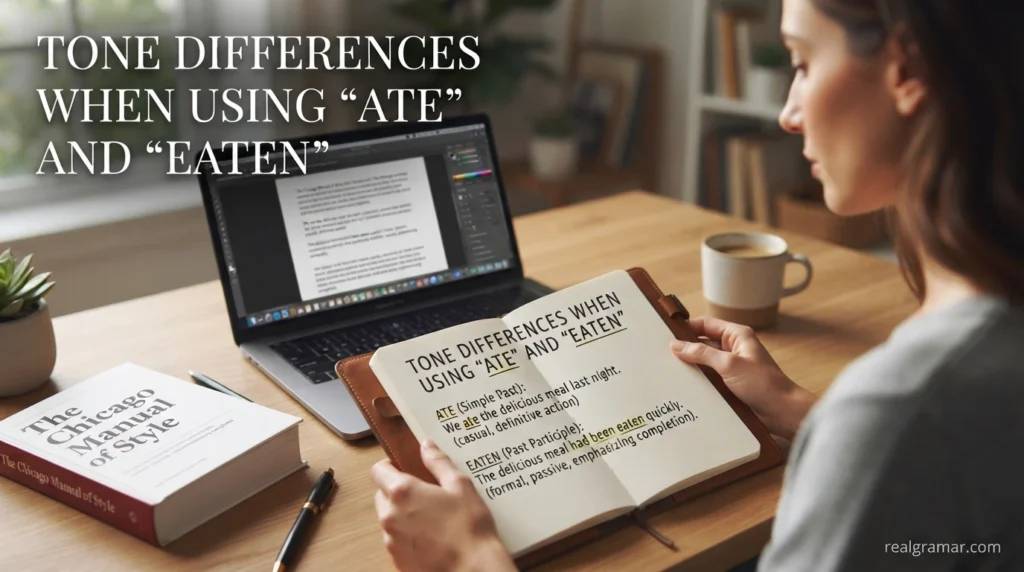
Although both words describe eating, their grammatical placement affects the tone and flow of a sentence.
“Ate” creates a direct, action-focused tone
Examples:
- He ate the cake.
- She ate breakfast before leaving.
- The children ate quickly.
This style is straightforward and commonly used in storytelling.
“Eaten” creates a connected or reflective tone
Examples:
- I have eaten many different types of food during my travels.
- She has eaten at famous restaurants around the world.
- They had eaten before the celebration began.
This form often focuses on experience, completion, or connection between events.
When to Avoid Using “Ate” and “Eaten”
Knowing when not to use a word is just as important as knowing when to use it.
Avoid “ate” when:
You are using perfect tenses
Incorrect:
- I have ate lunch.
Correct:
- I have eaten lunch.
You are describing an ongoing action
Incorrect:
- I ate dinner right now.
Correct:
- I am eating dinner right now.
You need the present participle
Incorrect:
- She was ate breakfast.
Correct:
- She was eating breakfast.
Avoid “eaten” when:
There is no helping verb
Incorrect:
- He eaten the cake.
Correct:
- He ate the cake.
You are describing a simple past event
Incorrect:
- Yesterday, I eaten pizza.
Correct:
- Yesterday, I ate pizza.
Practice Exercises: Choose Ate or Eaten
Improve your grammar skills by completing these sentences.
Exercise 1
Choose the correct word:
- I have ______ breakfast already.
- She ______ dinner at seven o’clock.
- They had ______ before the guests arrived.
- We ______ pizza last night.
- He has never ______ sushi.
Answers:
- eaten
- ate
- eaten
- ate
- eaten
Exercise 2: Correct the Mistakes
Find and correct the errors.
Sentence 1:
She has ate all the cookies.
Correct:
She has eaten all the cookies.
Sentence 2:
I eaten lunch before school.
Correct:
I ate lunch before school.
or
I have eaten lunch before school.
Sentence 3:
They ate already finished their meal.
Correct:
They had already finished their meal.
Writing Tips: Using Verb Accuracy to Improve Your Skills
Strong writing depends on small details. Correct verb forms make sentences easier to understand and help readers trust your message.
Here are some practical writing tips:
1. Identify the Time of Action
Ask:
- Did this happen at a specific past time?
- Has this action already happened?
- Did one past action happen before another?
Specific past time:
I ate breakfast at 9 a.m.
Life experience:
I have eaten breakfast at that hotel.
Earlier past action:
I had eaten before the meeting started.
2. Read Your Sentence Aloud
Reading aloud helps you notice unnatural grammar.
Example:
“I have ate dinner.”
When spoken, many learners recognize that it sounds incorrect.
3. Practice With Real-Life Examples
Create sentences about your own experiences.
Examples:
- I ate my favorite meal yesterday.
- I have eaten many interesting foods.
- My family had eaten before I arrived.
Personal examples help grammar rules become easier to remember.
Vocabulary Enhancement: Related Words and Expressions
Learning related vocabulary improves communication and makes writing more expressive.
Words related to eating
- consume
- taste
- enjoy
- swallow
- chew
- digest
- devour
- feast
- snack
- dine
Example:
Basic:
She ate the meal quickly.
More descriptive:
She devoured the meal after a long day of work.
The second sentence creates a stronger image.
Using “Eat” in Idioms and Expressions
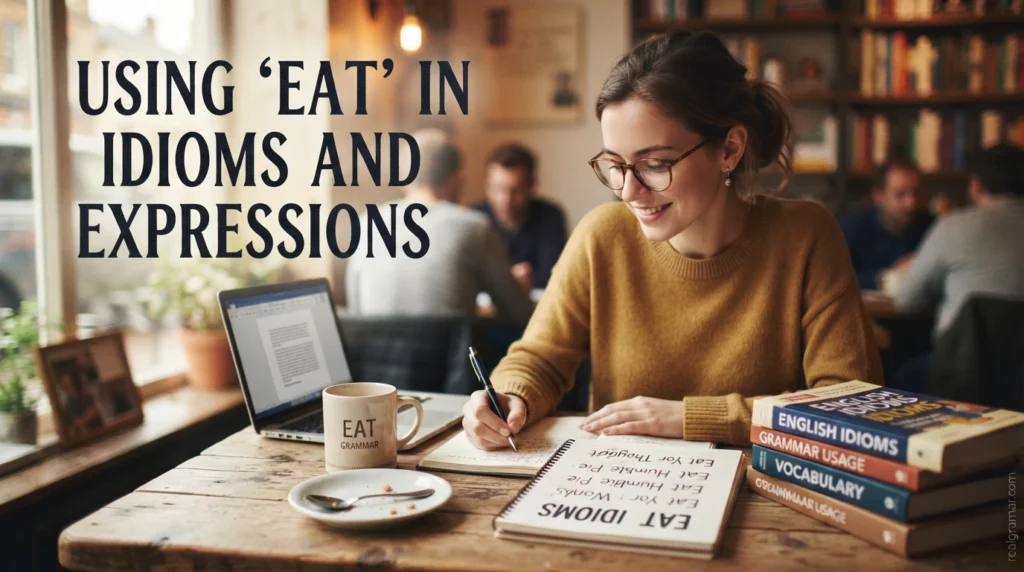
Idioms add personality and natural flow to communication.
“You are what you eat”
Meaning:
Your health is influenced by the food you consume.
Example:
- Many people believe that you are what you eat.
“Have your cake and eat it too”
Meaning:
Wanting two benefits that are usually impossible together.
Example:
- You cannot have your cake and eat it too.
“Eat someone alive”
Meaning:
To strongly criticize, defeat, or overwhelm someone.
Example:
- The debate team ate their opponents alive.
These expressions show how ordinary verbs can create powerful meanings beyond their literal definitions.
Advanced Comparison Examples: Understanding Context and Meaning
The best way to master confusing verb forms is to understand how meaning changes depending on context. While ate and eaten describe the same basic action, the surrounding words determine which form is correct.
A strong understanding of context improves grammar, communication, and writing ability. It also helps writers create smoother sentences, especially in storytelling, academic writing, and professional communication.
Comparing “Ate” and “Eaten” in Similar Sentences
Example 1
Ate:
Maria ate breakfast before going to school.
Meaning:
Maria finished eating at a specific time in the past.
Eaten:
Maria has eaten breakfast before going to school.
Meaning:
The action is completed and connected to the present situation.
Example 2
Ate:
The children ate all the cookies yesterday.
Meaning:
A completed past event happened yesterday.
Eaten:
The children have eaten all the cookies.
Meaning:
The cookies are already gone, and the result matters now.
Example 3
Ate:
I ate at that restaurant last weekend.
Meaning:
A specific past experience.
Eaten:
I have eaten at that restaurant many times.
Meaning:
A repeated experience up until now.
How Time Expressions Affect the Choice
Time expressions often reveal whether you need “ate” or “eaten.”
Words commonly used with “ate”
Because “ate” refers to a finished past action, it often appears with:
- yesterday
- last night
- last week
- two days ago
- this morning (when the time period is finished)
- in 2025
- when I was young
Examples:
- I ate pasta yesterday.
- She ate lunch last afternoon.
- They ate together last Sunday.
Words commonly used with “eaten”
Because “eaten” usually appears in perfect tenses, it often appears with:
- already
- ever
- never
- yet
- before
- recently
- so far
- many times
Examples:
- I have eaten already.
- Have you ever eaten Korean food?
- She has never eaten seafood.
- They have eaten there many times.
Eaten vs Ate in Questions
Questions are another area where English learners often make mistakes.
Correct questions with “ate”
Use “ate” with simple past questions.
Examples:
- Did you eat breakfast?
- What did you eat yesterday?
- Where did they eat dinner?
Notice:
After did, use the base form eat, not “ate.”
Incorrect:
- Did you ate lunch?
Correct:
- Did you eat lunch?
Correct questions with “eaten”
Use “eaten” with have/has/had.
Examples:
- Have you eaten breakfast?
- Has she eaten yet?
- Had they eaten before arriving?
Incorrect:
- Have you ate dinner?
Correct:
- Have you eaten dinner?
Eaten vs Ate in Negative Sentences
Negative sentences follow the same grammar rules.
Using “ate”
Simple past negative:
Structure:
did not + eat
Examples:
- I did not eat breakfast.
- She did not eat the cake.
- They did not eat dinner.
Important:
Do not use “ate” after “did not.”
Incorrect:
- I did not ate lunch.
Correct:
- I did not eat lunch.
Using “eaten”
Perfect tense negative:
Structure:
have/has/had + not + eaten
Examples:
- I have not eaten yet.
- She has not eaten anything today.
- They had not eaten before the trip.
The Role of Figurative Language in Better Writing
Understanding words deeply allows writers to move beyond basic communication. Figurative language transforms ordinary sentences into engaging expressions.
A simple verb like “eat” can represent:
- destruction
- emotion
- desire
- experience
- consumption
- change
This flexibility makes verbs powerful tools in creative writing.
Figurative Examples Using “Eat”
Literal meaning
The subject actually consumes food.
Examples:
- The child ate an orange.
- The family ate dinner together.
Metaphorical meaning
The word represents an abstract action.
Examples:
- The wildfire ate through the forest.
- Stress was eating away at his confidence.
- The waves ate the coastline over many years.
These metaphor examples create stronger mental images.
Personification examples
Personification gives human qualities to non-human things.
Examples:
- The flames ate the old building.
- The darkness ate the final light of evening.
- The ocean slowly ate the beach.
These literary devices are commonly used in poetry, novels, and descriptive writing.
Creative Writing Examples: Making Sentences More Powerful
Compare these two sentences:
Basic sentence:
The man ate his dinner.
Creative sentence:
The tired traveler ate his warm dinner slowly, savoring every bite after weeks on the road.
The second example uses:
- sensory details
- descriptive language
- emotional context
- storytelling techniques
The verb remains simple, but the surrounding words create a richer experience.
Improving Writing Skills Through Verb Awareness
Strong writers pay attention to small grammatical choices because accuracy affects credibility.
Using the correct verb form helps with:
Clarity
Readers immediately understand when an action happened.
Example:
I ate breakfast before work.
The timing is clear.
Professional Communication
Correct grammar creates a more polished impression.
Example:
Incorrect:
I have ate the documents.
Correct:
I have reviewed the documents.
(Choosing the correct verb matters in every context.)
Creative Expression
Accurate verbs allow writers to focus on style rather than fixing grammar mistakes.
Quick Grammar Checklist for Students
Before submitting writing, ask:
Question 1:
Is the action finished at a specific time?
Use:
✅ ate
Example:
She ate lunch at noon.
Question 2:
Is the action connected to the present or another time?
Use:
✅ eaten
Example:
She has eaten lunch already.
Question 3:
Is there a helping verb?
If yes, use:
✅ eaten
Examples:
- have eaten
- has eaten
- had eaten
Question 4:
Are you using “did”?
Use:
✅ eat
Example:
Did you eat dinner?
Not:
❌ Did you ate dinner?
Mini Practice Quiz
Choose the correct answer.
1. I have ______ sushi many times.
A) ate
B) eaten
Answer:
✅ eaten
2. She ______ breakfast before leaving home.
A) ate
B) eaten
Answer:
✅ ate
3. Have you ever ______ Indian food?
A) ate
B) eaten
Answer:
✅ eaten
4. They ______ pizza yesterday.
A) ate
B) eaten
Answer:
✅ ate
5. He had already ______ when we arrived.
A) ate
B) eaten
Answer:
✅ eaten
FAQs
1. What is the main difference between ate and eaten?
The main difference is grammar. “Ate” is the simple past form used for completed actions in the past. “Eaten” is the past participle form and usually requires a helping verb such as have, has, or had.
Examples:
- I ate dinner yesterday.
- I have eaten dinner already.
2. Can I use eaten by itself?
No. In standard English, “eaten” normally needs a helping verb.
Incorrect:
I eaten breakfast.
Correct:
I have eaten breakfast.
3. Is “ate” a past tense word?
Yes. “Ate” is the simple past tense of the verb “eat.”
Example:
- Present: I eat apples.
- Past: I ate apples.
4. Why do people confuse ate and eaten?
People often confuse them because both words describe the same action. The difference is grammatical structure rather than meaning.
Learning verb patterns helps avoid this confusion.
5. How can I remember when to use eaten?
Remember this simple rule:
If you see have, has, or had, think “eaten.”
Examples:
- I have eaten.
- She has eaten.
- They had eaten.
For a specific finished past event, use:
- I ate.
- She ate.
- They ate.
Quick Revision Guide: Ate vs Eaten
| Situation | Correct Form | Example |
| Specific past event | Ate | I ate dinner yesterday. |
| Present perfect | Eaten | I have eaten dinner. |
| Past perfect | Eaten | I had eaten before arriving. |
| Question with did | Eat | Did you eat lunch? |
| Habit | Eat | I eat vegetables daily. |
Conclusion
Language mastery comes from understanding how words function, not just memorizing definitions. The difference between ate and eaten may seem small, but learning this distinction improves grammar accuracy, writing confidence, and communication skills.
For students, mastering irregular verbs creates a stronger foundation for academic success, For writers, correct verb choices improve storytelling, descriptive language, and emotional impact. For English learners, understanding these patterns makes everyday conversations more natural.
Remember the simple formula:
- Eat = present action
- Ate = completed past action
- Eaten = past participle used with helping verbs
By practicing sentence examples, studying common mistakes, and applying these rules in real conversations, you can make your English clearer and more effective.
Good writing is built from small choices. When you choose the right words, your ideas become easier to understand, your stories become more engaging, and your communication becomes more powerful.
