
Words are the building blocks of communication, but choosing the right word can completely change the meaning, emotion, and impact of a sentence. In creative writing, academic work, professional communication, and everyday conversations, small spelling differences often create major misunderstandings. Two commonly confused words that demonstrate this idea are wonder and wander.
Strong writing is not only about using advanced vocabulary; it is about selecting words that accurately express thoughts, emotions, and images. Understanding subtle differences between similar-looking words improves writing skills, vocabulary enhancement, and overall language confidence.
Figurative language, descriptive language, and poetic expression depend heavily on precision. A writer describing curiosity, imagination, exploration, or movement needs to choose words carefully because each word carries its own emotional meaning. For example, a character who “wonders about the future” is thinking deeply, while someone who “wanders through the forest” is physically moving without a fixed direction.
Although these two words differ by only one letter, they represent completely different ideas. Learning their meanings, usage patterns, sentence structures, and common mistakes helps students, writers, and English learners communicate more clearly.
This guide explores wonder vs wander through definitions, comparison examples, literary devices, sentence examples, tone usage, writing tips, exercises, and practical explanations.
Understanding the Meaning of Wonder
The word wonder is connected with curiosity, amazement, surprise, admiration, or deep thought. It can function as both a noun and a verb.
When used as a noun, wonder describes a feeling of curiosity or something amazing.
When used as a verb, wonder means to think about something, question something, or feel curious.
Wonder as a Noun
As a noun, wonder refers to:
- A feeling of amazement
- Something extraordinary or impressive
- A mysterious or beautiful experience
Examples:
- The beauty of the night sky filled me with wonder.
- The ancient monument remains a wonder of human creativity.
- Children often look at the world with a sense of wonder.
- The natural beauty of the mountains is truly a wonder.
In these examples, wonder represents admiration, curiosity, or amazement.
Wonder as a Verb
As a verb, wonder means:
- To think curiously about something
- To question or consider possibilities
- To feel uncertain about something
Examples:
- I wonder what will happen tomorrow.
- She wondered why her friend had not arrived.
- They wonder whether the decision was correct.
- He wondered how the machine worked.
Here, wonder expresses mental activity rather than physical movement.
Understanding the Meaning of Wander
The word wander is related to movement, exploration, and traveling without a specific destination.
It usually means:
- To move around without a clear direction
- To travel casually
- To lose focus or become distracted
Like wonder, wander can also be used in different contexts.
Wander as Physical Movement
The most common meaning of wander is moving from place to place without a planned route.
Examples:
- We wandered through the streets of the old city.
- The child wandered away from the playground.
- She likes to wander through bookstores on weekends.
- They wandered around the park for hours.
In these examples, wander describes physical exploration.
Wander as Mental Movement
Wander can also describe thoughts, attention, or imagination moving away from the current subject.
Examples:
- My mind started to wander during the lecture.
- His thoughts wandered back to childhood memories.
- Try not to let your attention wander while studying.
This usage is common in creative writing because it creates imagery and emotional depth.
Wonder vs Wander
| Feature | Wonder | Wander |
| Main meaning | Curiosity, amazement, questioning | Moving without a fixed direction |
| Word type | Noun and verb | Verb and sometimes noun |
| Related ideas | Thinking, imagination, surprise | Travel, exploration, distraction |
| Focus | Mental experience | Physical or mental movement |
| Example | I wonder what she meant. | We wandered around the city. |
| Emotional tone | Curious, thoughtful, amazed | Relaxed, adventurous, uncertain |
Wonder vs Wander: The Simple Difference
The easiest way to remember the difference is:
Wonder = Think
Wander = Move
If your mind is asking questions, you wonder.
If your body or attention is moving without a clear path, you wander.
Memory Trick:
Think of the letter O in wonder as an “open question.”
Think of the letter A in wander as an “adventure.”
- Wonder → Questions and curiosity
- Wander → Adventure and movement
Sentence Examples Comparing Wonder and Wander
Understanding words becomes easier when comparing them in similar situations.
Example 1:
Wonder:
- I wonder where my keys are.
Meaning: I am thinking and searching mentally.
Wander:
- I wandered around the house looking for my keys.
Meaning: I physically moved around.
Example 2:
Wonder:
- She wondered why the sky looked different.
Meaning: She was curious.
Wander:
- She wandered through the garden.
Meaning: She walked without a specific goal.
Example 3:
Wonder:
- The child stared at the fireworks in wonder.
Meaning: The child felt amazed.
Wander:
- The child wandered into the backyard.
Meaning: The child moved away.
Using Wonder and Wander in Creative Writing
Creative writers often use these words to create emotional imagery and deeper meaning.
Both words can become powerful literary devices when used intentionally.
Using Wonder for Emotional Expression
Wonder is useful when writing about:
- Discovery
- Curiosity
- Dreams
- Imagination
- Mystery
- Inspiration
Creative Writing Example:
She looked at the endless ocean and wondered what secrets existed beyond the horizon.
This sentence creates curiosity and imagination.
Using Wander for Descriptive Writing
Wander works well when describing:
- Journeys
- Exploration
- Memories
- Lost moments
- Freedom
Creative Writing Example:
He wandered through the silent forest, following the whispers of the wind.
This sentence creates a peaceful and adventurous image.
Wonder and Wander in Figurative Language

Writers often use these words in figurative expressions, similes, and metaphors to create stronger emotional effects.
Wonder Metaphor Examples
A metaphor compares two ideas without using “like” or “as.”
Examples:
- Her imagination was a wonder waiting to unfold.
- The universe is a mystery that fills the mind with wonder.
- Childhood is a doorway to endless wonder.
These examples connect wonder with beauty, possibility, and discovery.
Wander Metaphor Examples
Examples:
- His thoughts were wandering through forgotten memories.
- Her dreams wandered across invisible landscapes.
- Life is a road where everyone wanders toward their own destination.
These metaphors use wander to represent emotional journeys and personal experiences.
Wonder Simile Examples
Similes compare using “like” or “as.”
Examples:
- The child’s curiosity was like a spark of wonder.
- The magical scene looked like a dream filled with wonder.
- Her eyes shined like stars full of wonder.
Wander Simile Examples
Examples:
- His thoughts wandered like clouds drifting across the sky.
- They wandered like travelers searching for a hidden path.
- The river wandered like a silver ribbon through the valley.
Tone Usage: How Wonder and Wander Change the Feeling of a Sentence
Choosing between wonder and wander is not only about grammar; it also affects the emotional tone of your writing. Writers use these words to create different moods, from curiosity and excitement to freedom and uncertainty.
Understanding tone usage helps writers create stronger descriptive language and more engaging communication.
Using Wonder for a Curious or Thoughtful Tone
The word wonder often creates a tone that feels:
- Curious
- Hopeful
- Reflective
- Inspirational
- Imaginative
- Philosophical
It invites readers to think deeply about ideas, experiences, or possibilities.
Examples:
- I wonder what dreams are made of.
- She wondered if one small decision could change her entire future.
- The young inventor looked at the stars and wondered about unexplored worlds.
These sentences create a thoughtful and imaginative atmosphere.
Using Wonder for a Magical or Emotional Tone
In storytelling and poetic expression, wonder often represents beauty, surprise, or emotional connection.
Examples:
- The little girl watched the snowfall with pure wonder.
- The artist captured the wonder of nature in every painting.
- The old castle stood quietly, surrounded by mystery and wonder.
Here, wonder creates feelings of amazement and appreciation.
Using Wander for an Adventurous Tone
The word wander often creates a feeling of:
- Freedom
- Exploration
- Discovery
- Relaxation
- Adventure
Examples:
- We wandered along the coastline, enjoying the peaceful evening.
- She wandered through the market, discovering hidden treasures.
- The traveler wandered across distant lands searching for inspiration.
The word creates movement and a sense of journey.
Using Wander for a Lost or Uncertain Tone
Sometimes wander suggests confusion, distraction, or lack of direction.
Examples:
- His thoughts wandered during the difficult conversation.
- She felt lost as her mind wandered through painful memories.
- The conversation wandered away from the original topic.
In these cases, wander creates uncertainty or emotional distance.
When to Use Wonder
Use wonder when you are talking about thoughts, questions, curiosity, or amazement.
Use Wonder for:
1. Asking Yourself Questions
Examples:
- I wonder why the stars shine so brightly.
- She wondered whether she made the right choice.
- They wonder how technology will change the future.
2. Showing Amazement
Examples:
- The beauty of the waterfall filled everyone with wonder.
- The audience watched the performance in wonder.
- The child experienced the wonder of nature for the first time.
3. Expressing Curiosity
Examples:
- I wonder what life was like centuries ago.
- He wonders how successful people develop confidence.
- She wondered why the old building was abandoned.
When to Use Wander
Use wander when describing movement, exploration, or thoughts drifting away.
Use Wander for:
1. Physical Movement Without a Clear Destination
Examples:
- We wandered around the city after dinner.
- The tourists wandered through the historic streets.
- The dog wandered into the neighbor’s yard.
2. Exploring Freely
Examples:
- I love wandering through art galleries.
- She wandered through the forest looking for inspiration.
- They wandered along the beach at sunset.
3. Losing Focus
Examples:
- My mind started to wander during the meeting.
- His attention wandered while reading the book.
- The discussion wandered away from the main topic.
When to Avoid Using Wonder and Wander
Many English learners misuse these words because they focus only on spelling rather than meaning.
Understanding when not to use them improves accuracy.
Avoid Using Wonder When Talking About Physical Movement
Incorrect:
❌ We wondered around the park for an hour.
Correct:
✅ We wandered around the park for an hour.
Why?
The sentence describes movement, so wander is the correct choice.
Avoid Using Wander When Expressing Curiosity
Incorrect:
❌ I wander why she left early.
Correct:
✅ I wonder why she left early.
Why?
The sentence expresses a question or curiosity, so wonder is needed.
Common Mistakes with Wonder and Wander
These words create confusion because they sound similar. Below are the most common errors.
Mistake 1: Confusing “Wonder” and “Wander”
Incorrect:
❌ I wandered what happened yesterday.
Correct:
✅ I wondered what happened yesterday.
Explanation:
The person is thinking about something, not walking.
Mistake 2: Incorrect Spelling in Questions
Incorrect:
❌ I wander if you can help me.
Correct:
✅ I wonder if you can help me.
Explanation:
The phrase “I wonder if…” means “I am curious whether…”
It is a common polite expression in English.
Mistake 3: Using Wander Instead of Wonder in Formal Writing
Incorrect:
❌ The researcher wandered about the results.
Correct:
✅ The researcher wondered about the results.
Explanation:
Academic writing often discusses thoughts, questions, and analysis, which require wonder.
Mistake 4: Forgetting That Wander Can Describe Thoughts
Some learners only connect wander with walking.
However, it can also describe mental activity.
Examples:
- My imagination wandered through endless possibilities.
- Her memories wandered back to childhood.
- His thoughts wandered during the quiet afternoon.
Wonder vs Wander in Idioms and Common Expressions
Idioms make language more natural and expressive. Both words appear in popular phrases.
Common Expressions with Wonder
“I wonder…”
Meaning:
A polite way to express curiosity or make a request.
Examples:
- I wonder if you could help me.
- I wonder what the future holds.
“No wonder”
Meaning:
Used when something is obvious or easily explained.
Examples:
- No wonder she is tired; she worked all night.
- No wonder the restaurant is popular; the food is excellent.
“Wonder of the world”
Meaning:
Something extremely impressive or remarkable.
Examples:
- The ancient structure became a famous wonder of the world.
- The natural landscape is considered a wonder of nature.
Common Expressions with Wander
“Wander around”
Meaning:
Move without a specific purpose.
Examples:
- We wandered around the shopping mall.
- He likes to wander around new neighborhoods.
“Mind wandering”
Meaning:
When your thoughts move away from the current activity.
Examples:
- My mind was wandering during the lecture.
- Meditation helps reduce constant mind wandering.
“Wander off”
Meaning:
Move away from a place unintentionally.
Examples:
- The child wandered off while playing.
- The puppy wandered off into the garden.
Wonder vs Wander: Grammar and Word Forms
Understanding different forms helps improve vocabulary skills.
| Base Word | Related Forms | Example |
| Wonder | wondered, wondering, wonderful | She wondered about the answer. |
| Wander | wandered, wandering, wanderer | The traveler wandered through villages. |
Wonder and Wander in Literature and Poetry

Authors often use these words to represent deeper human experiences.
Wonder in Literature
Wonder often symbolizes:
- Curiosity about life
- Human imagination
- Discovery
- Spiritual reflection
- Childhood innocence
Example:
The character’s sense of wonder allowed him to see beauty in ordinary moments.
Wander in Literature
Wander often symbolizes:
- Personal journeys
- Searching for identity
- Freedom
- Emotional uncertainty
- Exploration
Example:
The hero wandered through unknown lands searching for answers.
Practice Exercises: Choose Wonder or Wander
Test your understanding by selecting the correct word.
Exercise 1
- I ______ what she meant by that comment.
- The travelers ______ through the countryside.
- My mind began to ______ during the long speech.
- The child looked at the fireworks with ______.
- I often ______ about my future career.
Answers:
- Wonder
- Wandered
- Wander
- Wonder
- Wonder
Exercise 2: Correct the Mistakes
Rewrite these sentences correctly.
1.
❌ I wander why the sky changes color.
✅ I wonder why the sky changes color.
2.
❌ They wondered around the museum.
✅ They wandered around the museum.
3.
❌ Her thoughts wondered during the exam.
✅ Her thoughts wandered during the exam.
Quick Tips to Remember Wonder vs Wander
Ask Yourself:
Is this about thinking?
Use:
✅ Wonder
Examples:
- I wonder what happened.
- She wondered about the answer.
Is this about movement?
Use:
✅ Wander
Examples:
- We wandered through the park.
- He wandered away from home.
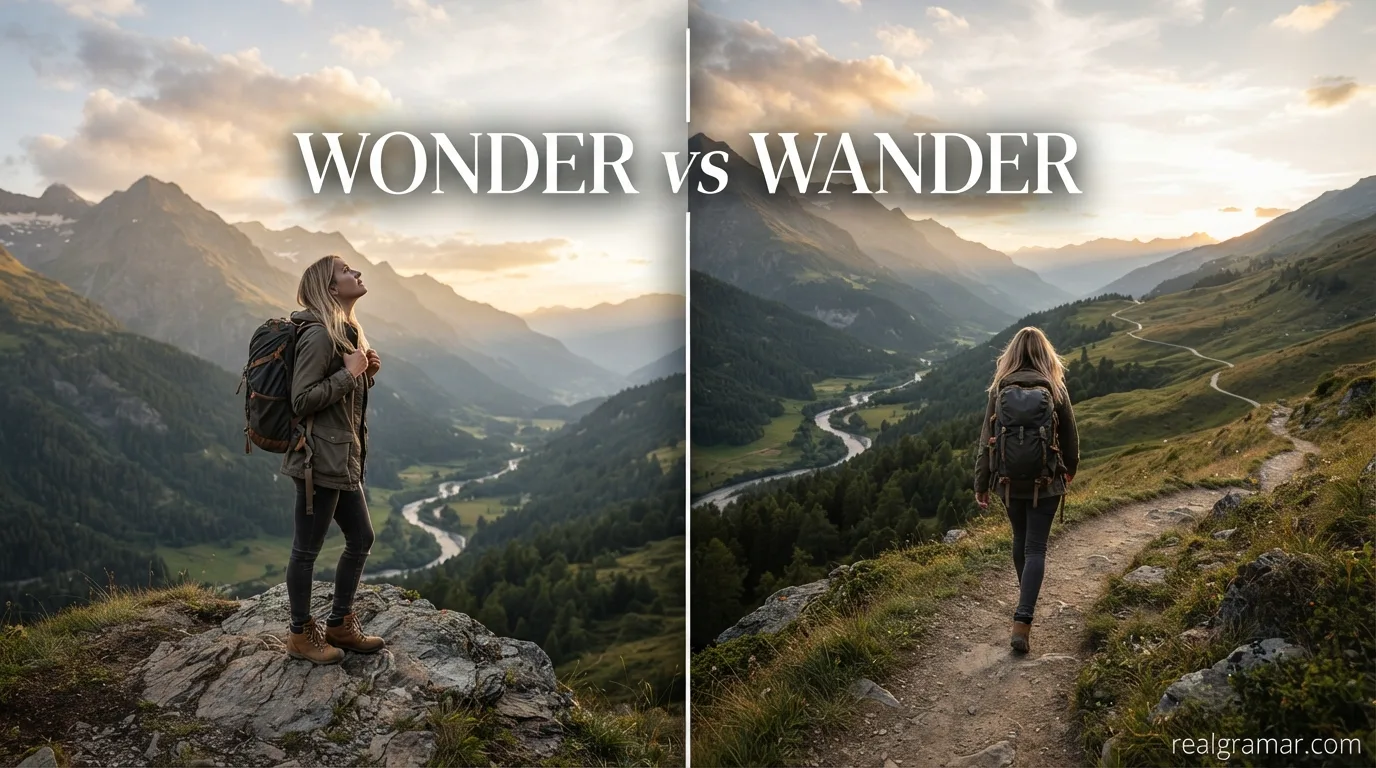
Visual Memory Method
Imagine:
Wonder = A person looking at stars and asking questions
Wander = A traveler walking along an unknown path
This simple image helps English learners remember the difference.
FAQs
1. What is the main difference between wonder and wander?
The main difference is that wonder relates to thinking, curiosity, or amazement, while wander relates to movement or drifting without a clear direction.
Example:
- I wonder why she left.
- We wandered through the streets.
2. Can wander describe thoughts?
Yes. Wander can describe thoughts, attention, or imagination moving away from the current subject.
Examples:
- My mind wandered during class.
- His thoughts wandered back to childhood.
3. Is “I wonder” a polite phrase in English?
Yes. “I wonder” is commonly used to politely express curiosity or make requests.
Examples:
- I wonder if you could explain this.
- I wonder whether the store is open.
4. Why do people confuse wonder and wander?
People confuse them because they look and sound similar. The difference is only one letter, but their meanings are completely different.
Remember:
- Wonder = mental activity
- Wander = movement
5. Can wonder and wander be used in creative writing?
Yes. Both words are powerful tools for creative writing.
Wonder helps express curiosity, beauty, and imagination.
Wander helps describe journeys, exploration, memories, and emotional experiences.
Conclusion
Understanding the difference between wonder and wander improves vocabulary, writing skills, and communication accuracy. Although these words appear almost identical, they represent two different human experiences: thinking and moving.
Wonder invites curiosity. It represents questions, amazement, imagination, and discovery. Wander represents movement, exploration, drifting thoughts, and personal journeys.
For students, writers, and English learners, mastering these small vocabulary differences creates stronger sentences and more meaningful expression. Whether you are writing an essay, creating a story, improving your English, or adding emotional depth to your words, choosing the correct term helps your message become clearer.
Language becomes powerful when every word carries the right meaning. By understanding subtle differences like wonder and wander, you develop better vocabulary awareness, stronger descriptive language, and greater confidence as a communicator.
