
Yes, “looking forward to working with you” is grammatically correct, natural, and widely used in professional English. It is a polite way to express enthusiasm about starting or continuing a professional relationship with someone.
You may see this expression in emails, business letters, job-related communication, client messages, networking conversations, and workplace correspondence. Although it is a simple sentence, many English learners hesitate over its grammar—especially the use of “to working” instead of “to work.”
The key point is that “look forward to” is followed by a noun, pronoun, or gerund (-ing form). Therefore, “working” is correct in this construction.
For example:
- I look forward to working with you.
- We look forward to hearing from you.
- She looks forward to meeting the team.
- They look forward to building a strong partnership.
This guide explains the meaning, grammar, correct usage, common mistakes, professional alternatives, and practical examples so you can use the expression confidently.
What Does “Looking Forward to Working With You” Mean?
The expression communicates positive anticipation about future cooperation or interaction.
When you tell someone that you are looking forward to working with them, you are essentially saying:
“I am pleased about the opportunity to work with you in the future.”
The phrase can communicate several ideas at once:
- You are enthusiastic about the upcoming collaboration.
- You expect to work together soon.
- You have a positive attitude toward the relationship.
- You want to maintain a friendly and professional tone.
- You appreciate the opportunity to collaborate.
For example, after accepting a new position, an employee might write:
“Thank you for the warm welcome. I look forward to working with you and the rest of the team.”
Here, the speaker expresses enthusiasm about joining the organization and cooperating with colleagues.
The expression does not necessarily indicate excitement in an emotional or exaggerated sense. In business English, it is usually a polite and professional expression of anticipation.
Why Is “Working” Grammatically Correct?
The grammar becomes easier to understand when you examine the structure of “look forward to.”
In this expression, “to” is a preposition, not part of an infinitive.
When “to” is a preposition, it is normally followed by:
- A noun
- A pronoun
- A gerund (-ing form)
Therefore, the correct construction is:
look forward to + noun/gerund
Examples include:
- I look forward to the meeting.
- I look forward to your response.
- I look forward to hearing from you.
- I look forward to working with you.
- We look forward to discussing the project.
A common mistake is to treat “to” as an infinitive marker and write “look forward to work with you.” That structure is incorrect.
Compare these two patterns:
| Expression | Correct? | Reason |
| I look forward to working with you. | Yes | “To” is a preposition followed by a gerund |
| I look forward to work with you. | No | The preposition requires a noun or gerund here |
| I look forward to our meeting. | Yes | “Our meeting” functions as a noun phrase |
| I look forward to hearing from you. | Yes | “Hearing” is a gerund |
| I am looking forward to meeting you. | Yes | “Meeting” follows the preposition “to” |
Understanding this rule helps you form many other sentences correctly.
When Should You Use This Expression?
This wording works particularly well when you already know that you will have some form of professional interaction with another person.
Starting a new job
A new employee can use it when communicating with a manager or future colleagues.
Example:
“I’m excited to join the company and look forward to working with everyone on the team.”
Beginning a business partnership
It can show enthusiasm about a new professional relationship.
Example:
“We appreciate the opportunity and look forward to working with your organization.”
Starting a project
A project manager, freelancer, consultant, or client can use the phrase when a collaboration has been agreed upon.
Example:
“Thank you for choosing our agency. We look forward to working with you on this project.”
After a successful interview
A job candidate can use a variation of the phrase when following up with a potential employer.
Example:
“Thank you for taking the time to speak with me. I look forward to the possibility of working with your team.”
Notice that “possibility of working” is appropriate when the position has not yet been confirmed.
In client communication
The expression is useful when establishing a positive relationship with a customer.
Example:
“Thank you for sharing the project requirements. We look forward to working with you to achieve your goals.”
Formal vs. Casual Uses
The expression is flexible, but the surrounding wording determines how formal the overall message sounds.
For highly professional communication, use a complete sentence with polite supporting language.
Formal:
“We appreciate the opportunity to collaborate with your team and look forward to working with you.”
Neutral:
“I look forward to working with you.”
Friendly:
“I’m really looking forward to working with you!”
Very casual:
“Looking forward to working together!”
The last version is common in workplace emails and messages, but it is technically a sentence fragment because the subject and auxiliary verb are omitted. That does not make it inappropriate in every context. Informal business communication frequently uses such shortened expressions.
For a formal letter or important business email, however, the complete version is usually the safer choice.
“Look Forward to” vs. “Looking Forward to”
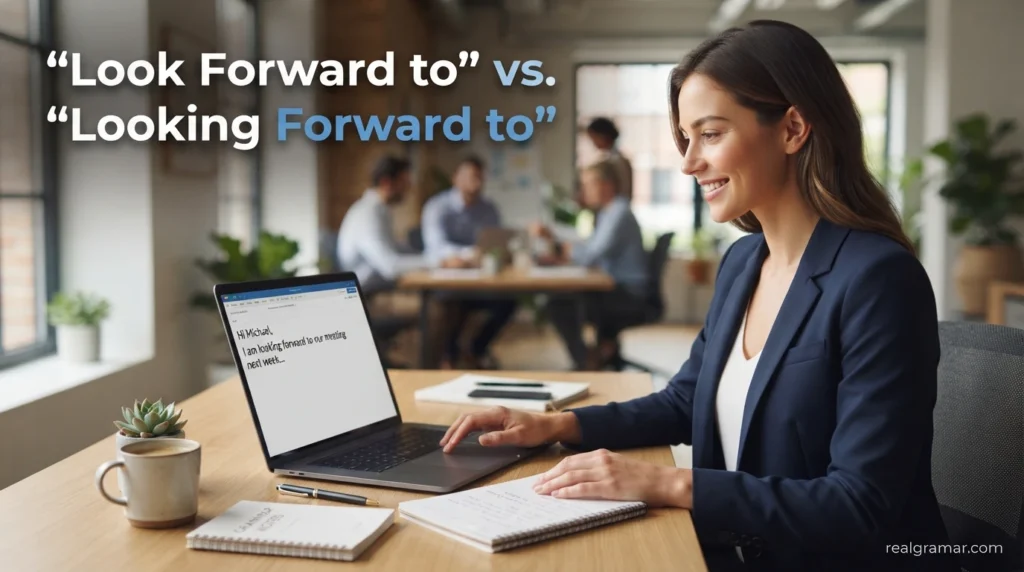
Both forms can be correct, but they serve slightly different purposes.
“I look forward to…”
This is particularly common at the end of formal or professional correspondence.
For example:
“Thank you for considering my application. I look forward to hearing from you.”
It sounds polished and conventional.
“I’m looking forward to…”
This uses the present continuous and often feels slightly warmer or more conversational.
For example:
“I’m looking forward to meeting you next week.”
The distinction is not about one being correct and the other incorrect. Both are standard English.
A useful rule is:
- Formal email or letter: “I look forward to…”
- Friendly workplace message: “I’m looking forward to…”
- Casual conversation: Either can work.
The surrounding context matters more than the choice between these two forms.
Common Grammar Mistakes to Avoid
Although the expression is straightforward, several mistakes appear frequently.
1. Using “to work” instead of “to working”
Incorrect:
“I look forward to work with you.”
Correct:
“I look forward to working with you.”
The reason is that “to” is functioning as a preposition.
2. Adding an unnecessary “for”
Incorrect:
“I look forward for working with you.”
Correct:
“I look forward to working with you.”
The fixed expression is “look forward to,” not “look forward for.”
3. Forgetting the verb agreement
With third-person singular subjects, use looks.
Correct:
- He looks forward to working with you.
- She looks forward to meeting the team.
- The company looks forward to collaborating with you.
With “I,” “we,” “you,” and “they,” use look.
4. Confusing “working with” and “working for”
These expressions have different meanings.
Working with someone generally means collaborating with them.
Working for someone usually means being employed by that person or organization.
For example:
- “I look forward to working with your team.” = I am looking forward to collaborating with the team.
- “I look forward to working for your company.” = I am looking forward to becoming an employee of the company.
Choosing the right preposition can therefore change the intended meaning.
Professional Examples You Can Use
Here are practical examples for different situations.
New colleague
“Welcome to the team. I look forward to working with you and learning from your experience.”
New manager
“Thank you for the introduction. I look forward to working with you and contributing to the team’s goals.”
Client
“Thank you for choosing our services. We look forward to working with you on this project.”
Business partner
“We are pleased to begin this partnership and look forward to working with your organization.”
Freelancer
“Thank you for providing the project details. I look forward to working with you and bringing your vision to life.”
Job offer
“Thank you for the offer. I’m delighted to accept and look forward to working with the team.”
Networking
“It was a pleasure speaking with you. I look forward to staying in touch and exploring opportunities to work together.”
Project email
“Thank you for outlining the next steps. I look forward to working with everyone involved.”
These examples demonstrate that the phrase can be adapted to different relationships without sounding repetitive.
Better Alternatives for Different Situations
Although the standard expression is perfectly acceptable, repeating it in every email can make your writing sound formulaic. You can choose an alternative based on the relationship and purpose.
| Alternative | Best for | Tone |
| I’m excited to work with you. | New collaboration | Warm |
| I look forward to collaborating with you. | Business partnerships | Formal |
| I’m pleased to be working with you. | Existing relationship | Professional |
| I’m excited about our collaboration. | Projects and partnerships | Enthusiastic |
| I look forward to working together. | Team communication | Neutral |
| I’m eager to get started. | New projects | Energetic |
| I’m pleased to have the opportunity to work with you. | Formal business communication | Very formal |
| I’m looking forward to our collaboration. | Business or creative projects | Polished |
The best option depends on how formal your communication needs to be.
For example, “I’m excited to work with you” sounds warmer and more enthusiastic than the traditional business expression.
Meanwhile, “I look forward to collaborating with you” may sound more formal and corporate.
Why This Phrase Matters in Professional Communication
Professional communication is not only about grammar. Tone matters just as much.
A well-chosen closing expression can help establish a positive relationship before a project or working relationship even begins.
Using this type of wording can:
- Demonstrate professionalism
- Express enthusiasm without being overly informal
- Create a positive impression
- Reinforce a cooperative attitude
- Make an email sound courteous
- Signal willingness to collaborate
- End a conversation on a constructive note
This is especially useful when communicating with clients, managers, recruiters, colleagues, suppliers, or business partners.
However, context should always guide your choice. If the situation is extremely formal, you may want a more polished sentence. If you are messaging a close colleague, a shorter and friendlier version may sound more natural.
How to Use It at the End of an Email
This expression is particularly common in email closings.
A simple professional email might look like this:
“Thank you for sending the information. I look forward to working with you on the upcoming project.”
You can also combine it with another sentence:
“Please let me know if you need anything else before we begin. I look forward to working with you.”
For a warmer approach:
“Thanks again for the opportunity. I’m excited to get started and look forward to working with you.”
For a more formal business relationship:
“We appreciate the opportunity to collaborate and look forward to working with your team.”
The important thing is not to force the phrase into every message. If the context does not involve future collaboration, another closing may be more appropriate.
Examples of Natural and Unnatural Sentences
Seeing the difference between correct and incorrect constructions makes the grammar easier to remember.
Natural
- “I look forward to working with you.”
- “We look forward to working together.”
- “She looks forward to meeting the new team.”
- “I’m looking forward to working on the project.”
- “They look forward to building a long-term partnership.”
Unnatural or incorrect
- “I look forward to work with you.”
- “I look forward for working with you.”
- “I am looking forward to work with you.”
- “We looks forward to working with you.”
- “I look forward working with you.”
The corrected forms follow the same basic pattern:
look/looked/looking forward to + noun or -ing form
Once you recognize this pattern, it becomes much easier to produce similar sentences correctly.
Related Expressions You Should Know
Several expressions are closely connected to this construction.
Looking forward to hearing from you
This is one of the most common email expressions.
Example:
“I look forward to hearing from you regarding the next steps.”
Again, “hearing” is correct after the preposition “to.”
Looking forward to meeting you
Use this when you expect to meet someone in the future.
Example:
“I’m looking forward to meeting you next Monday.”
Looking forward to seeing you
This works well when you already know the person or expect to see them soon.
Example:
“I look forward to seeing you at the conference.”
Looking forward to collaborating
This is useful in business and professional settings.
Example:
“We look forward to collaborating with your team.”
Looking forward to our conversation
Here, “our conversation” is a noun phrase, so no gerund is needed.
Example:
“I look forward to our conversation tomorrow.”
These examples all demonstrate the same grammatical principle.
FAQs
1. Is this phrase grammatically correct?
Yes. It is standard English and is widely used in professional communication. The important grammatical feature is that “working” follows the preposition “to.”
2. Should I say “to work” or “to working”?
After “look forward to,” use the -ing form when a verb follows. Therefore, “working” is the appropriate form.
For example:
“I look forward to working with you.”
3. Is “looking forward to working with you” formal?
Yes, it is suitable for professional communication. It can be used in emails, business correspondence, workplace messages, and networking situations.
4. Can I use this expression in a job application?
Yes, but use it according to the stage of the hiring process. If you have already received an offer, you can confidently express enthusiasm about joining the organization. If you are still waiting for a decision, a phrase such as “I look forward to the opportunity to contribute to your team” may be more appropriate.
5. Is “I look forward to working with you” better than “I’m looking forward to working with you”?
Neither is universally better. The first often sounds more formal and is common in business correspondence. The second can sound warmer and more conversational.
6. Can I say “looking forward to work with you”?
No. In standard English, the verb following “look forward to” should take the gerund form. Use “working”, not “work.”
7. Is “looking forward to working together” professional?
Yes. It is a natural professional expression, particularly when both parties will contribute to the same project or goal. It can also sound slightly more collaborative because “together” emphasizes mutual participation.
8. What is a good alternative to this expression?
Depending on the situation, you can say:
- “I’m excited to work with you.”
- “I look forward to collaborating with you.”
- “I’m pleased to have the opportunity to work with you.”
- “I’m eager to get started.”
- “I’m excited about our collaboration.”
Choose the alternative that matches the level of formality and enthusiasm you want to convey.
Conclusion
The phrase “looking forward to working with you” is correct, natural, and highly useful in professional English. The main grammar rule to remember is simple: “look forward to” is followed by a noun, pronoun, or gerund—not an infinitive.
That is why “working” is correct rather than “work.”
Whether you are starting a new job, communicating with a client, beginning a project, meeting a business partner, or writing a professional email, the expression can help you convey enthusiasm and courtesy.
For formal situations, “I look forward to working with you” is a reliable choice. For warmer communication, “I’m looking forward to working with you” or “I’m excited to work with you” may feel more natural.
Ultimately, good professional English is about more than avoiding grammatical mistakes. The best expression is the one that accurately matches your relationship, purpose, and desired tone.
