
Words are more than simple tools for sharing information. They help us create images, express emotions, describe experiences, and connect with readers. Strong communication depends not only on knowing vocabulary but also on choosing the right words for the right situation. This is especially important in creative writing, storytelling, academic writing, and everyday conversations.
When writers understand subtle differences between similar words, they can create clearer descriptions and more powerful messages. For example, describing a place as a “city,” “town,” or “village” does more than identify its size. Each word creates a different image in the reader’s mind. A city may suggest energy, diversity, and modern life, while a village may create feelings of tradition, nature, and community.
This connection between words and imagination is where figurative language, descriptive language, and literary devices become valuable. Writers often use comparisons, metaphors, and poetic expression to help readers visualize settings. A bustling city can be described as “a living machine,” while a quiet village may be portrayed as “a peaceful painting hidden among green fields.”
Understanding these differences improves writing skills and vocabulary enhancement. It helps students, writers, and English learners communicate ideas more accurately and choose expressions that match their intended tone.
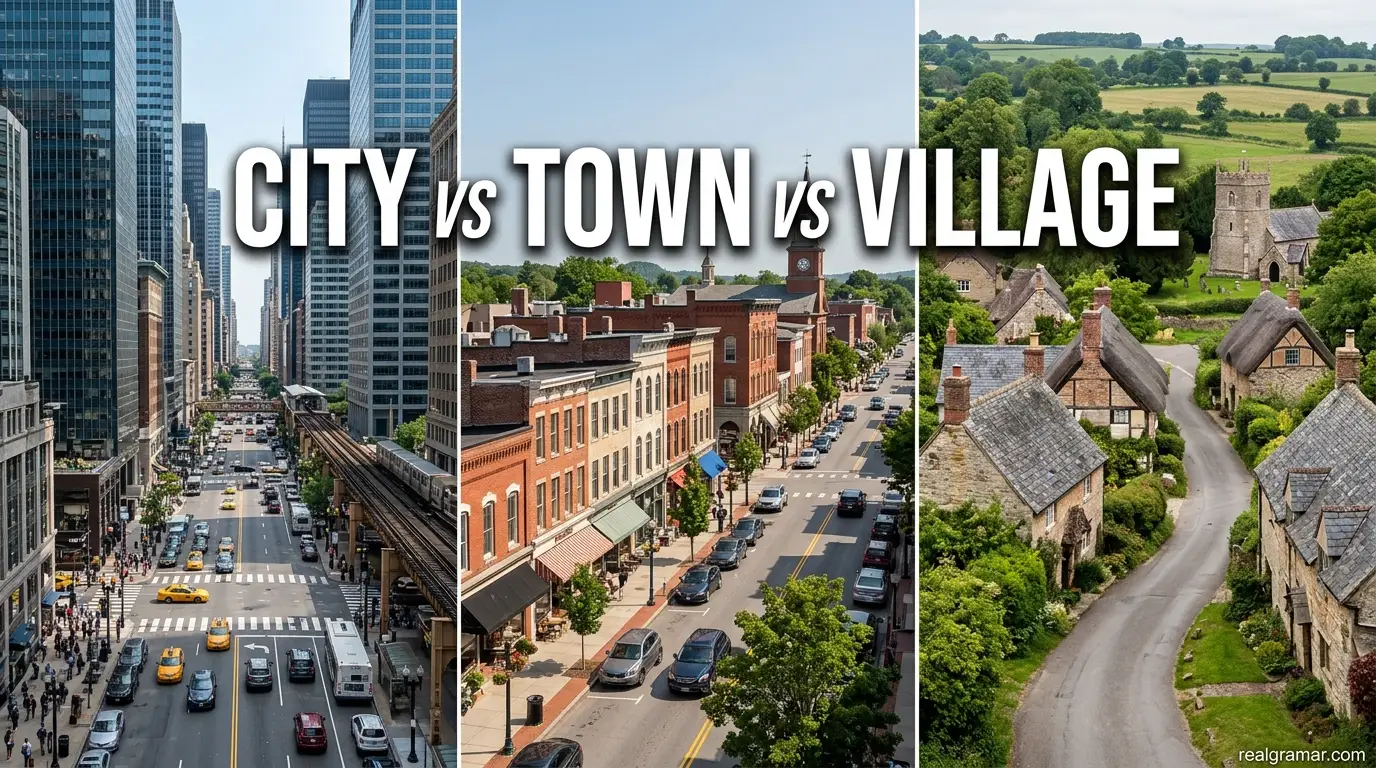
The comparison between city vs town vs village is not only about population size. It involves culture, lifestyle, geography, social structure, history, and the emotional meaning these words carry in language.
Whether you are writing a story, describing a location, learning English, or improving your vocabulary, knowing how these terms differ can make your sentences more natural and engaging.
What Is the Difference Between City, Town, and Village?
The words city, town, and village describe different types of human settlements. The main differences usually involve population size, infrastructure, services, and lifestyle. However, the exact definitions can vary depending on the country and local government systems.
In general:
| Settlement Type | General Meaning | Common Features |
| City | A large and highly developed urban area | Large population, businesses, transportation systems, advanced services |
| Town | A medium-sized settlement between a city and village | Local businesses, schools, services, smaller communities |
| Village | A small rural settlement | Fewer residents, close community relationships, connection with nature |
Although these definitions seem simple, writers often use these words to create different emotional impressions.
For example:
- “She moved to a city to pursue her career.”
- Suggests opportunities, ambition, and fast-paced living.
- “He opened a bookstore in a small town.”
- Suggests familiarity, community, and a balanced lifestyle.
- “They spent their summer in a peaceful village.”
- Suggests nature, simplicity, and traditional life.
The meaning of these words changes depending on context, tone, and the image a writer wants to create.
City Meaning: Definition, Features, and Examples
A city is a large settlement with a high population, developed infrastructure, and a wide range of public services. Cities usually contain commercial areas, government buildings, universities, hospitals, entertainment venues, and transportation networks.
Cities are often centers of economic activity, education, technology, and culture.
Common Features of a City
A city usually has:
- A large population
- Tall buildings and urban development
- Extensive transportation systems
- Shopping centers and businesses
- Universities and professional opportunities
- Cultural events and entertainment
- Diverse communities
Examples of sentences using “city”:
- “New York City attracts millions of visitors every year.”
- “The city never sleeps because people work and travel at all hours.”
- “She dreamed of building a successful career in the city.”
- “The city skyline looked like a collection of shining towers reaching toward the sky.”
The last example uses descriptive language by creating a visual image of the skyline.
City in Creative Writing and Figurative Language
Writers often use cities as symbols. A city can represent ambition, opportunity, chaos, freedom, or loneliness.
Metaphor Examples
- “The city was a giant heartbeat, constantly moving and changing.”
- “The city was a maze of dreams and challenges.”
These metaphors do not mean the city literally has a heartbeat or is a maze. They express emotional ideas.
Simile Examples
- “The city lights glittered like stars scattered across the earth.”
- “The streets were as busy as a river flowing with people.”
Similes help readers imagine the atmosphere of an urban environment.
Poetic Expression Examples
- “The city whispered stories beneath the glow of midnight lights.”
- “Among the concrete walls, millions of dreams quietly grew.”
These examples show how location words can create emotional depth in writing.
Town Meaning: Definition, Features, and Examples
A town is a settlement that is usually smaller than a city but larger and more developed than a village. Towns often have local businesses, schools, healthcare facilities, markets, and community spaces.
Towns usually offer a balance between convenience and a close community atmosphere.
Common Features of a Town
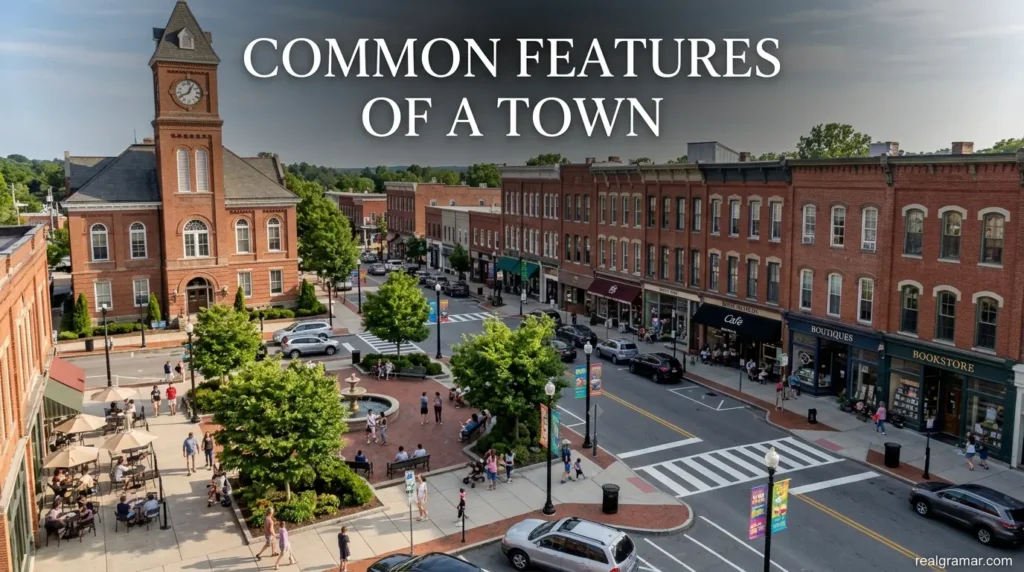
A town often includes:
- A moderate population
- Local shops and restaurants
- Schools and healthcare centers
- Residential neighborhoods
- Community events
- Smaller business areas
Sentence examples:
- “The town celebrated its annual cultural festival.”
- “Everyone in the town knew the local shop owner.”
- “She enjoyed the peaceful lifestyle of the coastal town.”
- “The small town had a surprising amount of history.”
The word “town” often creates a feeling of familiarity and connection.
Town as a Literary Setting
In storytelling, towns are popular settings because they allow writers to explore relationships and community life.
A town can symbolize:
- Belonging
- Tradition
- Childhood memories
- Personal growth
- Hidden secrets
Figurative Language Examples
Metaphor:
- “The town was a family tree with every branch connected.”
Meaning:
The writer compares the town to a family tree to show strong relationships among residents.
Simile:
- “The town was quiet like a forgotten story waiting to be opened.”
Meaning:
The comparison creates a feeling of mystery and peacefulness.
Creative Writing Example:
“Beyond the crowded highways stood a small town where every street carried a memory and every house held a story.”
This sentence uses descriptive language to create an emotional image.
Village Meaning: Definition, Features, and Examples
A village is a small settlement, usually located in rural areas. Villages often have fewer residents than towns and are commonly associated with farming, nature, traditions, and strong community relationships.
Villages may have fewer modern facilities, but they often provide a slower and simpler lifestyle.
Common Features of a Village
Villages often include:
- Small populations
- Natural surroundings
- Farming or agricultural activities
- Traditional lifestyles
- Close relationships among residents
- Peaceful environments
Sentence examples:
- “The village was surrounded by green fields and mountains.”
- “She grew up in a quiet village near the river.”
- “The village celebrated traditions passed down through generations.”
- “The villagers welcomed visitors with kindness.”
The word “village” often creates emotional associations with simplicity and nature.
Village in Figurative Language and Storytelling
Villages frequently appear in literature because they represent roots, history, and human connection.
Metaphor Examples
- “The village was a small universe filled with unforgettable stories.”
- “The village was a garden where traditions continued to bloom.”
Simile Examples
- “The village was peaceful like a sleeping child.”
- “The fields surrounding the village were as beautiful as a painting.”
Poetic Expression Examples
- “The village rested beneath the morning sun, carrying centuries of memories.”
- “Every path in the village seemed to whisper tales of the past.”
These expressions demonstrate how descriptive language transforms ordinary locations into meaningful settings.
(Part 1 ends here. Part 2 will continue with:
- City vs Town vs Village: Detailed Comparison Table
- Differences in Culture, Lifestyle, and Communication
- When to Use Each Word
- Common Mistakes English Learners Make
- More Sentence Examples and Tone Usage
- Writing Exercises
- FAQs
- Conclusion**)
Comparison, Usage, Common Mistakes, and Writing Practice
City vs Town vs Village
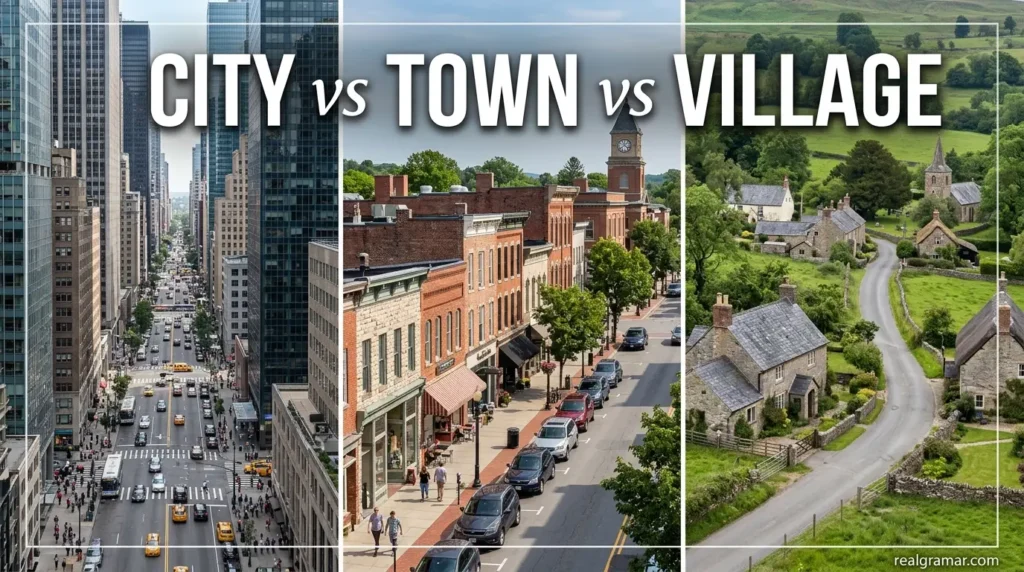
Understanding the difference between a city, town, and village becomes easier when comparing their major characteristics. Although these definitions can change depending on geography and government rules, the general differences remain similar in everyday English.
| Feature | City | Town | Village |
| Population | Usually large | Medium-sized | Small |
| Development | Highly developed | Moderately developed | Less developed |
| Environment | Mostly urban | Mix of urban and rural features | Mostly rural |
| Buildings | High-rise buildings, offices, large structures | Smaller buildings, local businesses | Houses, farms, traditional buildings |
| Transportation | Extensive public transport systems | Limited but available transportation | Fewer transportation options |
| Lifestyle | Fast-paced and busy | Balanced and community-focused | Slow-paced and traditional |
| Job Opportunities | Many industries and careers | Local businesses and services | Mostly agriculture and small occupations |
| Community Size | Large and diverse | Close-knit | Very close-knit |
| Cost of Living | Usually higher | Moderate | Often lower |
| Common Image | Opportunity and modern life | Comfort and familiarity | Nature and simplicity |
This table provides a general comparison, but writers should remember that real-life examples vary. Some villages may be modern, and some towns may be larger than cities in certain regions.
Differences Between City, Town, and Village in Lifestyle
The biggest difference between these settlements is often the lifestyle they represent.
A city represents movement, competition, and opportunity. People often move to cities for education, jobs, healthcare, and entertainment. Cities are usually full of different cultures, languages, and lifestyles.
A town represents balance. It often combines the convenience of urban areas with the friendliness of smaller communities.
A village represents simplicity, tradition, and connection with nature. Villages often have stronger social bonds because residents usually know each other personally.
Lifestyle Comparison Examples
City Lifestyle
“The city offered endless opportunities, but the constant noise made relaxation difficult.”
This sentence shows both advantages and challenges of urban life.
Town Lifestyle
“The town provided everything she needed while allowing her to enjoy a peaceful environment.”
This highlights balance and comfort.
Village Lifestyle
“The village gave him a chance to reconnect with nature and enjoy a slower rhythm of life.”
This emphasizes simplicity and calmness.
City vs Town vs Village in Creative Writing
Places are not just backgrounds in stories. They influence characters, emotions, and themes. Writers carefully choose locations because each setting creates a different atmosphere.
A city may create feelings of:
- Excitement
- Ambition
- Independence
- Competition
- Loneliness
A town may create feelings of:
- Belonging
- Friendship
- Nostalgia
- Community
- Mystery
A village may create feelings of:
- Peace
- Tradition
- Nature
- Family
- Simplicity
Example: Same Character, Different Settings
In a City:
“Maria walked through the crowded streets, surrounded by thousands of strangers chasing their own dreams.”
The city creates a feeling of energy and isolation.
In a Town:
“Maria walked through the familiar streets where shopkeepers greeted her by name.”
The town creates a feeling of connection.
In a Village:
“Maria walked along the dusty path where birds sang above fields filled with golden sunlight.”
The village creates a peaceful, natural atmosphere.
The location changes the emotional meaning of the story.
How Writers Use These Words for Tone and Mood
Choosing between city, town, and village affects the tone of writing. Tone refers to the attitude or emotional feeling created by words.
City: Common Tones
A city can create a:
Positive Tone
Example:
“The city was a place where dreams transformed into reality.”
Meaning:
The city represents opportunity and success.
Negative Tone
Example:
“The city swallowed his voice among millions of unfamiliar faces.”
Meaning:
The city represents loneliness or pressure.
Town: Common Tones
A town often creates a warm or nostalgic tone.
Examples:
- “The town welcomed strangers like old friends.”
- “The little town preserved memories from generations past.”
The word “town” often works well in family stories, romance novels, and personal essays.
Village: Common Tones
A village usually creates peaceful, emotional, or traditional feelings.
Examples:
- “The village slept beneath the stars, untouched by modern worries.”
- “The village carried ancient traditions like precious treasures.”
Writers often use villages in fantasy, historical fiction, and nature-based stories.
When to Use City, Town, and Village
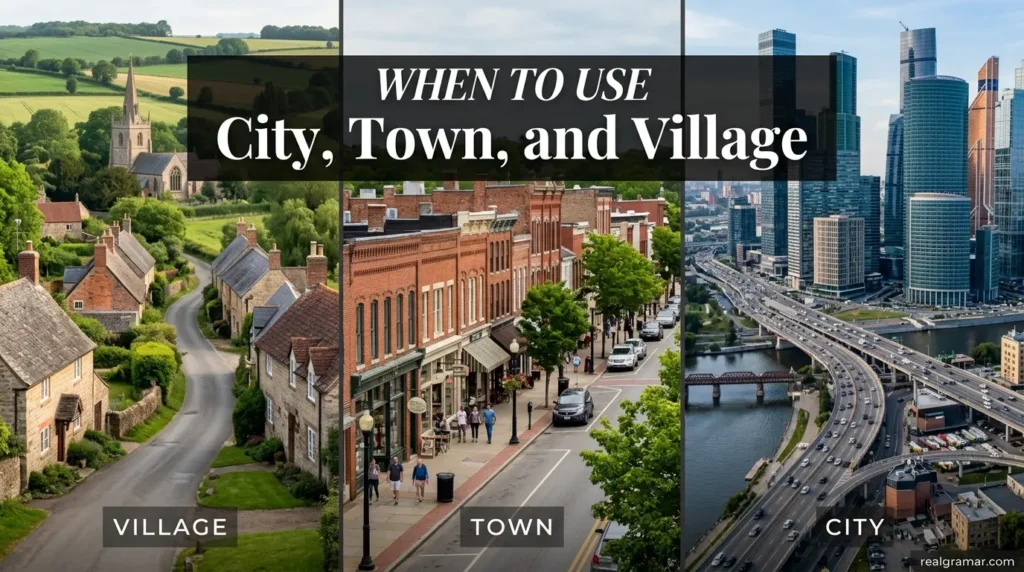
Using the correct word improves clarity and accuracy. Here are situations where each term works best.
Use “City” When Talking About:
- Large urban areas
- Major business centers
- Places with advanced infrastructure
- Famous metropolitan locations
Examples:
✔ “She moved to the city for a better job opportunity.”
✔ “The city has one of the busiest airports in the country.”
Avoid using “city” when describing a very small rural settlement.
Incorrect:
❌ “I visited a city with only fifty houses.”
Better:
✔ “I visited a small village with only fifty houses.”
Use “Town” When Talking About:
- Medium-sized communities
- Local markets
- Small business centers
- Places between rural and urban areas
Examples:
✔ “The town has a popular weekend market.”
✔ “Many families have lived in this town for generations.”
Avoid using “town” if the place is clearly a major metropolitan area.
Incorrect:
❌ “Tokyo is a small town.”
Better:
✔ “Tokyo is a major city.”
Use “Village” When Talking About:
- Small rural communities
- Farming areas
- Traditional settlements
- Natural surroundings
Examples:
✔ “The village is surrounded by mountains.”
✔ “The village depends mainly on farming.”
Avoid using “village” for large developed areas.
Incorrect:
❌ “London is a village.”
Better:
✔ “London is a city.”
Common Mistakes English Learners Make
Many English learners confuse city, town, and village because their meanings overlap. The mistake usually happens because different countries use these words differently.
Mistake 1: Thinking Population Is the Only Difference
Although population matters, it is not the only factor.
Incorrect idea:
“A place with many people is always a city.”
Reality:
Development, government classification, and local culture also influence the definition.
Mistake 2: Translating Directly From Another Language
Some languages have different categories for settlements. A word that means “town” in one language may not match exactly in English.
Tip:
Always consider the context instead of translating word-for-word.
Mistake 3: Using Village as a Negative Word
Some learners think “village” means backward or undeveloped.
However, in English, “village” can create positive meanings such as:
- Peaceful
- Traditional
- Beautiful
- Close community
Example:
“The village was a hidden paradise surrounded by forests.”
Mistake 4: Confusing Town With Downtown
“Town” and “downtown” are different.
Town = a type of settlement.
Example:
“She lives in a small town.”
Downtown = the central business area of a city or town.
Example:
“She works downtown.”
City, Town, and Village: Idiom Meaning and Expressions
English often uses settlement words in idioms and expressions. These phrases may not refer to actual locations but communicate ideas.
“A one-horse town”
Meaning:
A very small town with limited activities or opportunities.
Example:
“He left the one-horse town to search for bigger opportunities.”
This expression can sound negative.
“The city never sleeps”
Meaning:
A city remains active day and night.
Example:
“Visitors love the nightlife because the city never sleeps.”
This phrase is often used metaphorically.
“It takes a village”
Meaning:
Many people working together are needed to achieve something.
Example:
“It takes a village to raise a child.”
This expression highlights community support.
Practice Exercises: Improve Your Vocabulary and Writing Skills
Understanding these words is easier when you practice using them.
Exercise 1: Choose the Correct Word
Fill in the blanks with city, town, or village.
- New York is a famous ______ known for its skyscrapers.
- My grandparents live in a small ______ surrounded by farms.
- The coastal ______ attracts tourists every summer.
- She moved to the ______ to find better career opportunities.
Answers:
- city
- village
- town
- city
Exercise 2: Improve the Sentence
Basic sentence:
“The village was nice.”
Improved sentence:
“The peaceful village rested among green hills, creating a perfect escape from busy modern life.”
The improved version uses descriptive language and creates a stronger image.
Exercise 3: Creative Writing Challenge
Write three sentences describing the same place as:
- A city
- A town
- A village
Example:
City:
“The city roared with endless movement and ambition.”
Town:
“The town welcomed everyone with familiar smiles.”
Village:
“The village whispered stories through its quiet fields.”
This exercise helps develop creative writing skills and emotional expression.
Part 2 ends here. Part 3 will include:
- Advanced comparison examples
- City vs Town vs Village in academic writing and conversation
- Figurative language examples (metaphors, similes, poetic expressions)
- SEO-focused vocabulary section
- Frequently Asked Questions (5 FAQs)
- Final conclusion with key takeaways
Advanced Comparison Examples: City vs Town vs Village in Real Sentences
The difference between these three words becomes clearer when they are used in different contexts. A writer’s word choice can influence how readers imagine a place.
Example 1: Describing a Person’s Move
City:
“She moved to the city because she wanted more career opportunities and a more exciting lifestyle.”
Meaning:
The city represents growth, ambition, and professional possibilities.
Town:
“She moved to a small town where she could enjoy a peaceful life while staying connected to modern conveniences.”
Meaning:
The town represents balance and comfort.
Village:
“She moved to a village where she could escape the noise of urban life and reconnect with nature.”
Meaning:
The village represents simplicity and tranquility.
Example 2: Describing Childhood Memories
City:
“My childhood in the city was filled with crowded streets, busy markets, and endless discoveries.”
The city creates an image of activity and diversity.
Town:
“My childhood in the town was full of bicycle rides, familiar faces, and weekend adventures.”
The town creates an image of community and friendship.
Village:
“My childhood in the village was shaped by open fields, family traditions, and peaceful evenings.”
The village creates an image of nature and nostalgia.
Example 3: Describing Travel Experiences
City:
“The city amazed visitors with its towering buildings, museums, and vibrant nightlife.”
Town:
“The town attracted travelers with its charming streets and local culture.”
Village:
“The village welcomed visitors with beautiful landscapes and traditional customs.”
Each word creates a different emotional experience.
City vs Town vs Village in Academic Writing
Students often need to describe places in essays, reports, geography assignments, and research projects. Using accurate vocabulary improves clarity and demonstrates strong language skills.
Example Academic Sentences
City:
“Cities often provide greater access to education, healthcare, and employment opportunities.”
Town:
“Towns frequently serve as important centers for nearby rural communities.”
Village:
“Villages often maintain traditional lifestyles connected to agriculture and local customs.”
Academic writing usually requires neutral language. Avoid adding emotional descriptions unless the assignment asks for personal reflection.
City vs Town vs Village in Everyday Conversation
In casual conversations, people often use these words based on personal understanding rather than strict definitions.
Conversation Examples
Talking About Where You Live
Person A:
“Where do you live?”
Person B:
“I live in a small town near the mountains.”
This suggests a place that is not extremely large but has local facilities.
Talking About Moving
“I want to move to the city because there are more job opportunities.”
The speaker focuses on career advantages.
Talking About Holidays
“We visited a beautiful village during our vacation.”
The speaker likely wants to highlight nature, culture, or peaceful surroundings.
Figurative Language: How City, Town, and Village Create Powerful Images
Strong writers do not simply describe places. They create emotional connections. Figurative language helps transform ordinary descriptions into memorable expressions.
Metaphor Examples
A metaphor compares two things directly without using “like” or “as.”
City Metaphors
- “The city was a giant engine powered by human dreams.”
- “The city was a jungle of ambition and opportunity.”
- “The city was a river of endless movement.”
Meaning:
These comparisons show energy, competition, and constant activity.
Town Metaphors
- “The town was a woven blanket of shared memories.”
- “The town was a small book filled with familiar stories.”
- “The town was a bridge between the past and the future.”
Meaning:
These metaphors highlight relationships, history, and connection.
Village Metaphors
- “The village was a garden where traditions continued to grow.”
- “The village was a quiet poem written by nature.”
- “The village was a treasure chest of forgotten memories.”
Meaning:
These comparisons emphasize beauty, tradition, and peacefulness.
Simile Examples for Describing Settlements
A simile compares two things using “like” or “as.”
City Similes
- “The city lights shone like a blanket of stars.”
- “The streets moved like a flowing river.”
- “The city was as energetic as a festival.”
Town Similes
- “The town felt like a warm home filled with friendly faces.”
- “The streets were as quiet as a peaceful morning.”
- “The town was like a small family.”
Village Similes
- “The village was quiet like a sleeping child.”
- “The fields looked as beautiful as a painting.”
- “The village was as peaceful as a hidden paradise.”
These examples show how simple location words can become powerful literary devices.
Descriptive Language for Better Writing
Writers can make descriptions stronger by adding sensory details.
Instead of:
“The village was beautiful.”
Try:
“The village rested beneath green hills, where fresh air carried the scent of flowers and birds filled the morning sky with music.”
The second sentence allows readers to see, hear, and feel the environment
Sensory Description Examples
City
Visual:
“Glass towers reflected sunlight above crowded streets.”
Sound:
“Car horns and conversations filled the busy avenues.”
Feeling:
“The city created a sense of endless possibility.”
Town
Visual:
“Small shops lined the charming streets beside old houses.”
Sound:
“Friendly conversations echoed through the local market.”
Feeling:
“The town offered comfort and familiarity.”
Village
Visual:
“Wooden houses stood beside fields covered with morning mist.”
Sound:
“Bird songs replaced the noise of traffic.”
Feeling:
“The village provided a peaceful escape from modern life.”
How These Words Improve Vocabulary Enhancement
Learning the difference between city, town, and village expands vocabulary because these words connect with many related expressions.
Words Associated With Cities
- Urban
- Metropolitan
- Modern
- Industrial
- Commercial
- Crowded
- Cosmopolitan
Example:
“The metropolitan area attracts people from different cultures.”
Words Associated With Towns
- Local
- Community-based
- Traditional
- Historic
- Charming
- Neighborhood-focused
Example:
“The historic town preserved its cultural identity.”
Words Associated With Villages
- Rural
- Natural
- Peaceful
- Traditional
- Agricultural
- Remote
Example:
“The rural village depended on farming and local resources.”
Using related vocabulary helps writers avoid repetition and create more engaging content.
FAQs
1. What is the main difference between a city, town, and village?
The main difference is usually size, population, and development. A city is generally the largest and most developed settlement, a town is medium-sized, and a village is smaller and often rural.
However, definitions vary between countries.
2. Is a town bigger than a village?
Generally, yes. A town usually has more residents, businesses, and services than a village.
A village may have fewer buildings and facilities, while a town often has schools, markets, and healthcare services.
3. Can a village become a city?
Yes. As populations grow and infrastructure develops, some villages can expand into towns and eventually become cities.
Growth usually happens because of economic development, transportation, and increased services.
4. Is life better in a city or village?
It depends on personal preferences.
Cities often provide:
- More job opportunities
- Better access to services
- More entertainment options
Villages often provide:
- Peaceful surroundings
- Strong community connections
- A closer relationship with nature
Neither lifestyle is automatically better; they offer different experiences.
5. Why do writers use cities, towns, and villages in stories?
Writers use these settings because they create different moods and themes.
A city may represent ambition and change.
A town may represent community and relationships.
A village may represent tradition, nature, and simplicity.
The setting helps shape characters and emotions.
Quick Revision Chart: City vs Town vs Village
| Word | Main Idea | Emotional Feeling | Common Writing Use |
| City | Large urban settlement | Energy, ambition, opportunity | Modern stories, business, social themes |
| Town | Medium community | Comfort, belonging, familiarity | Romance, family stories, personal essays |
| Village | Small rural settlement | Peace, tradition, nature | Historical stories, fantasy, emotional writing |
Conclusion
Understanding the difference between a city, town, and village helps students, writers, and English learners communicate more effectively. These words may seem simple, but each one carries its own meaning, emotion, and cultural association.
A city is more than a collection of buildings; it can represent dreams, challenges, and endless possibilities. A town is more than a group of streets; it can symbolize friendship, memories, and community. A village is more than a small settlement; it can represent nature, traditions, and human connection.
For creative writers, these words provide powerful opportunities to create atmosphere through figurative language, metaphors, similes, and descriptive expressions. For students and language learners, understanding their differences improves vocabulary, sentence construction, and communication skills.
The best writing comes from choosing words carefully. When you understand the emotional meaning behind words, you can create clearer explanations, stronger stories, and more memorable descriptions.
Whether you are describing a crowded city street, a welcoming town square, or a peaceful village path, the right word helps your readers see the world exactly as you imagine it.
