Great writing is not only about using advanced vocabulary or complicated sentences. Often, the smallest word choices create the biggest impact. A single space, spelling variation, or phrase choice can change the tone, clarity, and professionalism of your message.
Figurative language, creative writing techniques, and descriptive language help writers express emotions, ideas, and experiences in memorable ways. Whether you are writing an essay, a story, a social media caption, or a professional email, understanding how words function allows you to communicate with confidence.
English learners frequently encounter confusing word pairs that look similar but have different levels of acceptance, tone, or meaning. These differences are especially important in everyday expressions. One common example is the choice between alright vs all right.
Many writers wonder whether these expressions mean the same thing, whether one is considered incorrect, and when each form should be used. Although they are often interchangeable in casual conversations, they carry different impressions in formal writing, academic work, and creative expression.
Learning these subtle distinctions improves writing skills, vocabulary enhancement, and overall language awareness. It also helps writers develop a stronger understanding of sentence structure, tone usage, and stylistic choices.
In this guide, we will explore the meaning, history, examples, common mistakes, and practical uses of alright vs all right so students, writers, and English learners can make better language decisions.
Understanding the Meaning of All Right
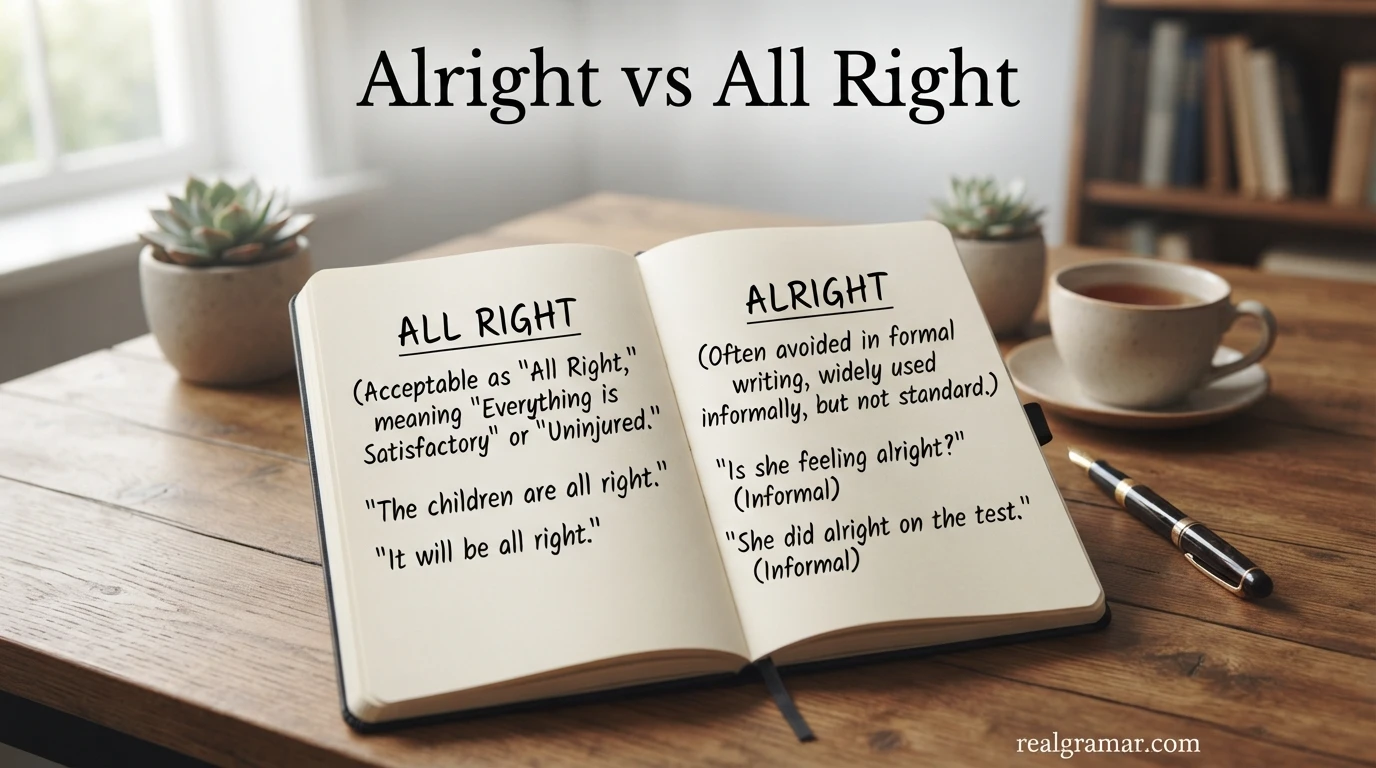
The phrase all right is the traditional and widely accepted form in English. It can function as an adjective, adverb, interjection, or conversational expression depending on the context.
The basic meaning of all right is:
- Acceptable
- Satisfactory
- Safe
- Correct
- In good condition
- Agreeable
The phrase can express approval, reassurance, agreement, or confirmation.
Examples of All Right Meaning “Acceptable”
- Your homework is all right, but you can improve your explanation.
- The movie was all right, although the ending was predictable.
- The food tasted all right, but it needed more seasoning.
In these examples, all right means “okay” or “acceptable.”
Examples of All Right Meaning “Safe or Well”
- Are you all right after the accident?
- She looked tired, but she said she was all right.
- Don’t worry; everything will be all right.
Here, the phrase expresses a person’s condition or emotional state.
Examples of All Right as Agreement
- “Can we start the meeting now?”
- “All right, let’s begin.”
In conversation, all right works similarly to words like:
- Okay
- Sure
- Fine
- Agreed
What Does Alright Mean?
Alright is a modern variation of all right that combines the two words into one. It is commonly used in informal writing, everyday speech, songs, dialogue, and online communication.
Although many dictionaries recognize alright as a word, some traditional grammar guides still prefer all right, especially in formal writing.
The meaning of alright is usually the same as all right:
- Fine
- Acceptable
- Okay
- Satisfactory
- Safe
Examples of Alright in Casual Writing
- I’m alright, don’t worry about me.
- The concert was alright, but I expected more.
- Alright, let’s move on to the next topic.
The difference is usually not meaning but style and tone.
Quick Comparison Table
| Feature | All Right | Alright |
| Standard form | Yes | Modern informal form |
| Formal writing | Preferred | Usually avoided |
| Casual conversations | Common | Very common |
| Meaning | Same meanings | Same meanings |
| Academic writing | Recommended | Less preferred |
| Creative writing | Depends on style | Useful for realistic dialogue |
| Professional communication | Better choice | Use carefully |
Is Alright Correct or Is All Right Correct?
This is one of the most common questions among English learners.
The answer depends on context.
In Formal English
All right is generally the safer choice.
Use it in:
- Academic essays
- Business documents
- Research papers
- Professional emails
- Official reports
Example:
✅ The results of the experiment were all right, but further research is needed.
Less recommended:
❌ The results of the experiment were alright, but further research is needed.
The second sentence is understandable, but the first one follows traditional formal writing standards.
In Informal English
Both forms are widely understood.
Examples:
- “Are you alright?”
- “Are you all right?”
Both communicate the same idea.
However, many style experts still prefer all right because it is older and more universally accepted.
The History Behind All Right and Alright
Language constantly changes. Many words that were once considered unusual eventually became accepted parts of everyday English.
The phrase all right developed from the combination of:
- “all” meaning completely or entirely
- “right” meaning correct, proper, or satisfactory
Over time, speakers naturally shortened the phrase by combining the words, creating alright.
This process is common in language evolution. Similar changes have happened with other expressions, where spoken language influences written forms.
For example:
- Already came from “all ready”
- Always came from “all ways”
- Altogether came from “all together”
However, unlike these examples, alright has not gained complete acceptance in every style of English writing.
Tone and StyleWord choice influences the emotional feeling of a sentence. This is especially important in creative writing, storytelling, poetry, and character development.
Language is not only about grammar rules; it is also about voice, rhythm, and expression.
Using All Right for a More Polished Tone
“All right” often sounds:
- Careful
- Traditional
- Professional
- Clear
Example:
Everything will be all right after we solve the problem.
This sentence feels reassuring and formal.
Using Alright for a More Casual Tone
“Alright” often sounds:
- Conversational
- Relaxed
- Modern
- Natural
Example:
Alright, guys, let’s start the adventure.
This sounds like everyday speech.
Alright vs All Right in Creative Writing
Creative writers often make intentional choices based on voice and character.
In fiction, dialogue should sound natural. A character who speaks casually may realistically use alright.
Example:
“Alright, I’m ready,” Jake whispered before opening the door.
Using alright helps create a believable conversational style.
However, in narration, many authors still prefer all right.
Example:
She knew everything would be all right in the end.
The phrase creates a smoother and more traditional narrative style.
Figurative Language and Expression with All Right
Although “all right” is not usually considered a figurative expression by itself, it can appear in sentences that use figurative language.
Writers often combine everyday phrases with literary devices such as:
- Similes
- Metaphors
- Personification
- Symbolism
- Emotional imagery
Simile Examples
A simile compares two things using “like” or “as.”
Examples:
- Her smile was like a sunrise, telling everyone that everything would be all right.
- His confidence was as strong as a mountain, making him believe he would be alright.
Metaphor Examples
A metaphor directly compares two ideas.
Examples:
- Hope was the light showing her that everything would be all right.
- His courage was an anchor keeping him alright during difficult times.
These examples show how common phrases can become part of expressive writing.
Common Mistakes When Using Alright and All Right
Even advanced English learners sometimes struggle with small word choices because language depends on context, tone, and purpose. While alright and all right often share the same meaning, choosing the wrong form can affect how polished or natural your writing sounds.
Understanding these common mistakes will help students, writers, and professionals improve accuracy and communication.
Mistake 1: Using Alright in Formal Academic Writing
One of the biggest mistakes is using alright in situations where traditional English standards expect all right.
Academic and professional writing usually values established forms.
Incorrect Style:
The results of the study were alright, but additional testing is required.
Better:
The results of the study were all right, but additional testing is required.
The second version sounds more appropriate for research papers, essays, and formal documents.
Formal Writing Examples:
- The presentation was all right, but several points needed clarification.
- The student’s answer was all right, although the explanation lacked detail.
- The plan is all right for now, but future changes may be necessary.
Mistake 2: Assuming Alright Is Always Wrong
Some people believe that alright is completely incorrect. This is not accurate.
Modern English accepts alright in many informal contexts.
It appears frequently in:
- Conversations
- Text messages
- Fictional dialogue
- Songs
- Online writing
- Social media posts
Examples:
- Alright, I’ll meet you tomorrow.
- Everything is alright now.
- I’m alright after the difficult experience.
In casual communication, using alright is usually natural and understandable.
Mistake 3: Confusing All Right With “All Correct” Only
Many learners think all right only means “correct.” However, the phrase has several meanings.
Meaning 1: Correct or Accurate
Example:
Your answer is all right.
Meaning:
Your answer is correct.
Meaning 2: Acceptable or Satisfactory
Example:
The restaurant was all right, but the service was slow.
Meaning:
The restaurant was okay, but not excellent.
Meaning 3: Safe or Healthy
Example:
Is your brother all right after the accident?
Meaning:
Is your brother safe or okay?
Meaning 4: Agreement or Permission
Example:
All right, you can start the project today.
Meaning:
I agree or give permission.
Mistake 4: Using These Words Without Considering Tone
Good writing requires understanding tone.
Tone is the emotional attitude behind your words. The same message can feel different depending on your word choice.
Compare:
Formal Tone:
Everything will be all right eventually.
Casual Tone:
Everything will be alright eventually.
Both sentences are correct in meaning, but the second feels more conversational.
When to Use All Right
Choosing all right is usually the safest option because it works in almost every situation.
Use all right when writing:
- Essays
- Reports
- Articles
- Business communication
- Academic assignments
- Formal letters
- Professional documents
Examples in Academic Writing
- The argument is all right, but it requires stronger evidence.
- The explanation is all right; however, more examples would improve clarity.
- The experiment went all right despite several challenges.
When to Use Alright
Use alright when you want a relaxed, conversational style.
It works well in:
- Personal messages
- Informal blogs
- Fiction dialogue
- Character conversations
- Social media content
Examples:
- Alright, everyone, let’s begin.
- I’m alright now, so you don’t need to worry.
- The movie was alright, but the book was better.
When to Avoid Alright
Although common, alright may not be the best choice when you want your writing to appear:
- Formal
- Traditional
- Academic
- Professional
- Highly polished
Avoid it in:
School Essays
Instead of:
The argument was alright.
Write:
The argument was acceptable.
or:
The argument was satisfactory.
Professional Reports
Instead of:
The project results were alright.
Write:
The project results were satisfactory.
Formal Presentations
Instead of:
The performance was alright.
Write:
The performance was successful.
Sentence Examples Comparing Alright and All Right
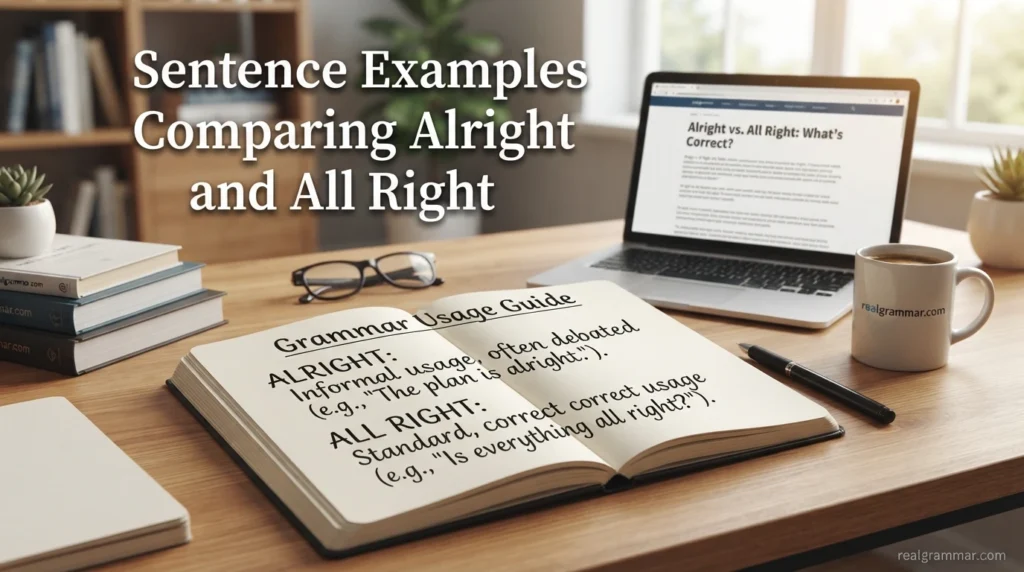
Seeing both forms in similar situations makes the difference clearer.
| Situation | All Right Example | Alright Example |
| Checking someone’s health | Are you all right after your journey? | Are you alright after your journey? |
| Giving permission | All right, you may leave now. | Alright, you may leave now. |
| Describing quality | The movie was all right. | The movie was alright. |
| Expressing reassurance | Everything will be all right. | Everything will be alright. |
| Starting something | All right, let’s begin. | Alright, let’s begin. |
The meaning remains almost identical, but the feeling changes slightly.
Alright vs All Right in Different Types of Writing
1. Academic Writing
Academic writing focuses on clarity, precision, and established grammar conventions.
Recommended:
- all right
- acceptable
- satisfactory
- appropriate
- correct
Example:
The methodology was all right, but additional research methods could strengthen the study.
2. Creative Writing
Creative writing allows more flexibility because authors create voices, characters, and emotions.
Both forms may appear.
Example:
“Alright, I guess we should leave,” she said quietly.
The informal spelling helps the dialogue feel realistic.
Narration:
She believed everything would be all right someday.
3. Social Media Writing
Online communication is usually casual and expressive.
Both forms work depending on your style.
Examples:
- Alright, weekend, I’m ready!
- Everything is all right when you have good friends.
- Alright, adventure begins now.
- My heart knows everything will be all right.
How Word Choice Connects With Writing Skills
Understanding small differences like alright vs all right improves overall language ability.
Strong writers pay attention to:
- Word meaning
- Audience expectations
- Emotional impact
- Sentence rhythm
- Context
- Style
Vocabulary enhancement is not just about learning new words. It also involves understanding how familiar words change depending on where and how they are used.
For example:
A casual message:
Alright, see you later!
A professional email:
All right, I will review the document and respond soon.
Both are understandable, but the second creates a more professional impression.
Using All Right and Alright in Poetic Expression
Poetry often depends on emotional meaning rather than strict rules. Writers may use either form to create rhythm, voice, or feeling.
Examples of Poetic Expression
- When storms arrive, I remind my soul that everything will be all right.
- The broken heart whispers softly, “You’ll be alright.”
- Through endless nights, hope tells me the morning will be all right.
The phrase can support themes of:
- Hope
- Recovery
- Strength
- Acceptance
- Emotional healing
Literary Devices With All Right and Alright

Writers often combine ordinary expressions with literary devices to create deeper meaning.
Personification Example
Giving human qualities to something non-human:
Hope whispered that everything would be all right.
Hope cannot literally whisper, but the expression creates emotional imagery.
Symbolism Example
The sunrise reminded her that life would be all right again.
The sunrise symbolizes:
- New beginnings
- Hope
- Positive change
Imagery Example
After years of darkness, the warm sunlight made him believe everything was finally all right.
This creates a visual and emotional picture for readers.
Practice Exercises: Choose Alright or All Right
Improve your understanding by completing these sentences.
Exercise 1
- Are you ______ after your long trip?
- ______, everyone, let’s begin the lesson.
- The movie was ______, but I expected more.
- She knew everything would be ______ eventually.
- ______, I understand your point.
Answers
- Are you all right after your long trip?
- All right, everyone, let’s begin the lesson.
- The movie was alright / all right.
- She knew everything would be all right.
- Alright / All right, I understand your point.
Advanced Tips for Choosing Between Alright and All Right
Understanding grammar rules is important, but skilled writers also understand flexibility, audience, and purpose. English is not only a system of rules; it is a tool for communication, creativity, and expression.
When choosing between alright and all right, consider three important questions:
- Who is reading your writing?
- What tone do you want to create?
- Is the situation formal or informal?
These questions help you make a more effective language choice.
Tip 1: Match Your Word Choice With Your Audience
Different audiences expect different styles of communication.
A teacher reading an academic essay may expect traditional grammar choices. A friend reading a text message may prefer casual language.
Examples:
Message to a Friend:
Alright, I’ll call you after work.
This sounds natural and relaxed.
University Assignment:
All right, the results indicate that the hypothesis was supported.
This sounds more appropriate for formal writing.
Good writers adjust their vocabulary according to their readers.
Tip 2: Use All Right for Professional Communication
Professional writing depends on clarity and credibility.
When writing:
- Cover letters
- Business emails
- Reports
- Presentations
- Official documents
All right is usually the better choice.
Example:
The proposal is all right, but we should review the financial details before approval.
The phrase sounds more polished and traditional.
Tip 3: Use Alright to Create Natural Dialogue
In storytelling, realistic speech is essential.
Characters do not always speak in perfectly formal language. Writers often use casual expressions to make conversations believable.
Example:
“Alright, I’m coming,” Maria shouted from the other room.
The word choice reflects everyday speech.
If the same dialogue used “all right”:
“All right, I’m coming,” Maria shouted from the other room.
It is still correct, but the tone may feel slightly more traditional.
Tip 4: Avoid Repetition by Using Stronger Alternatives
Sometimes neither alright nor all right is the strongest word choice.
Writers can improve their vocabulary by choosing more specific expressions.
Instead of:
The presentation was all right.
Consider:
- The presentation was successful.
- The presentation was satisfactory.
- The presentation was impressive.
- The presentation was acceptable.
- The presentation met expectations.
Instead of:
I am alright.
Consider:
- I am feeling better.
- I am doing well.
- I am safe.
- I am recovering.
More precise vocabulary creates stronger writing.
Better Alternatives for Different Contexts
| Meaning | Better Alternatives |
| Acceptable | Fine, satisfactory, adequate |
| Correct | Accurate, correct, valid |
| Safe | Secure, unharmed, protected |
| Agreement | Certainly, okay, agreed |
| Emotional reassurance | Everything will work out, things will improve |
Using different expressions improves vocabulary enhancement and prevents repetitive writing.
How Alright and All Right Affect Creative Writing
Creative writing depends heavily on voice and emotion. Small word choices influence how readers experience a story.
A writer creating a formal narrator may choose:
Everything would be all right in the end.
A writer creating a modern character may choose:
Everything’s gonna be alright.
The second version feels more conversational and personal.
This demonstrates how language choices support:
- Character development
- Emotional connection
- Realistic dialogue
- Storytelling style
Alright vs All Right in Poetry and Songwriting
Poets and songwriters often prioritize sound, rhythm, and emotional impact.
The combined form alright can sometimes fit better because it creates a smoother rhythm.
Examples:
I know the darkest nights will pass, and I’ll be alright.
The shorter spelling may feel more natural in lyrics.
However, traditional poetic writing may still use:
I know tomorrow will be all right.
The choice depends on the writer’s artistic intention.
Relationship Between Word Choice and Figurative Language
Although alright and all right are not figurative expressions themselves, they often appear alongside figurative language.
Strong writers combine everyday phrases with creative techniques.
Simile Examples
- Her hope was like a candle showing her that everything would be all right.
- His determination was like a river, reminding him he would be alright.
Metaphor Examples
- Hope was his compass guiding him toward a better future.
- Her courage was a shield protecting her from fear.
Descriptive Language Example
After years of struggle, the peaceful sunrise made her feel that everything was finally all right.
The phrase becomes more powerful because of the surrounding imagery.
FAQs
Is alright a real word?
Yes, alright is recognized by many modern dictionaries and is widely used in everyday English. However, some traditional grammar guides still prefer all right, especially in formal writing.
For academic and professional work, choosing all right is usually the safest option.
Which is more correct: alright or all right?
Both forms are understood, but all right is considered the more traditional and universally accepted form.
Use:
- All right for formal writing.
- Alright for casual communication and dialogue.
Can I use alright in an essay?
It is better to avoid alright in formal essays, especially academic writing.
Instead, use:
- All right
- Acceptable
- Appropriate
- Satisfactory
- Correct
Example:
Better:
The explanation was all right but needed additional evidence.
Do alright and all right have different meanings?
Usually, no. They generally express the same ideas:
- Okay
- Fine
- Acceptable
- Safe
- Agreed
The main difference is style and formality rather than meaning.
Why do people write alright if all right already exists?
Language naturally changes over time. Speakers often combine words, shorten expressions, and create new forms.
Alright developed because people began writing the phrase as one word, following patterns seen in other English expressions.
Although it is common today, many writers still choose all right for formal communication.
Quick Reference Guide
| Question | Answer |
| Most traditional form? | All right |
| Most formal choice? | All right |
| Common in conversations? | Both |
| Common in casual writing? | Alright |
| Best for academic essays? | All right |
| Good for character dialogue? | Alright can work well |
| Same meaning? | Usually yes |
Final Writing Checklist
Before choosing alright or all right, remember:
✅ Use all right when writing formally.
✅ Use alright when creating casual conversation or informal content.
✅ Consider your audience and purpose.
✅ Focus on clarity and tone.
✅ Choose stronger alternatives when a more specific word improves your sentence.
Conclusion
The difference between alright and all right may seem small, but it reveals an important lesson about English communication: effective writing depends on understanding context.
Words carry more than dictionary definitions. They create tone, personality, emotion, and connection. Whether you are writing an academic essay, developing a fictional character, creating poetic expression, or improving everyday communication, choosing the right form helps your message feel natural and appropriate.
All right remains the safest choice for formal, academic, and professional writing because of its long-established acceptance. Alright works well in informal conversations, creative dialogue, and modern communication where a relaxed tone is desired.
Strong writers do not simply memorize grammar rules. They understand how language works. They consider audience, purpose, style, and emotional impact.
By mastering small differences like this, students and English learners can improve their writing skills, expand vocabulary, and communicate with greater confidence.
The best writing is not only grammatically correct—it is meaningful, clear, and suited to the moment.
