
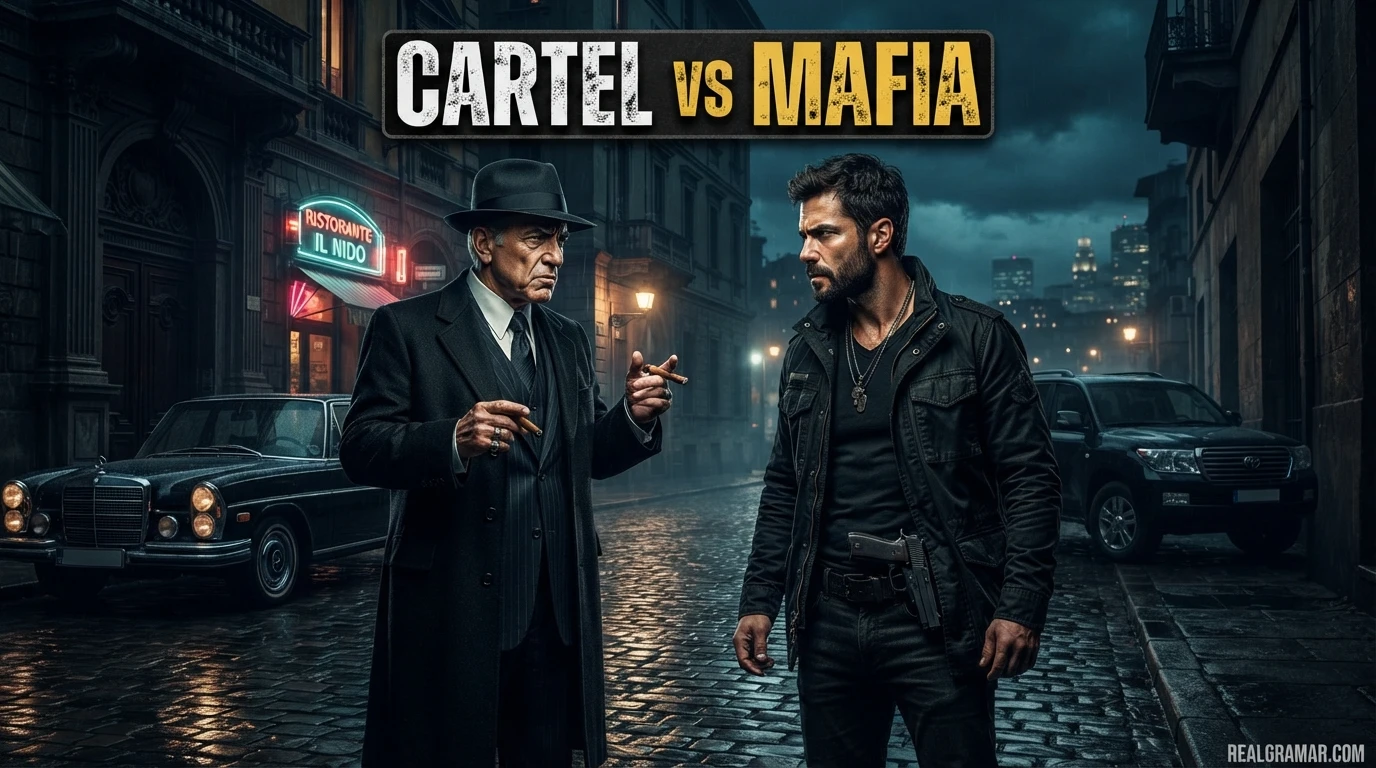
Language becomes more powerful when you understand the precise meaning of the words you use. Whether you’re reading news articles, writing essays, creating stories, or expanding your vocabulary, knowing the difference between similar terms helps you communicate more accurately. Many people mistakenly use cartel and mafia as interchangeable words because both are associated with organized crime. However, they have different origins, structures, goals, and meanings.
This guide explains what each term means, how they differ, when to use each one, and how to avoid common mistakes. Along the way, you’ll improve your writing skills, strengthen your vocabulary, and learn how to choose the right word in academic, journalistic, and creative writing.
What Is a Cartel?
A cartel is an organized group or alliance formed to control a market, industry, or illegal trade. While the word can describe legal business arrangements in economics, it is most commonly associated with criminal organizations involved in large-scale drug trafficking.
These organizations often operate across national borders and focus on generating profits through illegal commerce.
Key Characteristics
- Controls production or distribution
- Highly organized leadership
- Focuses on financial gain
- Often operates internationally
- May use violence to protect business interests
Example Sentences
- Authorities dismantled a major drug cartel operating across several countries.
- The documentary explained how the cartel expanded its influence.
- Governments continue working together to disrupt cartel activities.
What Is a Mafia?
A mafia refers to a secretive criminal organization, often built around family or ethnic connections. Unlike a cartel, a mafia traditionally controls territories through intimidation, extortion, corruption, and protection rackets.
The word originally referred to organized crime groups in Sicily before becoming a broader term for similar organizations worldwide.
Key Characteristics
- Family or clan-based structure
- Strong code of loyalty
- Controls local territories
- Engages in extortion and corruption
- Maintains secrecy and hierarchy
Example Sentences
- The novel tells the story of a powerful mafia family.
- Investigators uncovered evidence of mafia influence in local businesses.
- Several films portray the rise and fall of mafia leaders.
Quick Comparison Table
| Feature | Cartel | Mafia |
| Primary Goal | Control illegal markets | Control territory and criminal enterprises |
| Typical Activities | Drug trafficking, smuggling | Extortion, gambling, loan sharking, racketeering |
| Organization | Business-like network | Family-based hierarchy |
| Geographic Reach | Often international | Traditionally regional or local |
| Main Focus | Profit through trade | Power, influence, and criminal control |
| Origins | Economic term later linked to drug trade | Sicily, Italy |
| Membership | Professional criminal network | Family and trusted associates |
Historical Origins
Understanding the history behind these terms makes their meanings much clearer.
Origin of “Cartel”
The word originally described an agreement between competing businesses to regulate prices or production. Over time, the media began using it to describe large criminal organizations controlling illegal markets, particularly narcotics.
Origin of “Mafia”
The term originated in Sicily during the nineteenth century. It referred to secret criminal societies that gained influence through protection, intimidation, and political corruption. Today, it is used both historically and more generally for organized crime groups.
Organizational Structure
Although both are organized groups, they function differently.
Cartel Structure
- Executive leadership
- Financial managers
- Logistics coordinators
- Smuggling operations
- Armed enforcement units
Operations resemble a large business focused on maximizing revenue.
Mafia Structure
Traditional mafia organizations often include:
- Boss
- Underboss
- Consigliere (advisor)
- Captains
- Soldiers
- Associates
This hierarchy emphasizes loyalty, discipline, and long-term relationships.
Primary Activities
While there can be overlap, each organization is commonly associated with different criminal activities.
Cartels Commonly Engage In
- Drug production
- Drug trafficking
- International smuggling
- Money laundering
- Arms trafficking
Mafias Commonly Engage In
- Extortion
- Protection rackets
- Illegal gambling
- Loan sharking
- Fraud
- Political corruption
When to Use Each Term
Choosing the correct word depends on the context.
Use “Cartel” When
- Referring to drug trafficking organizations.
- Discussing illegal international trade.
- Writing about criminal networks driven primarily by commerce.
- Explaining market control in economics.
Use “Mafia” When
- Referring to traditional organized crime families.
- Discussing extortion or racketeering.
- Writing about Sicilian or Italian organized crime.
- Describing secret criminal societies with hierarchical leadership.
Tone and Writing Context
The choice between these terms can influence the tone of your writing.
| Writing Context | Better Choice |
| Academic essay | Use the historically accurate term |
| News article | Choose based on the organization’s activities |
| Creative writing | Depends on the story’s setting and culture |
| Historical writing | Use “mafia” for Sicilian organizations |
| Economics | Use “cartel” for business alliances where appropriate |
Being precise enhances credibility and clarity.
Sentence Examples
Using “Cartel”
- International agencies coordinated efforts against the cartel.
- The cartel controlled major trafficking routes.
- Financial investigators tracked cartel money across multiple countries.
- The report examined how the cartel recruited new members.
- Authorities seized assets connected to the cartel.
Using “Mafia”
- The mafia maintained influence through intimidation.
- Several witnesses testified against the mafia boss.
- Historians studied the origins of the Sicilian mafia.
- The mafia family expanded its criminal operations.
- The novel depicts life inside a fictional mafia organization.
Common Mistakes
Many learners misuse these terms because both relate to organized crime.
Mistake 1: Treating Them as Synonyms
Incorrect:
Every organized crime group is a mafia.
Better:
Different criminal organizations have different structures and purposes.
Mistake 2: Calling Every Drug Organization a Mafia
Many drug trafficking groups are more accurately described as cartels because they focus on controlling illegal markets rather than operating as traditional family-based organizations.
Mistake 3: Forgetting the Economic Meaning of “Cartel”
Not every cartel is criminal.
For example:
- Oil-producing countries may form a cartel to influence production and prices.
- Businesses can illegally create price-fixing cartels in violation of competition laws.
Mistake 4: Using the Terms Figuratively Without Context
Expressions like “coffee mafia” or “homework cartel” are humorous or figurative. Make sure readers understand that these are metaphors rather than references to actual criminal organizations.
Vocabulary Enhancement

Learning related words expands your understanding.
| Word | Meaning |
| Organized crime | Criminal activity carried out by structured groups |
| Syndicate | Organized criminal network |
| Smuggling | Secret transportation of illegal goods |
| Racketeering | Illegal business activities for profit |
| Extortion | Obtaining money through threats |
| Corruption | Abuse of power for personal gain |
| Trafficking | Illegal trade in goods or people |
| Money laundering | Hiding illegally obtained money |
| Criminal enterprise | Business-like illegal organization |
| Black market | Illegal buying and selling |
Practice Exercises
Exercise 1: Choose the Correct Word
- The international investigation targeted a large ______ involved in drug trafficking.
- The novel follows the rise of a powerful ______ family.
- Historians examined the origins of the Sicilian ______.
- Police uncovered evidence of a cross-border ______ network.
- Witnesses testified against the local crime ______.
Answers
- cartel
- mafia
- mafia
- cartel
- mafia
Exercise 2: True or False
- Every cartel is a mafia.
- Mafia organizations are traditionally family-based.
- Cartels often focus on controlling illegal markets.
- The word cartel can also have an economic meaning.
- Mafia originated in Sicily.
Answers
- False
- True
- True
- True
- True
FAQs
Is a cartel the same as a mafia?
No. A cartel usually focuses on controlling illegal markets, while a mafia traditionally operates through family-based organized crime, territorial control, and activities such as extortion and racketeering.
Can the word “cartel” be used legally?
Yes. In economics, a cartel can refer to businesses or organizations that cooperate to influence prices or production, although many such arrangements are illegal under competition laws.
Why are drug organizations often called cartels?
Because they are primarily organized around controlling the production, transportation, and distribution of illegal goods for profit.
Does every mafia operate in Italy?
No. Although the term originated in Sicily, it is now used more broadly for similar organized crime groups in different countries.
Which term should I use in academic writing?
Use the term that accurately describes the organization you are discussing. Precision improves clarity and credibility.
Conclusion
Although cartel and mafia are both associated with organized crime, they are not interchangeable. A cartel generally refers to an organization focused on controlling illegal markets and maximizing profits, while a mafia traditionally describes a family-based criminal network that exercises power through loyalty, intimidation, and territorial influence.
Understanding these distinctions helps students, writers, and English learners use the correct terminology in essays, reports, news discussions, and creative writing. By choosing words carefully and considering historical context, organizational structure, and purpose, you can communicate with greater accuracy and confidence while building a stronger, more precise vocabulary.
