
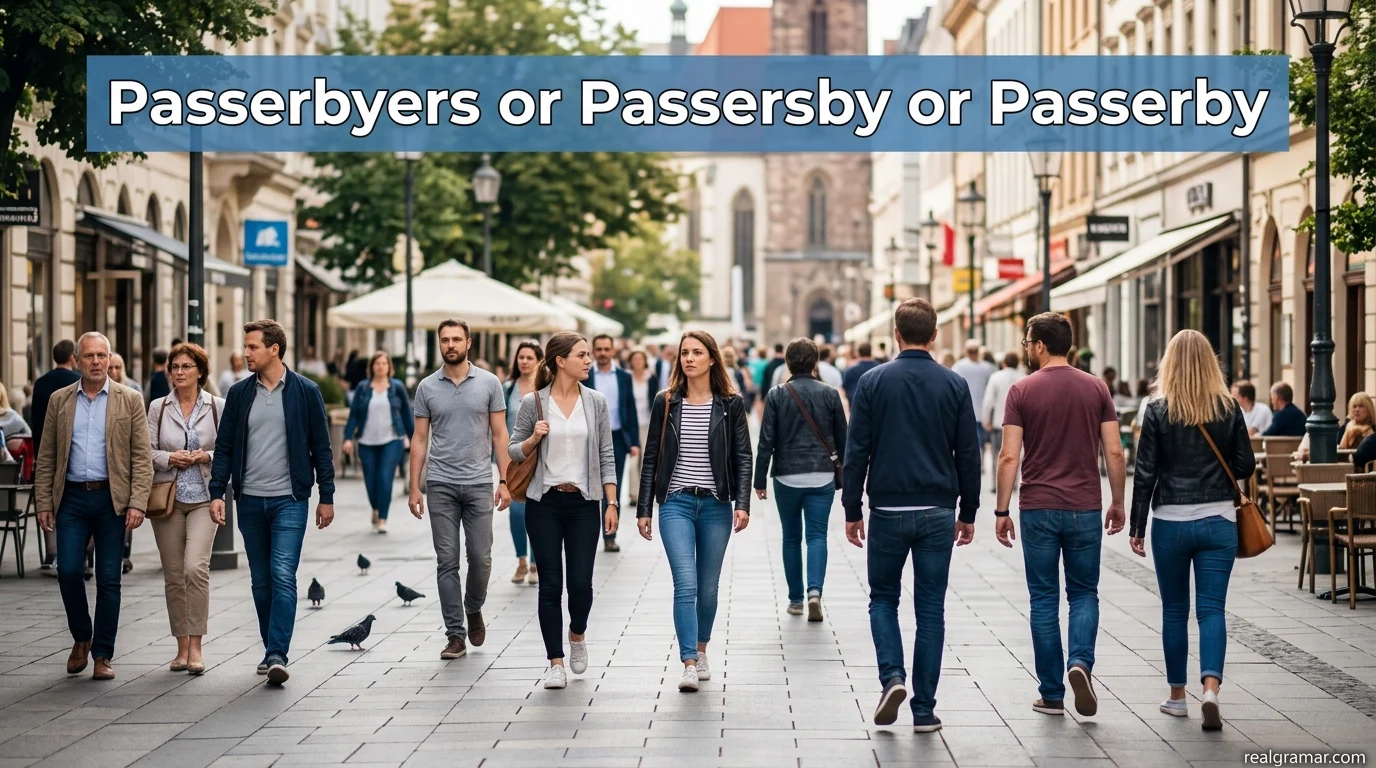
Imagine you’re walking down a bustling city street, crafting a vivid scene in your mind for your latest creative writing project. A crowd of people rushes past—but how do you describe them? Are they “passerbyers,” “passersby,” or simply “passerby”? This seemingly simple word trips up even experienced writers, leading to embarrassing errors that can undermine your writing skills and credibility.
In the world of vocabulary enhancement and descriptive language, mastering the correct forms of tricky words is essential. The confusion surrounding “passerby” stems from its unusual pluralization, which defies the standard rules of English grammar. This guide will help you navigate this linguistic puzzle while showing you how to use the word effectively in your writing, from sentence examples to figurative language and poetic expression.
For students, writers, and English learners, understanding the proper usage of “passerby” enhances your command of the language and adds precision to your descriptive writing. Whether you’re crafting a metaphor about the anonymity of city life or simply describing a scene, knowing the difference between “passerbyers,” “passersby,” and “passerby” ensures your writing remains polished and professional.
Passerbyers or Passersby or Passerby: The Correct Forms Explained
Let’s cut through the confusion immediately:
The correct singular form is “passerby.”
The correct plural form is “passersby.”
“Passerbyers” is NOT a correct word in standard English. It is a common error arising from attempting to pluralize an already pluralized form.
Why “Passersby” Is the Correct Plural
The word “passerby” is a compound noun made up of the verb “pass” and the adverb “by.” The person is one who “passes by.” When pluralizing compound nouns that consist of a noun plus a modifier, English often pluralizes the noun part . Therefore:
- Passerby = one who passes by
- Passersby = multiple people who pass by
This rule applies to other compound nouns as well:
- “Mother-in-law” → “mothers-in-law”
- “Attorney general” → “attorneys general”
- “Court martial” → “courts martial”
Why “Passerbyers” Is Incorrect
“Passerbyers” incorrectly treats the entire word “passerby” as a single unit and adds “-ers” to the end. This would be like saying “mother-in-laws” instead of “mothers-in-law”—it disregards the internal structure of the compound word.
A common mistake to avoid:
- ❌ “The passerbyers stopped to watch the street performer.”
- ✅ “The passersby stopped to watch the street performer.”
Quick Reference: Three Forms at a Glance

| Form | Correct? | Meaning | Example |
| Passerby | Yes | Singular—one person passing by | “A passerby helped the injured dog.” |
| Passersby | Yes | Plural—multiple people passing by | “Several passersby stopped to help.” |
| Passerbyers | No | Incorrect attempted plural | Never use this form |
Etymology and Historical Development
The word “passerby” first appeared in English during the 16th century . It’s a relatively straightforward compound, yet it has consistently troubled writers and speakers for generations.
The Structure
- Passer: This is a noun meaning “one who passes.” It comes from the Old French “passer,” which traces back to Latin “passus” (a step or pace) .
- By: An adverb meaning “near or past” .
- Combined: A passer-by is someone who passes by .
Evolution of Usage
The word has been written in various ways over time—”passer by,” “passer-by,” and “passerby” —though “passerby” is now the standard. The plural “passersby” has similarly undergone shifts, but the form that puts the “s” in the middle of the phrase has been the accepted version for centuries .
Common Spelling and Usage Mistakes
1: The “Passerbyers” Error
As noted, “passerbyers” is a common error. It likely arises from:
- Attempting to pluralize the word as a single unit
- Not recognizing that the “passer” part is a noun that must be pluralized
- Confusion with English words that form plurals by adding “-ers” to the end
2: Pluralizing the Wrong Part
- ❌ “There were many passerbies on the street.” (Incorrect—”passerbies” treats “passerby” as ending in “-y”)
- ❌ “Passerbys is the correct plural.” (Incorrect—the plural is “passersby”)
- ❌ “I saw several passerbyers during my walk.” (Incorrect—”passerbyers” is not a word)
3: Hyphenation and Spacing Issues
- ❌ “The passer by stopped.” (Incorrect—should be one word)
- ❌ “A passer-by waved.” (Acceptable but less common)
- ✅ “The passerby waved.” (Correct—one word without hyphen)
4: Subject-Verb Agreement
- ❌ “The passersby was walking quickly.” (Singular verb with plural subject)
- ✅ “The passersby were walking quickly.” (Plural verb with plural subject)
“Passerby” in Descriptive Language and Creative Writing

The concept of a passerby offers rich material for figurative language, literary devices, and poetic expression. The anonymity, transience, and potential for chance encounters make it a powerful element in creative writing.
Metaphor Examples Using “Passerby”
For life and existence:
- “We are all merely passersby in the theater of existence, entering and exiting the stage of life.”
- “Love is a passerby who might knock on your door but never stays.”
For anonymity:
- “He walked through the city as a passerby in his own life, a stranger to everyone he met.”
- “Fame is a passerby—it appears briefly, then moves on to the next person.”
Simile Examples Using “Passerby”
- “His attention drifted from one conversation to the next like a passerby window-shopping.”
- “The opportunities came and went like passersby on a busy street—there one moment, gone the next.”
- “Her thoughts were like passersby, each one appearing briefly before being replaced by the next.”
Personification
- “The city streets watched the passersby with indifference, each face just another moving blur.”
- “The pavement remembered the footsteps of every passerby who had crossed it.”
Poetic Expression
“Passersby on the city street,
Each a story, none complete.
Faces fading into the throng,
Silent footsteps, short and long.”
“I am but a passerby,
A question mark against the sky.
I pause, I pass, I disappear—
A whisper only time can hear.”
Descriptive Language for Scenes
Using “passersby” effectively in descriptive writing creates vivid imagery:
Neutral description: “Passersby hurried along the rain-slicked sidewalk, umbrellas bobbing like dark mushrooms.”
Emotional description: “The heartbroken man sat on the bench, oblivious to the stream of passersby flowing around him.”
Mysterious description: “Among the ordinary passersby, one figure moved with an unnatural stillness that made her seem apart from the crowd.”
“Passerby” in Different Contexts and Tones
When to Use “Passerby” and “Passersby”
Use these words when:
- Describing people moving past in an urban or public setting
- Discussing chance encounters or witnesses
- Creating atmosphere of anonymity or transience
- Setting a scene of everyday life
When to Avoid
Avoid using “passerby” when:
- The people are not moving or passing through
- You’re referring to a specific, named individual
- The context calls for a more formal term like “observer” or “witness”
- You need to emphasize speed or movement (use “pedestrian” for someone walking)
Tone Variations
Formal/Legal: “The accident was witnessed by a passerby who provided a statement to the police.”
Descriptive: “The street performer attracted a crowd of curious passersby.”
Poetic: “The silent passerby left only footprints on the path of memory.”
Colloquial: “A random passerby gave me directions when I was lost.”
Literary: “He existed as a mere passerby in the crowded narrative of city life.”
Literary Devices and Advanced Usage
Alliteration
- “Several silent passersby strolled slowly.”
- “Passersby paused, perplexed by the performance.”
Oxymoron with “Passerby”
- “The familiar passerby” (someone who passes by but is recognized)
- “The static passerby” (someone who passes by but remains in place figuratively)
Hyperbole
- “A million passersby flowed through Times Square, each one a universe of dreams.”
- “The lonely man felt invisible to the countless passersby who ignored him.”
Symbolism
In literature, the passerby often symbolizes:
- Anonymity: The loss of individual identity in modern society
- Transience: The fleeting nature of human existence
- Opportunity: The passing moment that must be seized
- Indifference: Society’s lack of concern for the individual
- The unknown: Strangers who might bring change or danger
Comparison with Related Terms

| Term | Meaning | Key Difference |
| Passerby | Someone passing by | General term, neutral |
| Pedestrian | Someone walking, especially in a city | Emphasizes the act of walking |
| Stranger | An unknown person | Doesn’t imply movement |
| Witness | Someone who sees an event | Implies observation, not passing |
| Bystander | Someone present at an event | Implies standing still, not passing |
| Observer | Someone watching | Focuses on watching rather than moving |
| Wayfarer | A traveler on foot | Suggests a journey, not a short passage |
| Stroller | Someone walking leisurely | Implies slow, casual movement |
Common Mistakes in Detail
The “Passerbyers” Error in Depth
This error is particularly common among:
- Students: Not yet familiar with compound noun pluralization rules
- Non-native English speakers: More likely to follow the “add -s” rule automatically
- Writers typing quickly: “Passerbyers” might look correct to the untrained eye
Why it’s so persistent:
- The word looks like it should be pluralized by adding “-s” to the end
- Many English words form plurals this way (dogs, cats, houses)
- The “passerby” structure isn’t obvious to all English speakers
The “Passerbies” Error
Some writers mistakenly treat “passerby” as a word ending in “-y” and change it to “-ies.” This is incorrect because:
- The word doesn’t end in a “-y” sound in a way that triggers that rule
- The final part is “by,” not “-by” as a suffix
Hyphenation Confusion
- “Passer-by” was historically common but has largely been replaced by “passerby”
- Modern style guides (including APA and MLA) prefer “passerby” without a hyphen
- However, both forms are considered acceptable in many contexts
Practical Exercises for Mastering “Passerby”
Exercise 1: Singular vs. Plural Identification
Identify whether each sentence should use “passerby” or “passersby”:
- “A _____ noticed the lost child.”
- “Several _____ gathered around the accident.”
- “Each _____ seemed lost in their own world.”
- “The _____ were oblivious to the disturbance.”
Answers: 1. passerby, 2. passersby, 3. passerby, 4. passersby
Exercise 2: Error Correction
Correct the errors in these sentences:
- “The passerbyers were shocked by the sudden noise.”
- “I saw three passerbies at the bus stop.”
- “A passerby helped me with my groceries.”
- “The passerbys were in a hurry.”
Answers:
- “The passersby were shocked by the sudden noise.”
- “I saw three passersby at the bus stop.”
- Correct as written.
- “The passersby were in a hurry.”
Exercise 3: Creative Writing Practice
Write a short paragraph describing a busy city scene using “passerby” or “passersby” at least three times. Include at least one simile or metaphor.
Exercise 4: Context Identification
For each context, choose the most appropriate term from the comparison table:
- A description of daily commuters walking to work → pedestrian
- A poetic reflection on life’s transience → passerby
- A courtroom statement about an event → witness
- A leisurely walk in the park → stroller
Exercise 5: Sentence Creation
Write five original sentences using “passerby” (singular) and five using “passersby” (plural). Try to vary the contexts and tones.
The Role of “Passerby” in Figurative Language
Understanding “passerby” isn’t just about grammar—it’s about how this concept enriches your writing. Here are advanced applications:
In Similes
- “The tourists moved through the museum like passersby in a dream, seeing but not really seeing.”
- “Her words were like passersby, entering one ear and exiting the other.”
In Metaphors
- “He was a passerby in his own life, never really belonging anywhere.”
- “Joy is a passerby that visits but never stays.”
Personification
- “The wind moved through the empty square like a solitary passerby, searching for company.”
- “The autumn leaves danced like distracted passersby, swirling and then settling.”
In Idioms and Expressions
While “passerby” itself isn’t an idiom, it appears in expressions like:
- “To be a mere passerby in history” (to have no lasting impact)
- “A passerby’s witness” (chance observation)
- “The passing parade” (life as a procession of passersby)
FAQs
1. Why is “passerbyers” incorrect?
“Passerbyers” incorrectly pluralizes an already pluralized compound word. “Passerby” consists of “passer” (one who passes) and “by.” The correct plural is “passersby” because the noun part “passer” becomes “passers.” “Passerbyers” treats the whole word as a single unit, which violates English compound noun pluralization rules.
2. Is “passer-bys” ever acceptable?
No. While hyphenated forms exist (“passer-by” and “passers-by”), the “s” must be attached to “passer” or “passers,” not to “by.” Therefore, “passer-bys” is incorrect. The correct hyphenated forms are “passer-by” (singular) and “passers-by” (plural).
3. How do I remember the correct plural form?
Think of “passerby” as “one who passes by.” For multiple people, it’s “people who pass by” → “passersby.” Another memory aid: you wouldn’t say “mother-in-laws” (correct: “mothers-in-law”), so don’t say “passerbyers” (correct: “passersby”).
4. Is “passerby” formal or informal language?
“Passerby” is neutral—it works in both formal and informal contexts. In legal writing, you might see “passerby” in witness statements. In creative writing, it appears in poetry and prose, In journalism, it’s standard for describing eyewitnesses or crowd scenes. It’s not overly casual or overly formal.
5. What’s the difference between “passerby” and “bystander”?
A “passerby” is someone who passes by a place, often moving through. A “bystander” is someone who is present at an event but not necessarily passing through—they might be standing still. “Bystander” often implies witnessing something significant; “passerby” suggests transience and movement. All passersby could be bystanders if they stop, but not all bystanders are passersby.
Quick Comparison Tables
Correct Forms at a Glance
| Form | Correct? | Part of Speech | Example |
| Passerby | ✅ Yes | Singular noun | “A passerby saw the accident.” |
| Passersby | ✅ Yes | Plural noun | “Passersby were shocked.” |
| Passerbyers | ❌ No | None | Never use this form |
| Passer-by | ✅ Yes (less common) | Singular noun | “A passer-by offered help.” |
| Passers-by | ✅ Yes (less common) | Plural noun | “Many passers-by stopped.” |
| Passerbys | ❌ No | None | Incorrect plural |
Related Terms Comparison
| Term | Definition | Emphasizes |
| Passerby | Someone passing by | Movement and transience |
| Bystander | Someone present but not involved | Observation and presence |
| Pedestrian | Someone walking | The act of walking |
| Witness | Someone who sees an event | Observation and potential testimony |
| Stranger | Unknown person | Unfamiliarity |
Summary and Key Takeaways
What You’ve Learned
- The correct singular is “passerby” and the correct plural is “passersby.”
- “Passerbyers” is NEVER correct—it’s a common but serious error.
- The word follows the rule for pluralizing compound nouns where the noun part is pluralized (like “mothers-in-law”).
- “Passerby” offers rich potential for figurative language, metaphors, similes, and poetic expression.
- Context matters—”passerby” works in many contexts but isn’t always the best choice.
Final Tips
- For singular: Always use “passerby” (or “passer-by” in British-style writing).
- For plural: Always use “passersby” (or “passers-by” in British-style writing).
- Never use “passerbyers”—it marks you as someone who hasn’t mastered this rule.
- Read widely to see how accomplished writers use this word.
- Practice regularly with the exercises above.
Conclusion
The confusion between “passerbyers,” “passersby,” and “passerby” reflects a common challenge in English grammar—understanding how to pluralize compound nouns. For students, writers, and English learners, mastering this distinction enhances writing skills, vocabulary enhancement, and overall credibility.
Beyond mere grammar, the concept of the passerby offers powerful possibilities for creative writing. From metaphors about life’s transience to vivid descriptive language about city scenes, this simple word can enrich your descriptive language and figurative expression. Whether you’re crafting a simile about fleeting opportunities or a poem about urban anonymity, “passerby” belongs in your literary toolkit.
Remember: “passerby” for one, “passersby” for many, and “passerbyers” for never. With this guide, you can confidently use this tricky word in your writing, knowing you’ve mastered one of English’s more challenging grammatical puzzles. And the next time you see a crowd of people moving past, you’ll have the perfect word to describe them—no matter how many of them there are.
