
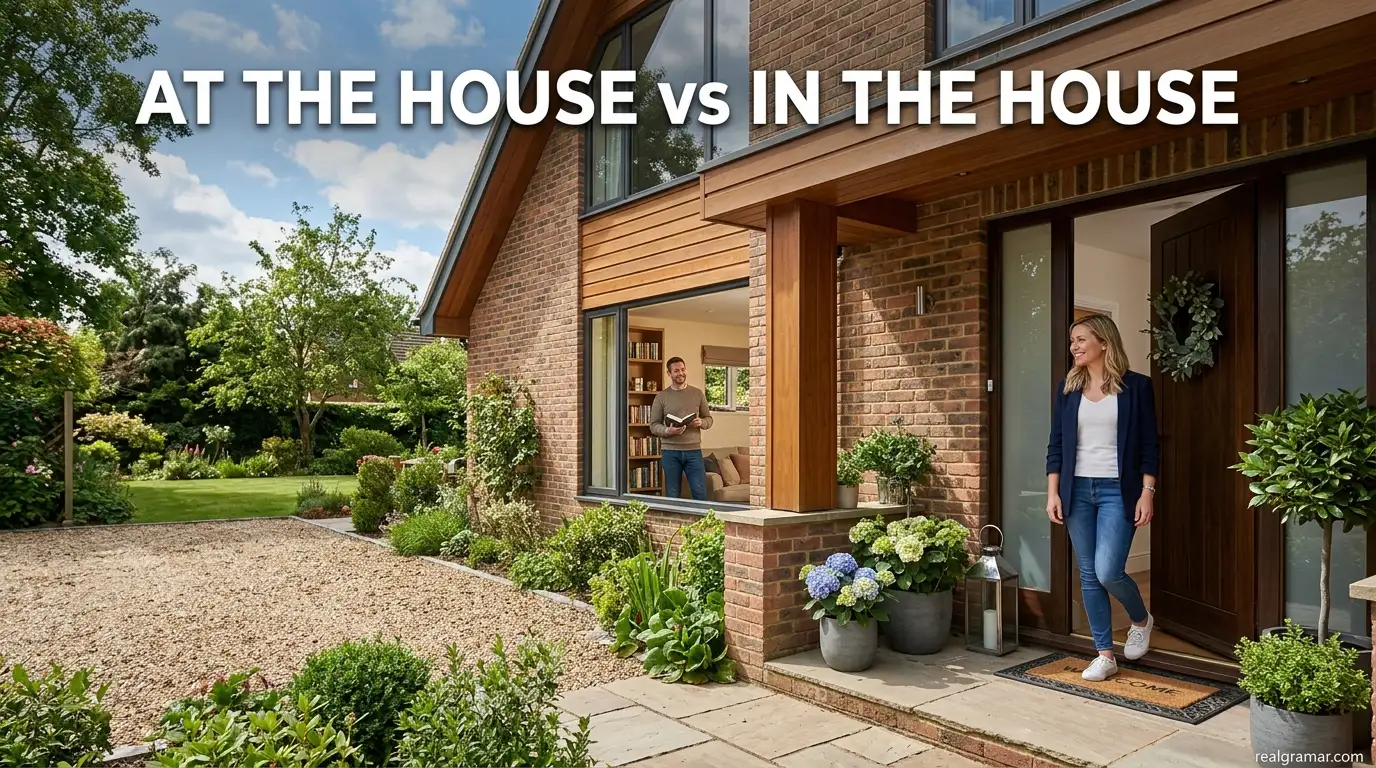
Learning English is about more than memorizing vocabulary—it’s about understanding how small word choices can completely change meaning. One of the most common questions English learners ask is whether they should say “at the house” or “in the house.” Although these phrases look similar, they describe different ideas and are used in different situations.
Mastering this distinction improves your grammar, strengthens your writing skills, and helps you sound more natural in both speaking and writing. Whether you’re writing essays, telling stories, improving your creative writing, or simply having conversations, choosing the correct preposition makes your message clearer.
Many learners confuse these expressions because both refer to a house. However, English prepositions describe different relationships such as location, position, movement, presence, and context. Once you understand these relationships, deciding which phrase to use becomes much easier.
In this guide, you’ll discover clear explanations, comparison examples, sentence examples, common mistakes, practical exercises, and writing tips that will help you confidently use both expressions.
What Does “At the House” Mean?
The phrase “at the house” refers to someone’s location or presence near or at a particular house. It does not necessarily mean the person is inside the building.
Think of it as describing a destination or general location.
Simple Definition
At the house = Located at that property or location.
The person may be:
- Standing outside
- In the driveway
- On the porch
- In the backyard
- Inside the house
- Somewhere on the property
The exact position isn’t important.
Examples
- I’m at the house waiting for everyone.
- She’s at the house fixing the garden.
- The delivery driver arrived at the house.
- We met at the house before the trip.
- They’re still at the house after the party.
- I’ll see you at the house around 6 PM.
- The children are at the house playing outside.
- Everyone gathered at the house before dinner.
- The electrician is at the house today.
- Is Dad at the house yet?
Notice that none of these examples tell us whether the person is inside.
What Does “In the House” Mean?
The phrase “in the house” specifically means someone or something is inside the building.
This expression focuses on the physical interior.
Simple Definition
In the house = Inside the building.
Examples
- Everyone is in the house because it’s raining.
- I left my wallet in the house.
- The dog is sleeping in the house.
- Nobody was in the house when I arrived.
- She’s cooking in the house.
- The lights are on in the house.
- There are three bedrooms in the house.
- The kids stayed in the house all afternoon.
- We spent the evening in the house watching movies.
- Someone is moving around in the house.
Unlike “at the house,” this phrase clearly tells the listener the location is indoors.
At the House vs In the House: Quick Comparison
| Feature | At the House | In the House |
| Location | General property | Inside building |
| Focus | Place or destination | Interior location |
| May be outdoors? | ✅ Yes | ❌ No |
| May be indoors? | ✅ Yes | ✅ Yes |
| Indicates exact position? | No | Yes |
| Common in directions? | Yes | Rarely |
| Used for arrivals? | Yes | Usually no |
| Describes interior? | No | Yes |
The Main Difference Explained

The easiest way to remember these expressions is this:
Use at when talking about the place.
Example:
I’m at the house.
The listener only knows where you are generally.
Use in when talking about being inside.
Example:
I’m in the house.
Now the listener knows you’re indoors.
Think about it like this:
- At = location
- In = inside
That simple rule works in most everyday situations.
Visualizing the Difference
Imagine a family home.
Someone says:
“I’m at the house.”
Possible locations include:
- Front porch
- Garage
- Backyard
- Driveway
- Living room
- Kitchen
All are possible because “at” refers to the property.
Now imagine someone says:
“I’m in the house.”
Possible locations include:
- Kitchen
- Bedroom
- Bathroom
- Living room
- Basement
- Hallway
Notice every location is indoors.
Sentence Comparison Examples
Looking at both phrases side by side makes the difference much easier to understand.
| At the House | In the House |
| I’m at the house waiting for you. | I’m in the house watching TV. |
| She’s at the house now. | She’s in the house now. |
| The plumber is at the house. | The plumber is in the house fixing the sink. |
| We met at the house. | We stayed in the house all day. |
| Everyone is at the house. | Everyone is in the house because it’s cold. |
| The police arrived at the house. | The police searched in the house. |
| I’ll be at the house tonight. | I’ll be in the house after dinner. |
| Guests are at the house already. | Guests are in the house eating dinner. |
Notice how “in the house” usually provides a stronger picture of what’s happening.
When to Use “At the House”
Choose “at the house” when discussing:
1. Arriving somewhere
Examples:
- We arrived at the house early.
- The movers are at the house.
- The guests are at the house already.
2. Giving someone’s location
Examples:
- Dad is at the house.
- She’s at the house now.
- Everyone’s at the house.
3. Meeting people
Examples:
- Let’s meet at the house.
- I’ll wait at the house.
- Meet us at the house after work.
4. Talking about appointments
Examples:
- The inspector is at the house.
- The electrician will be at the house tomorrow.
- The cleaners arrived at the house.
Writing Tip
Professional writing often uses “at the house” because the exact indoor or outdoor location doesn’t matter.
Example:
The repair technician arrived at the house at 9:00 AM.
This sounds more natural than:
The repair technician arrived in the house.
When to Use “In the House”
Use “in the house” whenever the inside location matters.
Examples include:
- describing activities indoors
- describing objects indoors
- describing people inside
- describing movement inside rooms
- emphasizing shelter from weather
Examples
- The children are in the house reading.
- There’s no food in the house.
- Someone is singing in the house.
- We stayed in the house because it snowed.
- There’s a strange noise in the house.
- My keys are somewhere in the house.
- Everyone remained in the house during the storm.
- They decorated every room in the house.
Writing Skills Tip
Strong writers choose prepositions carefully because they create more accurate descriptions.
Compare these two sentences:
The detective waited at the house.
The detective could be outside.
Now compare:
The detective waited in the house.
Now readers imagine the detective indoors, creating a completely different scene.
This small change adds precision and improves descriptive language, making your creative writing more vivid and engaging.
Common Mistakes English Learners Make

Even advanced English learners sometimes confuse “at the house” and “in the house.” The good news is that most mistakes follow predictable patterns. Once you recognize them, they become easy to avoid.
Mistake 1: Using “in” for arrival
❌ I arrived in the house at 6 PM.
✅ I arrived at the house at 6 PM.
Why?
“Arrive” usually refers to reaching a destination, not entering the building.
Mistake 2: Using “at” when talking about indoor activities
❌ We’re eating dinner at the house.
✅ We’re eating dinner in the house.
If you’re emphasizing that the activity is taking place indoors, in is the correct choice.
Mistake 3: Forgetting context
Sometimes both expressions are grammatically correct—but they communicate different ideas.
Example:
“I’m waiting at the house.”
You might be outside.
“I’m waiting in the house.”
You’re definitely indoors.
Always ask yourself:
Am I talking about the property or the inside of the building?
How Native English Speakers Use These Expressions
One of the easiest ways to sound natural is to understand how native speakers actually use these phrases.
Everyday Conversation
Friend:
Where are you?
You:
I’m at the house.
This simply tells your location.
Friend:
Where exactly?
You:
I’m in the house.
Now you’ve given a more specific answer.
Phone Conversations
- “I’m already at the house.”
- “Nobody’s in the house.”
- “Meet me at the house.”
- “Come inside—the kids are in the house.”
Notice how native speakers switch naturally depending on whether they’re describing the property or the interior.
Grammar Rule Behind the Difference
Understanding the grammar makes these expressions much easier to remember.
“At” = Point or Destination
English uses at for:
- addresses
- buildings
- schools
- stations
- airports
- stores
- homes
Examples:
- at school
- at work
- at the office
- at the station
- at home
- at the house
The focus is where, not inside.
“In” = Enclosed Space
English uses in for enclosed areas.
Examples:
- in the room
- in the building
- in the kitchen
- in the office
- in the classroom
- in the house
The focus is being physically surrounded by walls.
Real-Life Situations
Let’s compare common situations.
Situation 1: Pizza Delivery
Driver calls.
“I’m at the house.”
The driver is outside.
Situation 2: Family Dinner
Mom says:
“Everyone’s in the house.”
Everyone is indoors.
Situation 3: Visiting Friends
Text message:
“I’m at the house.”
You may still be parking.
Situation 4: Storm Warning
Announcement:
“Stay in the house.”
The instruction is to remain indoors.
Situation 5: Repair Appointment
“The plumber is at the house.”
The plumber may still be unloading tools.
Later:
“The plumber is in the house fixing the sink.”
Now he’s inside.
Formal vs Informal Usage

Both expressions are acceptable in formal and informal English.
| Situation | At the House | In the House |
| Conversation | ✅ | ✅ |
| Essays | ✅ | ✅ |
| Emails | ✅ | ✅ |
| Stories | ✅ | ✅ |
| Business writing | ✅ | ✅ |
| Reports | ✅ | ✅ |
The difference isn’t about formality.
It’s about meaning.
Comparison Examples
These sentence pairs highlight how one small preposition changes the picture.
Example 1
✅ She waited at the house.
She may be outside.
✅ She waited in the house.
She’s definitely indoors.
Example 2
✅ We gathered at the house.
Everyone met there.
✅ We gathered in the house.
Everyone gathered inside.
Example 3
✅ The police arrived at the house.
They reached the property.
✅ The police searched in the house.
The search happened indoors.
Example 4
✅ My brother is at the house.
General location.
✅ My brother is in the house.
Specific indoor location.
Example 5
✅ I’ll meet you at the house.
Meeting place.
✅ I’ll see you in the house.
You’ll meet after entering.
Writing Skills: Choosing the Right Preposition
Professional writers don’t choose prepositions randomly.
They think about what they want readers to imagine.
General Setting
We stopped at the house after work.
Readers imagine arriving.
Interior Scene
We relaxed in the house after work.
Readers imagine being inside.
This small choice creates stronger descriptive language, making your writing clearer and more engaging.
Creative Writing Examples

The correct preposition helps shape the reader’s mental image.
Example 1
She stood at the house, afraid to knock.
The suspense happens outside.
Example 2
She stood in the house, listening to every sound.
The tension moves indoors.
Example 3
The lights glowed warmly at the house as we approached.
The house is viewed from a distance.
Example 4
Laughter echoed in the house, filling every room.
The focus is on the interior atmosphere.
Tone and Context
The choice of preposition also affects tone.
| Tone | Better Choice |
| Giving directions | At the house |
| Talking about arrival | At the house |
| Describing indoor action | In the house |
| Building suspense indoors | In the house |
| Talking about property | At the house |
| Talking about rooms | In the house |
Matching the preposition to the context makes your English sound much more natural.
Quick Memory Trick
If you’re unsure which phrase to use, remember this simple rule:
Think of the question you’re answering.
Where is the person generally?
➡️ At the house
Where exactly is the person?
➡️ In the house
Another easy way to remember:
- At = Address
- In = Inside
This simple association works in most everyday situations and helps you choose the correct phrase quickly.
Advanced Usage and Special Situations

Once you’ve mastered the basic difference between “at the house” and “in the house,” you’ll notice that native English speakers sometimes choose one over the other depending on context rather than strict grammar. Understanding these subtle differences will make your English sound more fluent and natural.
Talking About Events
When referring to a gathering or event, “at the house” is usually the better choice because the focus is on the location of the event.
Examples:
- We had a barbecue at the house.
- Everyone met at the house before the wedding.
- The birthday party started at the house around noon.
- We spent Christmas Eve at the house with family.
- They hosted the reunion at the house.
Although people were eventually inside, the emphasis is on the venue, not the interior.
Talking About Objects
When discussing where an object is located inside a home, use “in the house.”
Examples:
- My laptop is in the house.
- There’s fresh coffee in the house.
- I can’t find my glasses in the house.
- Every room in the house has large windows.
- There’s a strange smell in the house.
The location is clearly indoors.
Talking About Pets
Examples:
- The dog is in the house sleeping.
- The cat stayed in the house all day.
- Our puppy refuses to stay in the house during storms.
- There’s a bird in the house!
- Please keep the puppy in the house tonight.
Again, the focus is on being inside.
Figurative Language and Creative Writing
Although “at the house” and “in the house” are primarily literal expressions, skilled writers often use them to create mood, symbolism, and atmosphere.
Using precise prepositions enhances descriptive language, improves creative writing, and strengthens writing skills by helping readers visualize scenes more clearly.
Example
She stood at the house, unsure whether to return to the life she had left behind.
Here, “at the house” symbolizes hesitation and standing on the threshold of a decision.
Another example:
Silence filled every corner in the house, reminding him of happier days.
The phrase emphasizes the emotional atmosphere inside the home.
Small grammatical choices often support larger literary effects.
Literary Devices and Descriptive Language
Strong writers use accurate location words to strengthen literary devices such as imagery and symbolism.
Imagery
Example:
Rain tapped softly on the windows in the house.
Readers can almost hear the sound.
Symbolism
Example:
She waited at the house, afraid that opening the door would change everything.
The house symbolizes a turning point.
Contrast
Example:
He smiled at the house, but cried once he was in the house.
The contrast between outside appearance and inner reality creates emotional depth.
Simile Examples
Although these expressions are not similes themselves, they often appear within similes.
Examples:
- She stood at the house like a lost traveler.
- The children ran in the house like excited puppies.
- Silence spread in the house like snowfall.
- He waited at the house like a patient guard.
- The music echoed in the house like gentle rain.
These comparisons make writing more vivid and engaging.
Metaphor Examples
Likewise, writers can combine these expressions with metaphors.
Examples:
- The house was a sanctuary, and everyone in the house felt safe.
- Standing at the house was standing at the edge of a new beginning.
- Hope lived in the house.
- Fear waited at the house every evening.
- Memories slept in the house.
These metaphors add emotional and poetic expression to your writing.
Idioms Related to Houses

While “at the house” and “in the house” are not idioms, English has many house-related idiomatic expressions that learners should know.
| Idiom | Meaning | Example |
| Make yourself at home | Feel comfortable | Please make yourself at home. |
| Bring the house down | Receive huge applause | The comedian brought the house down. |
| House of cards | Weak situation | His argument was a house of cards. |
| On the house | Free of charge | Dessert is on the house. |
| Keep house | Manage a home | She keeps house for her family. |
Learning related idioms expands your vocabulary and helps you understand natural English conversations.
Vocabulary Enhancement
Here are useful words often associated with houses and locations.
| Word | Meaning |
| Residence | A place where someone lives |
| Property | Land and buildings |
| Home | A place of comfort and living |
| Building | A physical structure |
| Dwelling | A place where people live |
| Interior | Inside part of a building |
| Exterior | Outside part of a building |
| Entrance | The way into a building |
| Porch | Covered area outside a house |
| Driveway | Private road leading to a house |
Using a wider range of vocabulary makes your writing richer and more professional.
Practice Exercises
Exercise 1
Choose the correct phrase.
- The delivery driver is ________.
a) at the house
b) in the house
Answer: at the house
- The children are playing ________.
a) in the house
b) at the house
Answer: in the house
- I’ll meet you ________ after work.
a) at the house
b) in the house
Answer: at the house
- There’s a spider ________.
a) in the house
b) at the house
Answer: in the house
- Everyone gathered ________ before leaving.
a) at the house
b) in the house
Answer: at the house
Fill in the Blanks
Choose at or in.
- We arrived ____ the house before sunset.
at
- Nobody was ____ the house during the storm.
in
- The electrician is ____ the house today.
at
- The children are sleeping ____ the house.
in
- I’ll wait ____ the house until you arrive.
Answer: at
Quick Review Table

| Situation | Correct Expression |
| Arriving at a location | At the house |
| Waiting outside | At the house |
| Meeting someone | At the house |
| Inside the kitchen | In the house |
| Watching TV indoors | In the house |
| Looking for your keys indoors | In the house |
| Delivery reaches the property | At the house |
| Family eating dinner inside | In the house |
Key Takeaways
Before you finish, remember these simple rules:
- At the house refers to the property or general location.
- In the house refers to the inside of the building.
- Use at when talking about arrival, destinations, meetings, or general presence.
- Use in when describing activities, objects, or people located indoors.
- Context matters. Sometimes both are grammatically correct, but each creates a different meaning.
- Choosing the correct preposition improves clarity, descriptive language, and overall writing quality.
In the final part, we’ll cover five frequently asked questions (FAQs), additional comparison tips, a final summary, and a strong conclusion to reinforce everything you’ve learned.
Quick Comparison Cheat Sheet
If you’re ever unsure which phrase to use, this quick reference can help you decide in seconds.
| If You Mean… | Use | Example |
| A general location | At the house | I’m at the house waiting for you. |
| Inside the building | In the house | Everyone is in the house. |
| A meeting place | At the house | Let’s meet at the house. |
| An indoor activity | In the house | We’re eating in the house. |
| Someone arriving | At the house | The guests are at the house. |
| Something located indoors | In the house | My phone is in the house. |
| A delivery destination | At the house | The package arrived at the house. |
| A room or interior | In the house | There’s music in the house. |
The One-Minute Rule
Ask yourself these two questions:
- Am I talking about the property or destination? → At the house
- Am I talking about being inside the building? → In the house
This simple habit will help you choose the correct preposition almost every time.
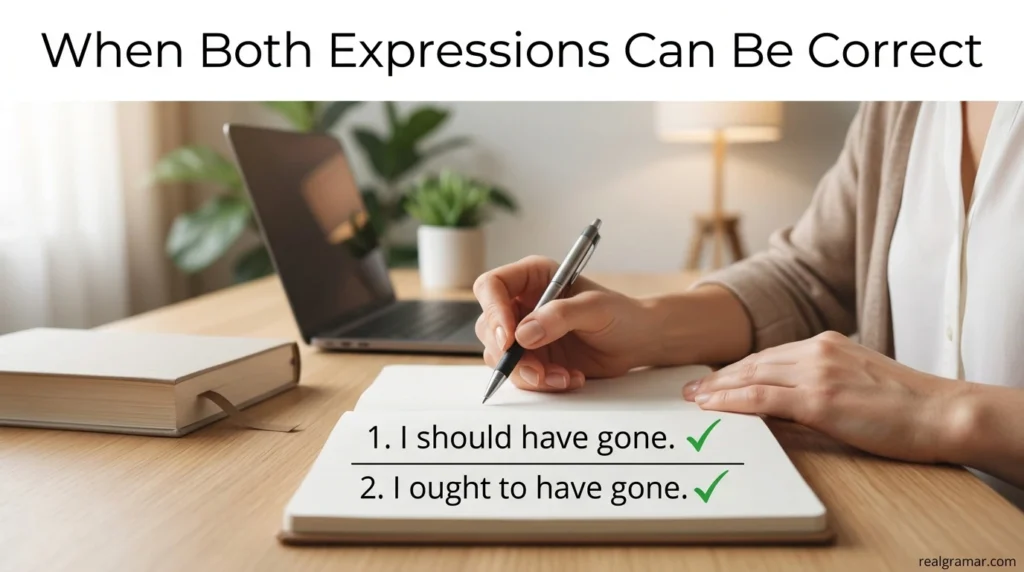
In some situations, both phrases are grammatically correct, but they highlight different perspectives.
Example 1
I’m at the house.
This simply tells someone where you are.
I’m in the house.
This tells them exactly where you are—inside.
Example 2
She’s waiting at the house.
She could be on the porch, in the driveway, or inside.
She’s waiting in the house.
She is definitely indoors.
Example 3
is at the house.
family is on the property.
family is in the house.
The family is inside the home.
Understanding this subtle difference helps you communicate more naturally and accurately.
Writing Tips for Students and English Learners
Small grammar choices can have a big impact on your writing. Here are a few practical tips to improve your accuracy.
1. Think About the Reader
Choose the preposition that gives your reader the clearest picture.
- If the exact indoor location matters, use in.
- If you’re simply referring to the place, use at.
2. Read Your Sentence Aloud
Hearing the sentence often makes the correct choice obvious.
For example:
- “The guests arrived at the house.” ✔️
- “The guests arrived in the house.” ✖️ (less natural)
3. Learn Common Collocations
English relies on common word partnerships.
Examples include:
- arrive at the house
- wait at the house
- stay in the house
- sleep in the house
- live in the house
Learning these combinations will make your English sound much more fluent.
4. Use Context Clues
Ask:
- Is someone traveling to a place?
- Are they already inside?
Your answer determines the correct preposition.
Practice Challenge
Choose the correct expression before checking the answers.
- We left our shoes ________.
- The guests arrived ________ at noon.
- There’s nobody ________ today.
- I’ll meet you ________ after work.
- We spent the weekend ________ because it snowed.
Answers
- in the house
- at the house
- in the house
- at the house
- in the house
FAQs
1. Is “at the house” grammatically correct?
Yes. It refers to someone’s general location or the property itself. The person may be inside or outside.
2. Is “in the house” grammatically correct?
Absolutely. It specifically means someone or something is inside the building.
3. Can I use both expressions in the same conversation?
Yes. Native speakers often switch between them depending on the context.
Example:
“I’m at the house now. Come inside—I’m in the house.”
4. Which expression is more common?
Both are very common. The choice depends entirely on what you’re describing.
- Use at for locations and destinations.
- Use in for interior spaces.
5. How can I remember the difference easily?
Remember this simple formula:
- At = Address or destination
- In = Inside
If you’re talking about the property, choose at. If you’re talking about the interior, choose in.
Final Summary
Understanding the difference between at the house and in the house is a small but important step toward mastering English prepositions. Although the phrases are closely related, they describe different relationships with a location.
Use at the house when referring to a general place, destination, or property. Use in the house when referring specifically to the inside of the building. Paying attention to this distinction will improve your grammar, make your writing more precise, and help you communicate with greater confidence.
Whether you’re writing essays, improving your creative writing, preparing for exams, or simply having everyday conversations, choosing the right preposition allows your ideas to sound more natural and professional.
The more you read, write, and practice these expressions in real-life situations, the more instinctive they’ll become. Over time, you’ll notice that accurate preposition use strengthens not only your grammar but also your overall writing skills, vocabulary, and descriptive language—making your English clearer, more engaging, and more effective.
