
Have you ever typed a sentence and paused to wonder whether “soo” or “so” is correct? It’s a surprisingly common question, especially in texting, social media, and informal online conversations. Many English learners, students, and even experienced writers occasionally encounter this confusion because digital communication has blurred the line between standard spelling and expressive writing.
Learning the correct word choice is one of the easiest ways to improve your writing skills. Whether you’re writing an essay, email, story, blog post, or social media caption, using the right spelling helps readers understand your message clearly and makes your writing appear more polished and professional.
Beyond grammar, strong writing also relies on figurative language, descriptive language, literary devices, and thoughtful vocabulary choices. These elements transform ordinary sentences into memorable ones, helping writers create emotion, paint vivid images, and communicate ideas effectively. Understanding when a word belongs in formal English and when it’s simply an informal stylistic choice is an important step toward becoming a confident communicator.
In this guide, you’ll learn the meaning of each term, see practical comparison examples, explore sentence examples for different situations, understand tone and style, avoid common mistakes, and discover how this distinction fits into creative writing, poetic expression, idioms, similes, metaphors, and everyday English.
Understanding the Difference Between Soo and So
At first glance, these two spellings look almost identical. However, only one belongs to standard English.
| Feature | So | Soo |
| Standard English word | ✅ Yes | ❌ No |
| Accepted in academic writing | ✅ Yes | ❌ No |
| Dictionary entry | ✅ Yes | Usually No (except as a proper name) |
| Used in professional writing | ✅ Yes | ❌ Never |
| Used in text messages | Sometimes | Often for emphasis |
| Formal writing | ✅ Appropriate | ❌ Incorrect |
The word so is a legitimate English word with several meanings and grammatical functions. It can act as an adverb, conjunction, pronoun, or intensifier depending on the sentence.
Meanwhile, soo is generally considered a nonstandard spelling. People intentionally add an extra “o” online to exaggerate emotion or excitement. While this may be acceptable between friends in casual chats, it should never replace the correct spelling in formal writing.
For example:
- I am so excited about graduation. ✅
- I am soo excited about graduation. ⚠ Informal texting only
What Does “So” Mean?
“So” is one of the most versatile words in English. It performs several grammatical functions depending on context.
1. Showing Degree
This is its most common use.
Examples:
- The movie was so funny.
- She is so kind.
- The soup is so hot.
Here, so intensifies an adjective or adverb.
2. Showing Result
“So” often connects cause and effect.
Examples:
- It started raining, so we stayed inside.
- I studied hard, so I passed the exam.
- He missed the train, so he arrived late.
In these examples, it works as a conjunction.
3. Referring Back to Previous Information
Examples:
- I think so.
- If you say so.
- I hope so.
Instead of repeating an entire statement, “so” replaces it.
4. Expressing Agreement
Examples:
- So do I.
- So am I.
- So can we.
These structures are common in spoken and written English.
Is “Soo” Ever Correct?
For standard English, the answer is generally no.
“Soo” is not recognized as a correct spelling of “so.”
Instead, people use it informally to stretch the pronunciation for emotional effect.
Examples:
- I’m soo happy!!
- That’s soo adorable!
- You look soo cute!
These examples imitate how someone might emphasize the word while speaking.
Although readers usually understand the intention, professional editors, teachers, and employers consider this spelling incorrect outside casual messaging.
Acceptable Situations
Using soo may be acceptable when:
- texting close friends
- chatting online
- writing humorous dialogue
- creating social media posts
- showing exaggerated emotion
Situations to Avoid
Avoid using it in:
- school assignments
- research papers
- resumes
- job applications
- business emails
- reports
- professional blogs
- examinations
Choosing standard spelling improves readability and credibility.
Why People Type “Soo”
Language evolves online. Many internet users intentionally misspell words for emphasis.
Examples include:
- sooo
- soooo
- soooooo
- yesss
- nooo
- pleeease
- hiiii
These spellings imitate spoken language by visually stretching sounds.
Instead of saying:
I’m so excited!
someone might write:
I’m soooo excited!
The extra letters communicate enthusiasm without changing the meaning.
This technique is especially common in:
- Instagram captions
- TikTok comments
- Snapchat messages
- WhatsApp chats
- memes
- online gaming
- casual texting
However, expressive spelling belongs to informal communication rather than standard written English.
Common Meanings of “So”
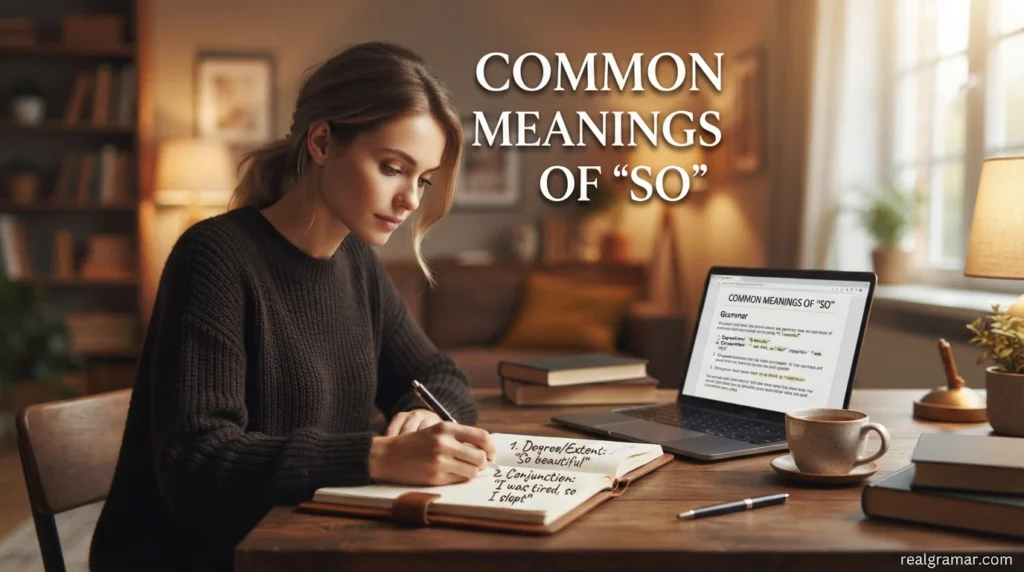
Depending on context, so can communicate several ideas.
| Meaning | Example |
| Very | She is so talented. |
| Therefore | We were tired, so we slept. |
| To this degree | I didn’t know it was so expensive. |
| Agreement | So do I. |
| Confirmation | I think so. |
| Introduction | So, what’s next? |
Understanding these meanings helps writers avoid repetition while improving sentence variety.
Sentence Examples in Everyday English
School
- The lesson was so interesting.
- I was so nervous before the presentation.
- The homework looked so difficult.
Workplace
- Thank you so much.
- The meeting ended so quickly.
- Everyone worked so efficiently.
Family
- Mom cooks so well.
- Dad was so proud.
- The children were so excited.
Travel
- The beach was so beautiful.
- The mountains looked so peaceful.
- The hotel was so comfortable.
Conversations
- I think so.
- If you say so.
- So far, everything is going well.
- So what happened next?
- So that’s the answer.
Using “So” in Different Tones
One reason “so” appears frequently is its flexibility across different writing styles.
Formal Tone
- The evidence was so convincing that the committee approved the proposal.
- The experiment produced so many results that further analysis became necessary.
Neutral Tone
- She was so busy yesterday.
- It was so cold outside.
Friendly Tone
- Thanks so much!
- You’re so thoughtful.
Emotional Tone
- I’m so grateful.
- We were so surprised.
- She’s so proud of you.
Persuasive Tone
- This strategy is so effective because it focuses on long-term growth.
- The new method is so simple that anyone can learn it.
The versatility of “so” makes it one of the most frequently used words in English.
Using “So” in Creative Writing
Creative writers often use so to increase emotional intensity and improve descriptive language.
Example:
The forest was so silent that every falling leaf sounded like thunder.
Instead of simply saying the forest was quiet, the sentence becomes more vivid.
Another example:
The sky was so dark that the stars seemed brighter than ever.
These sentences create stronger imagery without becoming overly complicated.
In storytelling, “so” often works alongside adjectives, sensory details, and figurative language to help readers imagine scenes more clearly.
Figurative Language and Expressive Writing
Although so is not itself a figurative expression, it frequently strengthens figurative language.
Simile Example
- She was so graceful that she moved like a swan.
Metaphor Example
- His determination was so strong that it became an unbreakable wall.
Hyperbole
- I’m so hungry I could eat a mountain.
Personification
- The wind was so angry that it screamed through the trees.
Imagery
- The sunset was so colorful that the entire sky looked painted.
In each example, “so” intensifies the description, making the figurative language more impactful and engaging for readers.
Continue with the next part to cover common mistakes, comparison examples, literary devices, vocabulary enhancement, exercises, FAQs, and a detailed conclusion.
Common Mistakes When Using “So” and “Soo”
Even though the difference seems straightforward, many English learners and native speakers make similar mistakes, especially when switching between casual texting and formal writing. Recognizing these errors will help you write with greater confidence and accuracy.
Mistake 1: Using “soo” in Academic Writing
❌ Incorrect:
- The lesson was soo interesting.
- I am soo grateful for your help.
✅ Correct:
- The lesson was so interesting.
- I am so grateful for your help.
Remember that academic papers, reports, exams, and professional documents should always use standard English spelling.
Mistake 2: Thinking “soo” Is an English Dictionary Word
Some learners assume that because they see soo frequently on social media, it must be an accepted alternative spelling. In reality, it is simply an informal way of stretching the pronunciation for emphasis.
Think of it as a stylistic effect rather than a grammar rule.
Mistake 3: Overusing “So”
Because “so” is such a useful intensifier, writers sometimes repeat it too often.
Example:
The movie was so funny, the actors were so talented, and the ending was so emotional.
While grammatically correct, repeated use can make writing sound repetitive.
Instead, vary your vocabulary:
- incredibly
- remarkably
- exceptionally
- extremely
- truly
- highly
- particularly
- remarkably
Improved example:
The movie was incredibly funny, the actors were exceptionally talented, and the ending was truly emotional.
Vocabulary variety makes your writing richer and more engaging.
Comparison Examples
The easiest way to remember the difference is by seeing both spellings side by side.
| Situation | Correct Usage |
| School essay | so |
| Research paper | so |
| Business email | so |
| Job application | so |
| Novel dialogue (casual speech) | so or stylistic soo if intentionally representing speech |
| Text messages | soo sometimes acceptable |
| Instagram comments | soo often used stylistically |
| Professional blog | so |
More Examples
Formal:
- She is so talented.
- Thank you so much.
- The project was so successful.
Informal Text:
- You’re soo funny 😂
- I’m sooo excited!!
- This cake is soooo good!
Notice how the informal versions emphasize emotion rather than follow standard spelling rules.
“So” in Figurative Language
Figurative language makes writing more expressive by helping readers visualize ideas and emotions. While so is not a figurative device itself, it often strengthens the effect of literary expressions.
Simile Examples
A simile compares two things using like or as.
Examples:
- She was so calm, like a peaceful lake.
- The baby slept so quietly, like a feather drifting through the air.
- He was so quick as lightning.
The word “so” increases the intensity of the comparison.
Metaphor Examples
A metaphor directly compares two unlike things.
Examples:
- His heart was so heavy, it became a stone.
- The classroom was so alive that it felt like a beehive.
- Her smile was so bright that it became sunshine.
These metaphors become more expressive with thoughtful intensifiers.
Hyperbole
Hyperbole is deliberate exaggeration.
Examples:
- I’m so tired I could sleep for a week.
- She’s so fast she could outrun the wind.
- The backpack was so heavy it felt like carrying a mountain.
Hyperbole creates humor and emotional impact.
Personification
Personification gives human qualities to non-human things.
Examples:
- The wind was so angry it howled all night.
- The flowers looked so happy in the sunlight.
- The river was so restless it refused to sleep.
Imagery
Imagery appeals to the senses.
Example:
The beach was so peaceful that only gentle waves whispered across the sand.
Readers can easily picture and hear the scene.
Literary Devices That Pair Well with “So”

Creative writing often combines intensifiers with literary techniques.
| Literary Device | Example |
| Simile | She was so brave like a lion. |
| Metaphor | His hope was so bright it became a star. |
| Hyperbole | I’m so hungry I could eat a horse. |
| Personification | The trees were so excited they danced in the wind. |
| Imagery | The sunset was so colorful it painted the sky. |
| Alliteration | So silently the silver snow settled. |
These devices improve storytelling, essays, speeches, and poetry.
Poetic Expression
Poets frequently use simple words like so to create rhythm and emotional emphasis.
Example:
The night was so quiet,
The stars shone so bright,
Every dream felt closer
Before the morning light.
Although the vocabulary is simple, repetition creates musical flow and emotional depth.
Idioms Featuring “So”
English contains many common expressions that include the word so.
So Far
Meaning: until now
Example:
- So far, everything has gone well.
So Long
Meaning: goodbye
Example:
- So long! See you tomorrow.
So What?
Meaning: expressing indifference
Example:
- “I forgot my umbrella.”
- “So what? We’ll stay inside.”
And So On
Meaning: continuing in the same way
Example:
- We studied grammar, vocabulary, pronunciation, and so on.
Not So Fast
Meaning: slow down or wait
Example:
- Not so fast—we haven’t finished discussing the plan.
Understanding idioms improves reading comprehension and conversational English.
Vocabulary Enhancement
Instead of relying on so repeatedly, expand your vocabulary with stronger alternatives.
| Instead of “So” | Try |
| so happy | delighted |
| so sad | heartbroken |
| so big | enormous |
| so small | tiny |
| so good | excellent |
| so bad | terrible |
| so beautiful | stunning |
| so smart | brilliant |
| so funny | hilarious |
| so cold | freezing |
Example
Basic:
The movie was so good.
Improved:
The movie was absolutely outstanding.
Improving vocabulary creates more precise and engaging writing.
Writing Tips for Students and English Learners

Developing strong writing habits takes practice. These strategies will help you avoid spelling mistakes and communicate more effectively.
- Use so in all formal and academic writing.
- Treat soo as an informal stylistic choice rather than correct spelling.
- Proofread assignments before submitting them.
- Replace repeated uses of so with stronger descriptive words when appropriate.
- Read books, newspapers, and quality articles to see how experienced writers use intensifiers naturally.
- Practice writing complete sentences instead of relying on internet slang.
- Learn new adjectives and adverbs to expand your vocabulary.
- Use figurative language thoughtfully to make descriptions vivid without overdoing them.
Consistent practice will improve grammar, style, and confidence.
Practice Exercises
Exercise 1: Choose the Correct Word
- I am ___ excited for the trip.
- She speaks ___ clearly.
- Thank you ___ much.
- The teacher was ___ kind.
- We were tired, ___ we went home.
Answers
- so
- so
- so
- so
- so
Exercise 2: Correct the Sentences
Rewrite these sentences using standard English.
- I’m soo tired.
- That’s soo amazing.
- We are soo lucky.
- This is soo easy.
- Thank you soo much.
Answers
- I’m so tired.
- That’s so amazing.
- We are so lucky.
- This is so easy.
- Thank you so much.
FAQs
1. Is “soo” a real English word?
No. It is generally an informal spelling used online to show extra emotion or emphasis. Standard English uses so.
2. Can I write “soo” in school assignments?
No. Academic, professional, and formal writing should always use the standard spelling so.
3. Why do people type “sooo” or “soooo”?
They are stretching the word visually to imitate speech and express excitement, surprise, affection, or humor in casual digital communication.
4. Does using “soo” change the meaning?
Not really. The meaning remains the same, but the extra letters add emotional emphasis. It is a stylistic choice rather than a grammatical one.
5. How can I avoid overusing “so”?
Expand your vocabulary by using alternatives such as extremely, remarkably, exceptionally, highly, truly, or more precise descriptive adjectives.
Conclusion
Understanding the distinction between so and soo is a small but valuable step toward becoming a stronger writer. While so is the correct and accepted spelling in standard English, soo is simply an informal internet variation used to exaggerate emotion in casual conversations. Knowing where each belongs helps you adapt your writing to different audiences and situations.
More importantly, effective communication goes beyond choosing the right spelling. Building a rich vocabulary, using descriptive language, incorporating figurative language, and mastering literary devices such as similes, metaphors, imagery, and hyperbole all contribute to clearer, more engaging writing. Whether you’re preparing an academic essay, crafting a creative story, or sending a friendly text, selecting the appropriate tone and word choice ensures your message has the greatest impact.
As you continue learning English, make proofreading a habit, read widely, and practice writing regularly. Over time, you’ll develop greater confidence in your grammar, strengthen your writing skills, and communicate your ideas with clarity, precision, and creativity.
