
Language becomes more powerful when writers understand the subtle differences between words that look or sound similar. Strong vocabulary is not only about knowing many words—it is about choosing the exact word that expresses the intended meaning. This skill improves writing clarity, storytelling ability, and everyday communication.
Words such as minuet vs minute are a perfect example of how English can be both fascinating and confusing. Although these two words share almost identical spelling, they have completely different meanings, pronunciations, and uses. One describes a historical dance filled with elegance and rhythm, while the other refers to a unit of time or something extremely small.
For students, writers, and English learners, learning these differences strengthens vocabulary enhancement and prevents common language mistakes. Writers who understand precise word choices can create stronger descriptions, develop richer characters, and use descriptive language more effectively.
Figurative language, creative writing techniques, and literary devices often depend on selecting words with accuracy. A single incorrect word can change the entire meaning of a sentence. For example, describing a graceful ballroom scene with “minute” instead of “minuet” removes the artistic image completely. Similarly, using “minuet” when talking about time creates confusion.
Understanding similar-looking words helps improve:
- Writing skills
- Reading comprehension
- Academic communication
- Professional writing
- Creative storytelling
- Poetic expression
- Vocabulary confidence
This guide explores the meanings, differences, sentence examples, tone usage, common mistakes, and practical exercises related to these two words so learners can use them naturally and correctly.
What Is the Difference Between Minuet and Minute?
The main difference between minuet and minute is their meaning and function in English.
| Word | Meaning | Pronunciation | Common Use |
| Minuet | A slow, elegant dance from the 17th and 18th centuries | /ˌmɪnjuˈet/ | Music, history, literature |
| Minute | A unit of time equal to 60 seconds; something extremely small | /ˈmɪnɪt/ or /maɪˈnjuːt/ | Daily conversation, science, descriptions |
The word minuet is connected with art, music, and traditional European culture. It usually appears in discussions about classical dance, historical events, or creative descriptions.
The word minute has multiple meanings. Most commonly, it represents time:
- “Wait for one minute.”
- “The meeting lasted ten minutes.”
However, “minute” can also mean very small or detailed:
- “The scientist examined every minute detail.”
When writers understand these distinctions, they can create more accurate sentence structures and avoid confusing readers.
Understanding the Meaning of Minuet
A minuet is a slow, formal dance that became popular in Europe during the 17th century. It was especially associated with royal courts and elegant social gatherings.
The dance usually features:
- Graceful movements
- Small, controlled steps
- Formal patterns
- Polished manners
- Musical rhythm
The word comes from the French word menuet, which is related to the idea of “small” or “fine” steps.
Historically, minuets were common in the courts of European nobility. Many classical composers included minuets in their musical compositions.
For example:
- Wolfgang Amadeus Mozart composed works containing minuets.
- Johann Sebastian Bach also used the minuet form in his music.
Today, the word appears mostly in historical writing, music discussions, and creative descriptions.
Examples of Minuet in Sentences
- The dancers performed a beautiful minuet at the historical festival.
- The composer included a graceful minuet between the two faster movements.
- The novel described a royal ballroom where guests moved elegantly in a traditional minuet.
- The museum displayed paintings showing nobles participating in a minuet.
- The orchestra played a classical minuet that filled the hall with elegance.
Understanding the Meaning of Minute
The word minute has several meanings depending on context. It is one of the most commonly used words in English.
Meaning 1: A Unit of Time
The most familiar meaning of minute is a measurement of time.
One minute equals:
- 60 seconds
- 1/60 of an hour
Sentence Examples
- I will call you in five minutes.
- The presentation lasted thirty minutes.
- She arrived one minute before the deadline.
- Please wait a minute while I finish this task.
This meaning is used in everyday conversations, schedules, appointments, and instructions.
Meaning 2: Extremely Small or Tiny
The adjective minute can also mean very small or insignificant.
In this meaning, it is pronounced differently:
minute = my-NOOT
Examples:
- The scientist discovered minute changes in the experiment.
- The artist added minute details to the painting.
- Even a minute error can affect the final result.
This usage appears frequently in academic writing, science, research, and detailed descriptions.
Meaning 3: Detailed or Careful
Minute can describe something examined with great attention.
Examples:
- The detective conducted a minute investigation.
- The researcher recorded every minute observation.
- The engineer studied the machine’s minute components.
This meaning connects strongly with descriptive language because it focuses on small details.
Minuet vs Minute: Pronunciation Differences
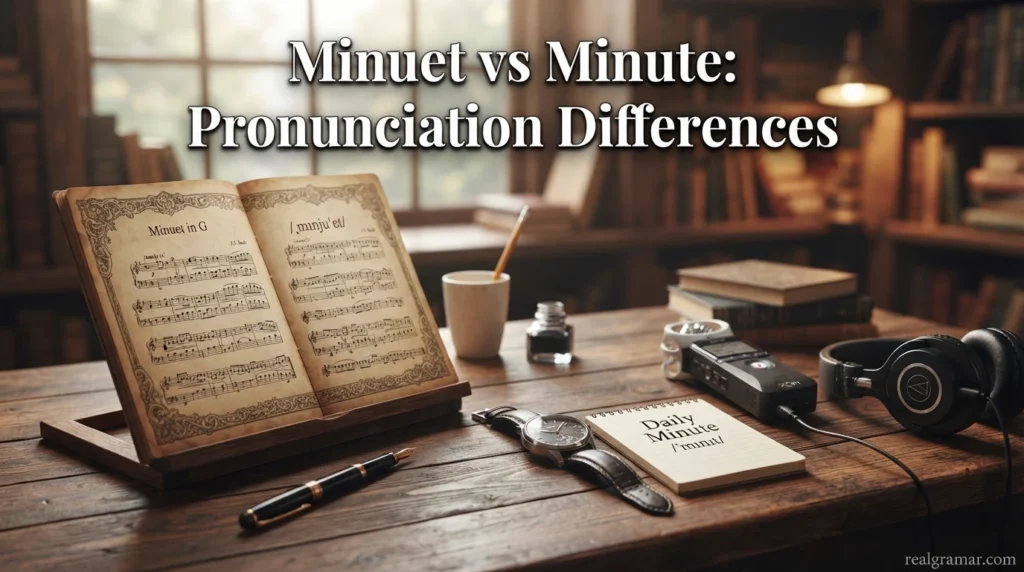
Although the spelling looks similar, pronunciation helps separate these words.
| Word | Pronunciation | Sound Example |
| Minuet | min-yoo-ET | Ends with “wet” sound |
| Minute (time) | MIN-it | Two short syllables |
| Minute (tiny) | my-NOOT | Emphasis on second syllable |
Compare:
Minuet
The couple danced a graceful minuet.
Minute
The train will arrive in one minute.
Minute (tiny)
The artist painted minute details.
English learners often confuse these words because spelling alone does not reveal pronunciation.
Why Minuet and Minute Are Commonly Confused
Many English learners struggle with words that have:
- Similar spelling
- Different pronunciation
- Different meanings
- Different historical origins
These words are called confusing word pairs or commonly mistaken words.
Other examples include:
- Affect vs effect
- Compliment vs complement
- Principal vs principle
- Stationary vs stationery
The confusion between minuet and minute happens because:
- Both words begin with “min.”
- Both are connected historically to the idea of smallness.
- Their spelling appears almost identical.
- Their meanings are completely different today.
Understanding word origins can improve vocabulary skills because it helps learners remember why words developed different meanings.
Quick Comparison Table: Minuet vs Minute
| Feature | Minuet | Minute |
| Part of speech | Noun | Noun, adjective |
| Origin | French dance term | Latin/French origins |
| Main meaning | Elegant historical dance | Time measurement or very small detail |
| Common field | Music, history, literature | Everyday language, science, business |
| Pronunciation | min-yoo-ET | MIN-it / my-NOOT |
| Modern frequency | Less common | Extremely common |
Using Minuet in Creative Writing and Figurative Language
Although minuet is a historical term, writers often use it creatively as a metaphor or symbol.
Because a minuet represents elegance, balance, and careful movement, authors may use it to describe situations beyond dancing.
Metaphor Examples
- The conversation between them was a delicate minuet of words.
- Their negotiation became a careful minuet of patience and strategy.
- The birds performed a natural minuet across the morning sky.
In these examples, “minuet” does not literally mean a dance. Instead, it creates an image of harmony and coordination.
This type of figurative language helps writers add emotion and depth.
Simile Examples Using Minuet
A simile compares two things using “like” or “as.”
Examples:
- The dancers moved like a minuet across the polished floor.
- Their movements were as graceful as a royal minuet.
- The leaves fell like a silent minuet in the autumn wind.
These comparisons create visual imagery and strengthen poetic expression.
Using Minute in Descriptive Language and Writing

The adjective form of minute is valuable in detailed writing.
Writers use it to highlight small observations that readers might otherwise miss.
Examples:
- She noticed the minute cracks in the ancient painting.
- The writer described every minute detail of the character’s expression.
- The photographer captured minute patterns on the butterfly’s wings.
This type of language is especially useful in:
- Mystery writing
- Science writing
- Historical descriptions
- Character development
- Nature writing
Small details often create powerful scenes.
How Tone Changes the Use of Minuet and Minute
Understanding tone is an important part of effective communication. The same word can create different feelings depending on where and how it is used. Writers, students, and professionals must choose vocabulary that matches the situation.
The word minuet usually creates a sophisticated, artistic, or historical tone. It carries feelings of elegance, tradition, and refinement.
The word minute is much more flexible. Depending on its meaning, it can create a practical, scientific, urgent, or detailed tone.
Tone Examples with Minuet
1. Formal and Historical Tone
- The royal guests gathered in the grand hall for an evening minuet.
- The manuscript described the customs of aristocratic life, including formal minuets and ceremonial dances.
Here, “minuet” supports a historical atmosphere.
2. Elegant and Artistic Tone
- The orchestra transformed the quiet evening into a graceful minuet of sound.
- The dancers created a visual minuet of movement and emotion.
The word suggests beauty and harmony.
3. Figurative and Literary Tone
- Their friendship was a delicate minuet of trust, patience, and understanding.
- The changing seasons performed a natural minuet across the landscape.
In creative writing, “minuet” becomes a powerful symbol.
Tone Examples with Minute
1. Everyday Conversational Tone
The most common use of minute refers to time.
Examples:
- I will be ready in a minute.
- Can you give me a minute to think?
- The movie starts in ten minutes.
This meaning appears frequently in casual speech.
2. Scientific and Academic Tone
When minute means extremely small or detailed, it often appears in technical writing.
Examples:
- Researchers observed minute differences between the two samples.
- The scientist analyzed minute particles under a microscope.
- The study focused on minute changes in environmental conditions.
This usage creates a precise and professional tone.
3. Serious or Analytical Tone
Writers often use minute when describing careful observation.
Examples:
- The investigator examined every minute detail of the case.
- The architect considered every minute aspect of the building design.
The word suggests accuracy and attention.
When to Use Minuet
Use minuet when you are talking about:
- A traditional dance
- Classical music
- Historical events
- Elegant movements
- Artistic comparisons
- Figurative descriptions involving harmony or rhythm
Correct Usage Examples
performers practiced a traditional minuet for the cultural event.
The composer added a minuet to the final movement of the symphony.✔ Their conversation was a careful minuet of polite disagreement.
✔ The writer described the birds’ flight as a graceful minuet.
When to Avoid Using Minuet
Avoid using minuet when you mean:
- A short amount of time
- Something very small
- A detailed examination
Incorrect:
❌ I will arrive in one minuet.
Correct:
✔ I will arrive in one minute.
Incorrect:
❌ The scientist found a minuet difference between the samples.
Correct:
✔ The scientist found a minute difference between the samples.
Incorrect:
❌ Please wait a minuet.
Correct:
✔ Please wait a minute.
When to Use Minute
Use minute when referring to:
1. Time
Examples:
- The class begins in five minutes.
- She spent thirty minutes reading.
- The meeting lasted an hour and twenty minutes.
2. Small Size or Tiny Amount
Examples:
- The insect had minute wings.
- The artist painted minute flowers on the vase.
- The machine contains minute parts.
3. Detailed Attention
Examples:
- The lawyer reviewed the document with minute attention.
- The researcher provided a minute analysis of the results.
When to Avoid Using Minute
Avoid using minute when describing a historical dance.
Incorrect:
❌ The couple performed a beautiful minute at the ceremony.
Correct:
✔ The couple performed a beautiful minuet at the ceremony.
Also avoid confusing the adjective pronunciation.
Incorrect:
❌ The scientist found a MIN-it difference.
Correct:
✔ The scientist found a my-NOOT difference.
Pronunciation changes the meaning.
Common Mistakes English Learners Make
Learning confusing words requires understanding not only definitions but also context.
Here are the most common mistakes involving minuet and minute.
Mistake 1: Confusing the Dance With Time
Incorrect:
❌ The concert will begin in a minuet.
Why it is wrong:
A concert does not begin in a dance. It begins after a period of time.
Correct:
✔ The concert will begin in a minute.
Mistake 2: Using Minute for a Historical Performance
Incorrect:
❌ The dancers performed a beautiful minute.
Why it is wrong:
A dance is called a minuet.
Correct:
✔ The dancers performed a beautiful minuet.
Mistake 3: Mispronouncing Minute
Many learners pronounce every form of minute the same way.
However:
MIN-it = time
Example:
- I waited for a minute.
my-NOOT = extremely small
Example:
- The scientist observed minute changes.
Mistake 4: Ignoring Context
Words must match meaning.
Compare:
Sentence A:
She waited for a minute.
Meaning:
A short period of time.
Sentence B:
She noticed a minute detail.
Meaning:
A very small detail.
Sentence C:
She watched a minuet.
Meaning:
A traditional dance.
The surrounding words reveal the correct meaning.
Minuet vs Minute: Categorized Example Sentences
Everyday Examples
Minute (Time)
- I only need one minute to finish this task.
- The bus will arrive in five minutes.
- She called me after ten minutes.
- Please wait a minute before leaving.
- Every minute of the day was carefully planned.
Academic Examples
Minute (Small or Detailed)
- The scientist recorded minute variations in temperature.
- The researcher examined minute changes in the data.
- The student noticed a minute error in the calculation.
- The report included minute observations.
- The engineer studied the minute components of the machine.
Historical and Artistic Examples
Minuet
- The palace hosted an evening minuet for the nobles.
- The orchestra performed a traditional minuet.
- The dancers practiced the minuet for weeks.
- The painting showed people enjoying a courtly minuet.
- The novel included a scene featuring an elegant minuet.
Creative Writing Examples
Using Minuet as a Literary Device
- Their emotions moved in a quiet minuet between hope and fear.
- The waves created a peaceful minuet along the shore.
- The dialogue became a careful minuet of hidden meanings.
- The stars appeared to perform a celestial minuet.
- The changing colors of sunset formed a natural minuet.
Minuet and Minute in Poetry and Figurative Language
Strong writers often use ordinary vocabulary in imaginative ways. Figurative language allows readers to experience ideas emotionally instead of simply receiving information.
Symbolism of Minuet
A minuet can symbolize:
- Balance
- Romance
- Cooperation
- Elegance
- Controlled movement
- Social interaction
Example:
Their relationship was a slow minuet, filled with careful steps and unspoken emotions.
The sentence does not describe an actual dance. Instead, the word creates a metaphor for a relationship.
Symbolism of Minute
Minute can represent:
- Attention to detail
- Small moments
- Hidden discoveries
- Precision
Example:
She found beauty in every minute detail of the old garden.
The word emphasizes careful observation.
Vocabulary Enhancement Tips for Remembering the Difference
Here are simple memory techniques:
Remember Minuet = Music + Movement
The word starts with “min,” but think:
Minuet → Music → Movement → Dance
Example:
The musicians played while couples danced the minuet.
Remember Minute = Moments
Think:
Minute → Moment → Time
Example:
I will return in a minute.
Remember Minute = Tiny Details
Think:
Minute → Mini → Small
Example:
The artist added minute details.
Practice Exercises: Choose Minuet or Minute
Complete the sentences with the correct word.
Exercise 1
- The dancers performed a traditional ______ at the festival.
- I will finish the assignment in one ______.
- The scientist studied the ______ differences between the samples.
- The composer created a beautiful ______ for the orchestra.
- Please wait a ______ while I check the information.
Answers
- minuet
- minute
- minute
- minuet
- minute
Sentence Transformation Practice
Change the incorrect sentences into correct ones.
Incorrect:
The couple danced a romantic minute.
Correct:
The couple danced a romantic minuet.
Incorrect:
The machine showed a minuet variation.
Correct:
The machine showed a minute variation.
Incorrect:
I will call you after one minuet.
Correct:
I will call you after one minute.
FAQs
1. What is the main difference between minuet and minute?
A minuet is a traditional slow dance, while a minute is either a measurement of time or something extremely small. They have different meanings, pronunciations, and uses.
2. Is minuet still used in modern English?
Yes, but it is less common. It usually appears in discussions about classical music, history, literature, and creative writing.
3. Why does minute have two pronunciations?
English pronunciation changes depending on meaning. “Minute” meaning time is pronounced MIN-it, while “minute” meaning extremely small is pronounced my-NOOT.
4. Can minuet be used as a metaphor?
Yes. Writers often use minuet as a metaphor for careful movements, relationships, conversations, or interactions.
Example:
Their negotiation was a delicate minuet of patience and strategy.
5. How can I remember the difference between minuet and minute?
Remember:
- Minuet = music and dance
- Minute = moments or tiny details
Connecting words with images makes vocabulary easier to remember.
Conclusion
Understanding confusing word pairs like minuet and minute helps students, writers, and English learners communicate with greater accuracy and confidence. Although these words look similar, they represent completely different ideas: one captures the elegance of historical dance, while the other describes time, smallness, or careful detail.
Strong vocabulary is essential for effective writing. Whether you are creating a story, writing an essay, improving academic skills, or learning English, choosing the right word creates clearer meaning and stronger emotional impact.
The word minuet can add artistic beauty and poetic expression to creative writing, while minute helps writers describe precise moments and tiny details. Both words demonstrate how language can transform simple ideas into powerful communication.
By practicing sentence examples, studying context, and paying attention to pronunciation, learners can avoid common mistakes and develop stronger vocabulary skills.
Great writing is built from small choices—and sometimes, understanding one tiny word difference can make a big difference.
