

Writing becomes more memorable when you choose the right words for the right occasion. Whether you’re composing a poem, giving a heartfelt speech, or analyzing literature, understanding the difference between similar words strengthens both your communication and writing skills. Many English learners confuse elegy and eulogy because both are connected to death, remembrance, and honoring someone’s life. However, they serve different purposes and belong to different forms of expression.
Learning the distinction not only helps you avoid embarrassing mistakes but also improves your vocabulary enhancement, creative writing, descriptive language, and overall command of English. It also deepens your understanding of figurative language, poetic expression, literary devices, metaphor examples, simile examples, and emotional storytelling.
In this guide, you’ll discover the meanings, differences, examples, common mistakes, comparison tables, writing exercises, and practical tips to help you confidently use both words in everyday English, academic writing, speeches, and literature.
What Do Elegy and Eulogy Mean?
Although these two words sound alike, they belong to different categories of writing.
| Word | Part of Speech | Meaning | Common Use |
| Elegy | Noun | A poem or literary work mourning someone who has died | Literature, poetry, creative writing |
| Eulogy | Noun | A speech or written tribute praising someone’s life | Funerals, memorial services, ceremonies |
The easiest way to remember them is:
- Elegy = Poem
- Eulogy = Speech
Both honor a person, but the format and purpose are different.
What Is an Elegy?
An elegy is a thoughtful and emotional poem that expresses sorrow over someone’s death. While many elegies focus on grief, they often move toward remembrance, hope, acceptance, or celebrating a person’s legacy.
Unlike ordinary poems, elegies explore emotions through poetic expression and figurative language.
Characteristics include:
- Reflective tone
- Emotional imagery
- Symbolism
- Metaphors
- Similes
- Descriptive language
- Literary devices
- Themes of loss and remembrance
Many famous poets have written elegies that remain classics in English literature.
Simple Examples
- The poet wrote an elegy for his childhood friend.
- Her elegy beautifully expressed the pain of losing her mother.
- Students studied an elegy in English literature class.
- The book ends with a touching elegy honoring fallen soldiers.
What Is a Eulogy
A eulogy is a speech delivered to honor and celebrate someone’s life, usually during a funeral or memorial service.
Rather than focusing only on grief, a eulogy highlights achievements, character, memories, kindness, humor, and the positive impact the person had on others.
Most eulogies are spoken aloud, although they may later be published in writing.
Typical characteristics include:
- Personal stories
- Respectful tone
- Gratitude
- Inspiration
- Celebration of life
- Comfort for family and friends
Simple Examples
- She delivered a heartfelt eulogy at her grandfather’s funeral.
- His eulogy made everyone smile through their tears.
- The family thanked him for preparing such a meaningful eulogy.
- Writing a eulogy requires sincerity and compassion.
Key Differences Between Elegy and Eulogy

Although both honor someone who has passed away, they differ significantly.
| Feature | Elegy | Eulogy |
| Form | Poem | Speech |
| Purpose | Express grief through poetry | Praise and remember someone’s life |
| Usually Presented | Written | Spoken |
| Setting | Literature, poetry collections | Funeral or memorial |
| Writing Style | Artistic and symbolic | Personal and conversational |
| Literary Devices | Extensive | Limited |
| Audience | Readers | Listeners |
Remember:
Elegies are read.
Eulogies are heard.
Of course, both can later be published.
Why Do People Confuse These Words?
Several reasons make these terms easy to mix up.
Similar Pronunciation
Both begin with similar sounds and end with “-gy.”
Similar Context
Both are connected with death and remembrance.
Similar Emotional Tone
Both express respect, love, sadness, and appreciation.
Limited Everyday Use
Unlike common English words, these appear mostly in literature, ceremonies, or formal contexts.
Because of these similarities, learners often substitute one for the other incorrectly.
When Should You Use Each One?
Choosing the correct word depends on what you’re creating.
Use an Elegy When
- Writing poetry
- Studying literature
- Expressing grief artistically
- Practicing creative writing
- Exploring symbolism and imagery
Example situations:
- English class assignment
- Poetry competition
- Literary magazine
- Personal reflective poem
Use a Eulogy When
- Speaking at a funeral
- Honoring a loved one
- Giving a memorial speech
- Remembering someone’s achievements
- Comforting family and friends
Example situations:
- Funeral service
- Memorial ceremony
- Tribute event
- Celebration of life gathering
Understanding the audience helps determine which word is appropriate.
Literary Devices Commonly Found in Elegies
Elegies often showcase beautiful poetic craftsmanship through literary devices that make emotions vivid and memorable.
Metaphor Examples
Metaphors compare two unlike things without using “like” or “as.”
Examples:
- His life was a fading sunset.
- Her memory became a guiding star.
- Time is a silent thief.
These metaphors create emotional depth while encouraging readers to imagine abstract ideas vividly.
Simile Examples
Similes compare things using “like” or “as.”
Examples:
- She rested like a peaceful bird.
- His voice faded like autumn leaves.
- The silence spread as gently as snowfall.
Similes make poetic descriptions easier to visualize.
Personification
Giving human qualities to objects or nature.
Examples:
- The wind whispered farewell.
- The trees mourned quietly.
- The stars watched over him.
Symbolism
Objects often represent deeper meanings.
Common symbols include:
- White lilies for peace
- Candles for remembrance
- Birds for freedom
- Rivers for life’s journey
- Seasons for stages of life
Imagery
Imagery paints vivid mental pictures using sensory details.
Example:
The golden leaves drifted softly across the empty path where laughter once lived.
This sentence appeals to sight, sound, and emotion simultaneously.
Tone Differences Between Elegies and Eulogies
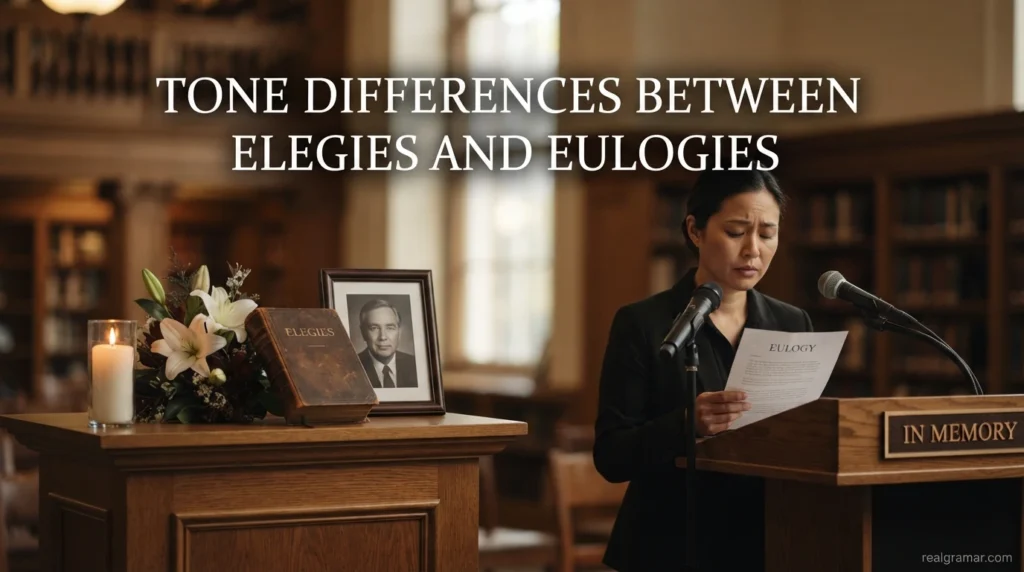
significantly changes how readers or listeners experience a message.
Tone of an Elegy
Often includes:
- Reflective
- Melancholic
- Peaceful
- Hopeful
- Philosophical
- Symbolic
The language tends to be artistic rather than conversational.
Tone of a Eulogy
Usually includes:
- Respectful
- Warm
- Personal
- Appreciative
- Inspirational
- Comforting
Many speakers even include gentle humor to celebrate happy memories.
Comparing Tone
| Situation | Better Choice |
| Literary poem | Elegy |
| Funeral speech | Eulogy |
| Poetry collection | Elegy |
| Memorial gathering | Eulogy |
| Creative writing assignment | Elegy |
| Speaking to family members | Eulogy |
Sentence Examples in Different Contexts
Literature
- The author’s elegy remains one of the finest poems of the century.
- Students analyzed the poem’s imagery and symbolism.
Public Speaking
- The mayor delivered a moving eulogy for the community leader.
- Her eulogy comforted everyone in attendance.
Creative Writing
- He composed an elegy filled with vivid metaphors.
- The collection concluded with an emotional elegy about friendship.
Everyday English
- She asked me to help write the eulogy.
- Our professor explained why an elegy differs from a memorial speech.
Figurative Language in Elegies
Figurative language helps writers express emotions in ways that literal language cannot. Since an elegy is meant to reflect grief, remembrance, and hope, it often relies on imagery and symbolism instead of direct statements.
Rather than saying:
I miss my friend.
A poet may write:
The brightest star slipped quietly beyond the morning sky.
The second sentence creates a stronger emotional impact because it encourages readers to imagine and feel the loss instead of simply reading about it.
Common Figurative Language Used in Elegies
| Literary Device | Purpose | Example |
| Metaphor | Creates symbolic meaning | Life is a fading candle. |
| Simile | Makes emotional comparisons | She smiled like the morning sun. |
| Personification | Gives human qualities to nature | The rain wept all afternoon. |
| Symbolism | Represents deeper ideas | A white dove symbolizes peace. |
| Imagery | Paints vivid mental pictures | Golden leaves covered the silent road. |
| Alliteration | Adds musical rhythm | Softly singing sorrow. |
| Repetition | Emphasizes emotion | We remember. We honor. We cherish. |
Using these literary devices makes poetry more expressive and memorable.
Writing an Effective Eulogy
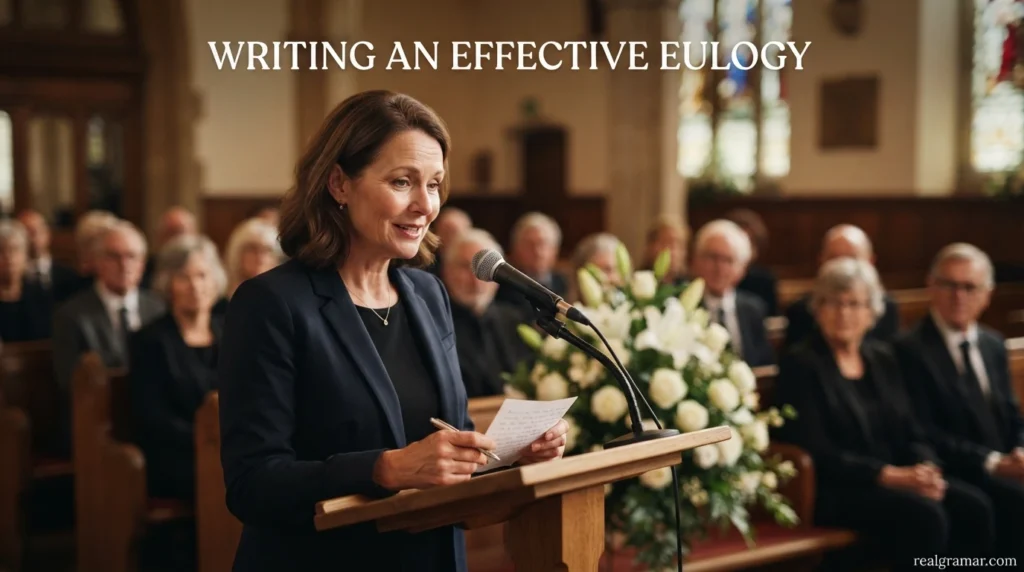
Unlike an elegy, a eulogy is designed to connect with listeners. It should sound sincere, respectful, and personal rather than overly poetic.
A good eulogy usually follows this structure:
- Welcome everyone.
- Introduce your relationship with the person.
- Share meaningful memories.
- Highlight their character and achievements.
- Explain how they influenced others.
- End with gratitude, hope, or a final farewell.
Example Opening
Today we gather to celebrate the remarkable life of someone who filled every room with kindness and laughter.
Example Closing
Though we will miss them deeply, their generosity and love will continue to inspire everyone fortunate enough to know them.
Notice that these examples focus on celebrating a person’s life instead of describing grief through poetic imagery.
Common Mistakes to Avoid
Because elegy and eulogy are closely related, learners often misuse them in writing and conversation.
Mistake 1: Calling a Funeral Speech an Elegy
❌ The minister delivered an elegant elegy at the funeral.
✅ The minister delivered a heartfelt eulogy at the funeral.
Mistake 2: Calling a Poem a Eulogy
❌ The poet published a beautiful eulogy.
✅ The poet published a beautiful elegy.
Mistake 3: Assuming They Mean the Same Thing
Although both honor someone who has died, one is poetry while the other is a speech.
Mistake 4: Using Both Words Interchangeably
Choose the word based on the format.
- Poem → Elegy
- Speech → Eulogy
Mistake 5: Making a Eulogy Sound Too Formal
A eulogy should sound natural and heartfelt.
Instead of:
He possessed extraordinary moral excellence throughout his existence.
Try:
He was one of the kindest people I’ve ever known.
Simple language often creates a stronger emotional connection.
Vocabulary Enhancement
Learning related words expands your vocabulary and improves your writing.
| Word | Meaning |
| Tribute | An act of showing respect |
| Memorial | Something that honors a person |
| Remembrance | The act of remembering |
| Legacy | Something meaningful left behind |
| Mourning | Expressing sorrow after a death |
| Commemoration | Honoring an important person or event |
| Reflection | Careful thought or consideration |
| Consolation | Comfort during sadness |
| Sympathy | Feelings of compassion |
| Respect | Admiration for someone |
These words frequently appear in literature, speeches, and academic writing.
Practice Exercises
Test your understanding by completing these activities.
Exercise 1: Choose the Correct Word
- The daughter gave a touching ______ at the funeral.
- The poet composed an emotional ______ after losing his mentor.
- The minister praised the community leader in his ______.
- Students analyzed the famous ______ in English literature.
- The family appreciated her heartfelt ______.
Answers
- eulogy
- elegy
- eulogy
- elegy
- eulogy
Exercise 2: True or False
- An elegy is usually a speech.
- A eulogy often includes personal memories.
- Elegies frequently use symbolism.
- Eulogies are commonly delivered at memorial services.
- Both words relate to honoring someone.
Answers
- False
- True
- True
- True
- True
Exercise 3: Identify the Type
Read each sentence and decide whether it describes an elegy or a eulogy.
- The speaker thanked everyone for attending and shared childhood memories.
- The poem compared life to autumn leaves.
- The minister honored a beloved teacher.
- The poet used vivid imagery and symbolism.
- Family members laughed while remembering funny stories.
Answers
- Eulogy
- Elegy
- Eulogy
- Elegy
- Eulogy
Quick Comparison Summary
| Feature | Elegy | Eulogy |
| Type | Poem | Speech |
| Main Goal | Express grief artistically | Celebrate someone’s life |
| Delivery | Written | Spoken |
| Uses Figurative Language | Frequently | Occasionally |
| Uses Literary Devices | Extensively | Sometimes |
| Includes Personal Stories | Sometimes | Often |
| Audience | Readers | Listeners |
| Common Setting | Literature | Funeral or memorial |
| Emotional Style | Reflective | Personal and comforting |
Easy Memory Trick
Remember this simple phrase:
- Elegy = Literary poem
- Eulogy = Spoken tribute
Thinking of the letter “P” in Poem can remind you of Elegy, while “S” in Speech can remind you of Eulogy.
FAQs
1. Can an elegy be read aloud at a funeral?
Yes. An elegy may be read during a funeral or memorial service. However, it is still considered a poem rather than a speech. If someone is speaking personally about the deceased, that speech is called a eulogy.
2. Does a eulogy have to be emotional?
Not necessarily. While many eulogies express sadness, they often include gratitude, admiration, hope, and even gentle humor to celebrate the person’s life and comfort those attending.
3. Are elegies always about death?
Traditionally, yes, but modern literature sometimes uses the elegy form to express sorrow over the loss of places, relationships, cultures, or significant moments in life.
4. Which is more common in literature?
Elegies are much more common in poetry and literary studies because they showcase poetic techniques, imagery, symbolism, and figurative language.
5. How can English learners remember the difference?
Think of the purpose:
- Elegy = poem that mourns.
- Eulogy = speech that praises.
Associating each word with its format makes it much easier to choose the correct one.
Conclusion
Although elegy and eulogy are often confused because they both relate to honoring someone who has died, they serve different purposes. An elegy is a poetic expression of grief that relies on figurative language, imagery, symbolism, and other literary devices to explore loss and remembrance. A eulogy, on the other hand, is a heartfelt speech that celebrates a person’s life through personal stories, appreciation, and encouragement.
Understanding this distinction strengthens your writing skills, enriches your vocabulary, and helps you communicate more accurately in academic, literary, and everyday contexts. Whether you’re studying English literature, preparing a memorial speech, or developing your creative writing, choosing the right word demonstrates precision and confidence. As you continue practicing with comparison examples, sentence exercises, metaphor and simile examples, and descriptive language, you’ll become a more thoughtful and effective communicator.
