Introduction
Every conversation begins with curiosity. Whether you’re speaking to a teacher, sending an email to a colleague, participating in an interview, or chatting with an AI assistant, asking questions is one of the most important communication skills you can develop. The phrase “my question is” is a common way to introduce a question politely and clearly, making it easier for listeners or readers to understand that you’re seeking information.
Many English learners use this expression because it sounds natural, respectful, and direct. However, understanding when to use it, when to choose alternative expressions, and how to ask questions effectively can significantly improve your speaking and writing skills.
This guide explains the meaning, grammar, common uses, professional applications, examples, and best practices for introducing questions. You’ll also discover practical tips, comparison tables, real-life scenarios, and expert advice to help you communicate with confidence.
Understanding the Search Intent
Someone searching for this phrase usually wants to know one or more of the following:
- What the expression means
- Whether it’s grammatically correct
- How to use it naturally
- Better alternatives in formal and informal English
- Examples in conversations and writing
- Tips for asking clearer questions
Rather than focusing only on grammar, this article explores the broader topic of introducing questions effectively in different situations.
What Does This Expression Mean?
This phrase is a polite introduction used before asking something.
Instead of immediately asking:
How do I improve my writing?
A speaker may say:
My question is: How do I improve my writing?
The introductory statement prepares the listener for the actual question.
Its primary purpose is to:
- Gain attention
- Organize thoughts
- Make communication clearer
- Sound polite in discussions
- Introduce a new topic
It doesn’t change the meaning of the question—it simply introduces it more naturally.
Why People Use This Expression
People introduce questions for several reasons.
1. It Signals That a Question Is Coming
Instead of suddenly asking something, the listener is prepared.
Example:
I’d like to ask something. My question is: How does this process work?
2. It Improves Clarity
In presentations or meetings, speakers often explain some background before asking.
Example:
I’ve reviewed the report carefully. My question is whether the data includes last year’s results.
3. It Sounds Polite
Beginning with an introduction often sounds more respectful than asking abruptly.
Instead of:
Why did you reject my application?
You might say:
Thank you for reviewing my application. My question is why it was rejected.
4. It Helps Organize Complex Discussions
In classrooms, conferences, and interviews, people often ask several questions.
Introducing each one helps everyone follow the conversation.
Example:
My first question concerns the budget.
My second question relates to staffing.
Is It Grammatically Correct?
Yes.
The expression is completely grammatical and widely used by native English speakers.
The basic structure is:
Introductory statement + question
Examples:
- My question is: What time does the meeting begin?
- My question is whether the results are accurate.
- My question is how this software works.
Notice that the punctuation depends on the sentence structure.
Direct Question
My question is: Why is the project delayed?
Indirect Question
My question is whether the project has been approved.
Indirect questions usually do not end with a question mark because they are part of a larger statement.
Common Situations Where It’s Used

This expression appears in many real-life situations.
Classroom Discussions
Students often use it when speaking to teachers.
Examples:
- My question is about today’s homework.
- My question is how to solve problem number five.
- My question is why this formula works.
Business Meetings
Professionals use it to introduce thoughtful questions.
Examples:
- My question is whether we can reduce costs.
- My question is about the project timeline.
- My question is how the company plans to expand.
Job Interviews
Candidates ask questions after interviews.
Examples:
- My question is about career development opportunities.
- My question is how performance is evaluated.
- My question is what a typical workday looks like.
Emails
Many professional emails include this expression.
Example:
Thank you for your detailed explanation.
My question is whether additional documents are required.
Online Forums
People frequently ask for advice online.
Examples:
- My question is how to fix this error.
- My question is whether anyone has experienced this issue.
- My question is which option is better.
Direct vs

Understanding the difference helps improve grammar and writing.
| Type | Example | Common Use |
| Direct Question | What time is the meeting? | Everyday conversation |
| Introduced Question | My question is: What time is the meeting? | Presentations, discussions |
| Indirect Question | My question is whether the meeting has been confirmed. | Formal writing |
| Embedded Question | Could you tell me when the meeting starts? | Polite requests |
Indirect questions often sound more professional and courteous.
Better Alternatives in Different Situations
Although this phrase is useful, varying your language makes your communication more natural.
Formal Alternatives
Use these in business or academic settings:
- I’d like to ask…
- I was wondering…
- Could you clarify…
- I’d appreciate some clarification about…
- I’d like to know…
- Could you explain…
- I have a question regarding…
- May I ask…
Example
Instead of:
My question is about the deadline.
You could say:
I’d like to know more about the deadline.
Informal Alternatives
Among friends or family, shorter introductions sound more natural.
Examples:
- Can I ask something?
- I have a quick question.
- I was wondering…
- Do you know…?
- Could you help me understand…?
Real-Life Examples
Here are practical examples showing how this expression works in everyday communication.
At School
Teacher:
Does anyone have questions?
Student:
My question is how to improve essay organization.
During a Meeting
Manager:
Any questions before we finish?
Employee:
My question is whether the project deadline has changed.
Customer Service
Customer:
My question is how I can update my account information.
Representative:
I’d be happy to help.
Technical Support
User:
My question is why the application keeps crashing.
Support Agent:
Let’s troubleshoot the issue together.
Public Speaking
Presenter:
Thank you for listening.
Audience Member:
My question is about your research methodology.
Benefits of Introducing Questions Clearly
Using a structured introduction offers several advantages.
- Makes communication easier to follow
- Sounds respectful and professional
- Helps organize thoughts before speaking
- Reduces misunderstandings
- Encourages detailed responses
- Creates confidence during presentations
- Improves academic and workplace communication
People are more likely to receive accurate answers when their questions are introduced clearly and logically.
Next Part (Part 2) will cover:
- Types of questions (open-ended, closed-ended, rhetorical, probing, clarifying, and leading)
- How to ask better questions
- Common mistakes English learners make
- Professional communication tips
- Writing and speaking best practices
- More real-world examples and comparison tables
Types of Questions and How to Ask Them Effectively
Knowing how to introduce a question is only one part of becoming a strong communicator. Equally important is understanding the different types of questions and choosing the right one for the situation. Whether you’re participating in a classroom discussion, writing an email, attending a job interview, or having a casual conversation, selecting the appropriate question style helps you receive clearer and more useful answers.
Open-Ended Questions
Open-ended questions encourage detailed responses rather than simple “yes” or “no” answers. They are excellent for discussions, interviews, brainstorming sessions, and learning new information.
Characteristics
- Invite explanation
- Encourage conversation
- Gather opinions and ideas
- Develop critical thinking
Examples
- How can I improve my writing skills?
- What are the advantages of online learning?
- Why is communication important in the workplace?
- What strategies help students prepare for exams?
When to Use
- Classroom discussions
- Business meetings
- Customer feedback
- Research interviews
- Coaching and mentoring
Closed-Ended Questions
Closed-ended questions usually require short, direct answers.
Characteristics
- Quick to answer
- Easy to understand
- Useful for confirming facts
Examples
- Is the meeting tomorrow?
- Have you completed the assignment?
- Did the package arrive?
- Can you attend the conference?
Best Uses
- Confirming information
- Surveys
- Scheduling
- Simple decision-making
Clarifying Questions
Clarifying questions help avoid misunderstandings and ensure accurate communication.
Examples
- Could you explain what you mean?
- Can you give an example?
- Are you referring to last week’s report?
- Could you clarify the deadline?
These questions are especially valuable in academic writing, workplace communication, and technical discussions.
Probing Questions
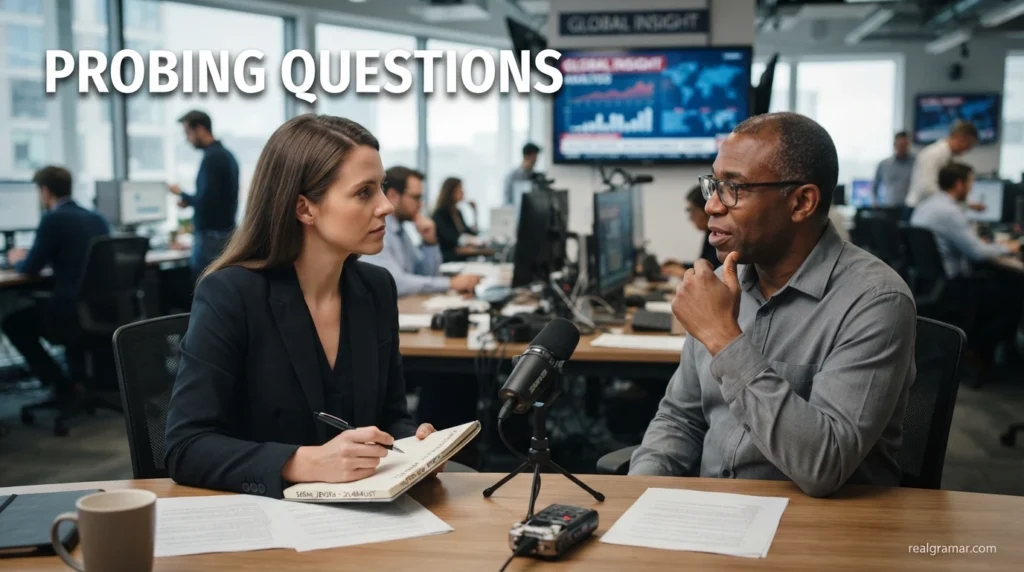
Probing questions encourage someone to provide additional details.
Examples
- What led you to that conclusion?
- Can you explain your reasoning?
- What happened after that?
- Why do you think this solution works?
These questions promote deeper conversations and critical thinking.
Rhetorical Questions
A rhetorical question is asked for effect rather than to receive an answer.
Examples
- Who doesn’t want to succeed?
- Isn’t education the key to opportunity?
- What could be more rewarding than helping others?
Writers often use rhetorical questions to engage readers and emphasize important ideas.
Leading Questions
Leading questions suggest or influence the answer.
Examples
- Don’t you think this is the best solution?
- Wouldn’t it be better to start earlier?
- Isn’t this product more reliable?
While these can be persuasive, they should be used carefully in surveys and interviews because they may introduce bias.
Choosing the Right Question Type
| Situation | Best Question Type | Example |
| Classroom discussion | Open-ended | What are the main causes of climate change? |
| Customer support | Clarifying | Could you describe the error message? |
| Job interview | Open-ended | What qualities make someone successful in this role? |
| Survey | Closed-ended | Have you used this product before? |
| Research interview | Probing | What influenced your decision? |
| Speech or article | Rhetorical | Why should we ignore such an important issue? |
Selecting the appropriate question style helps conversations become more productive and meaningful.
Common Mistakes When Introducing Questions
Even advanced English learners occasionally make mistakes when introducing questions. Recognizing these errors can improve both spoken and written communication.
1. Making the Introduction Too Long
Instead of writing several unnecessary sentences before asking, keep your introduction brief.
Less Effective:
I have been thinking about this topic for a very long time, and after reading many articles and discussing it with my classmates, I wanted to ask something.
Better:
I’d like to ask about the application process.
2. Asking Multiple Questions at Once
Too many questions in one sentence can confuse the listener.
Less Effective:
Could you explain the deadline, grading policy, attendance requirements, textbook list, and exam schedule?
Better:
Ask one topic at a time or organize questions into a numbered list.
3. Being Too Vague
Unclear questions often receive unclear answers.
Vague:
Can you explain this?
Specific:
Could you explain how the passive voice is used in formal writing?
4. Forgetting the Audience
Your wording should match the person you’re speaking to.
Formal
- Could you clarify…
- Would you mind explaining…
- I’d appreciate your guidance…
Informal
- Can you help me?
- Do you know why…?
- What do you think?
Adapting your language makes communication more effective.
Tips for Asking Better Questions
Strong communicators don’t just ask questions—they ask them clearly, respectfully, and purposefully.
Be Specific
Instead of:
Can you help?
Try:
Could you explain how to improve my essay introduction?
Provide Context
A little background helps others understand your question.
Example:
I’m learning English grammar, and I’d like to understand when to use present perfect tense.
Keep It Concise
Avoid unnecessary details that distract from your main point.
Ask One Main Question
If you have several questions, separate them into individual points.
Choose Appropriate Vocabulary
Use polite language in professional settings and natural language in casual conversations.
Real-Life Examples
Example 1: Student and Teacher
Student:
I’ve reviewed the chapter carefully. Could you explain why the author used symbolism in the final paragraph?
Teacher:
Certainly. The symbolism represents hope and personal growth.
Example 2: Workplace
Employee:
I’d like to know whether the project deadline has changed.
Manager:
Yes, it has been extended until next Friday.
Example 3: Customer Support
Customer:
Could you clarify why my order hasn’t shipped yet?
Representative:
Let me check the latest tracking information.
Example 4: Job Interview
Candidate:
Could you describe the training process for new employees?
Interviewer:
Of course. New team members complete a four-week onboarding program.
Improving Communication Through Effective Questions
The ability to ask thoughtful questions is a valuable life skill. It helps you:
- Learn more efficiently
- Solve problems faster
- Build stronger relationships
- Reduce misunderstandings
- Demonstrate curiosity and professionalism
- Encourage meaningful conversations
Whether you’re a student, writer, professional, or English learner, asking clear and well-structured questions can make your communication more confident and effective.
Next (Final) Part will include:
- Related communication concepts
- Advanced examples
- Practical exercises
- 8 SEO-focused FAQs
- Strong conclusion summarizing the topic and key takeaways
Related Communication Skills That Improve Question Asking
Learning how to introduce a question is only one part of becoming an effective communicator. The most successful students, writers, and professionals also develop complementary skills that make their conversations more productive.
Active Listening
Good questions begin with careful listening. Before asking, pay attention to what the speaker has already explained.
Benefits of active listening:
- Prevents asking questions that have already been answered.
- Helps you ask more relevant follow-up questions.
- Shows respect and professionalism.
- Improves understanding.
Example:
Instead of interrupting immediately, wait until the speaker finishes, then ask:
Could you explain how the final step works?
Critical Thinking
Critical thinking helps you analyze information before asking for clarification.
Rather than asking:
Is this correct?
Try:
Why is this approach considered more effective than the previous one?
Questions that encourage explanation often lead to more valuable discussions.
Clear Communication
A well-structured question includes three elements:
- Brief context
- Main question
- Desired outcome (if appropriate)
Example:
I’m preparing for an English exam. Could you explain the difference between active and passive voice so I can use them correctly in my essay?
This approach gives the listener enough information to provide a helpful answer.
Practical Exercises
Practice introducing questions in different situations.
Exercise 1: Rewrite the Question
Rewrite the following to sound more professional.
Original:
Tell me about the deadline.
Possible Answer:
Could you tell me what the deadline is for submitting the project?
Exercise 2: Choose the Best Introduction
Which option sounds most appropriate in a business meeting?
A. Hey, I want to know this.
B. I’ve got something.
C. I’d like to ask about the project’s timeline.
Correct Answer: C
Exercise 3: Improve Clarity
Original:
Can you explain this?
Improved:
Could you explain how this formula is applied in real-world situations?
Best Practices for Students, Writers, and Professionals

No matter your goal, these habits can make your questions more effective.
Students
- Read the material before asking.
- Ask one question at a time.
- Use specific examples.
- Take notes on the answer.
For Writers
- Ask for targeted feedback.
- Clarify the audience and purpose.
- Request examples when learning grammar or style.
For Professionals
- Be concise.
- Stay respectful.
- Focus on solutions rather than assumptions.
- Ask follow-up questions only when necessary.
FAQs
1. Is “My question is” grammatically correct?
Yes. It is a grammatically correct and widely accepted way to introduce a question in both spoken and written English.
2. Is it too formal for everyday conversation?
Not necessarily. It sounds slightly more formal than simply asking the question, but it is perfectly natural in meetings, classrooms, presentations, interviews, emails, and many everyday situations.
3. What are some natural alternatives?
Common alternatives include:
- I’d like to ask…
- I have a question about…
- Could you explain…?
- I was wondering…
- May I ask…?
- Can you tell me…?
- Could you clarify…?
- I’m curious about…
Choosing different expressions adds variety to your communication.
4. Should I always introduce my question?
No. In casual conversations, you can usually ask directly.
For example:
Instead of:
My question is: What time is it?
Simply say:
What time is it?
Introductions are most useful in formal or structured discussions.
5. What’s the difference between a direct and an indirect question?
A direct question asks for information immediately.
Where is the library?
An indirect question is embedded within another sentence.
Could you tell me where the library is?
Indirect questions often sound more polite and professional.
6. How can I make my questions clearer?
To improve clarity:
- Be specific.
- Provide relevant context.
- Avoid asking multiple questions at once.
- Use simple, precise language.
- Match your tone to the situation.
7. Why do effective questions matter?
Clear questions help you:
- Learn faster.
- Avoid misunderstandings.
- Receive more accurate answers.
- Build stronger professional and personal relationships.
- Improve communication and critical thinking skills.
8. Can this expression be used in academic writing?
Yes. It is commonly used in classroom discussions, presentations, interviews, seminars, and research settings. However, in formal academic papers, it is usually better to state the issue directly rather than writing conversational phrases.
Key Takeaways
| Topic | Summary |
| Meaning | A polite way to introduce a question. |
| Grammar | Correct and widely accepted in English. |
| Best Use | Meetings, presentations, classrooms, interviews, and emails. |
| Alternatives | “I’d like to ask…”, “Could you explain…”, “I have a question about…” |
| Common Mistakes | Being vague, asking multiple questions at once, or using unnecessary introductions. |
| Benefits | Improves clarity, professionalism, and communication effectiveness. |
Conclusion
Introducing a question clearly is a simple but powerful communication skill. While “my question is” is grammatically correct and appropriate in many situations, effective communication goes beyond a single expression. Understanding your audience, choosing the right question type, and providing enough context can make conversations more productive and engaging.
Whether you’re a student seeking knowledge, a writer refining ideas, or a professional participating in meetings, asking thoughtful questions demonstrates curiosity, confidence, and respect. By practicing the techniques covered in this guide—using clear language, selecting appropriate introductions, avoiding common mistakes, and adapting your tone—you’ll improve both your spoken and written English.
Remember that the best questions are not only grammatically correct but also purposeful, concise, and easy to understand. Developing this skill will help you learn more effectively, solve problems efficiently, and build stronger connections in academic, professional, and everyday communication.
