
Words are the building blocks of communication. A single letter can completely change meaning, tone, and the message a writer wants to express. This is especially true with confusing word pairs and homophones—words that sound similar but have different spellings and meanings.
Strong vocabulary skills help students, writers, and English learners express ideas with accuracy and creativity. When you understand subtle differences between similar-sounding words, your writing becomes clearer, your storytelling becomes more powerful, and your communication becomes more confident.
Language is not only about sharing information; it is also about creating images, emotions, and connections. Writers use descriptive language, figurative language, and literary devices to make their ideas memorable. A novelist may describe a character’s accent to reveal personality, a poet may use an ascent as a metaphor for growth, or a speaker may show assent to represent agreement and unity.
Confusing these words can create misunderstandings. For example, saying someone “gave an accent” when you mean “gave assent” changes the entire meaning of a sentence. Learning the difference between accent vs ascent vs assent helps improve vocabulary enhancement, writing skills, and everyday communication.
This guide explains the meanings, differences, sentence examples, tone usage, common mistakes, creative writing applications, and practical exercises to help you use these three words correctly.
Accent vs Ascent vs Assent: Quick Comparison Table
Before exploring each word in detail, look at this simple comparison:
| Word | Pronunciation | Part of Speech | Meaning | Example |
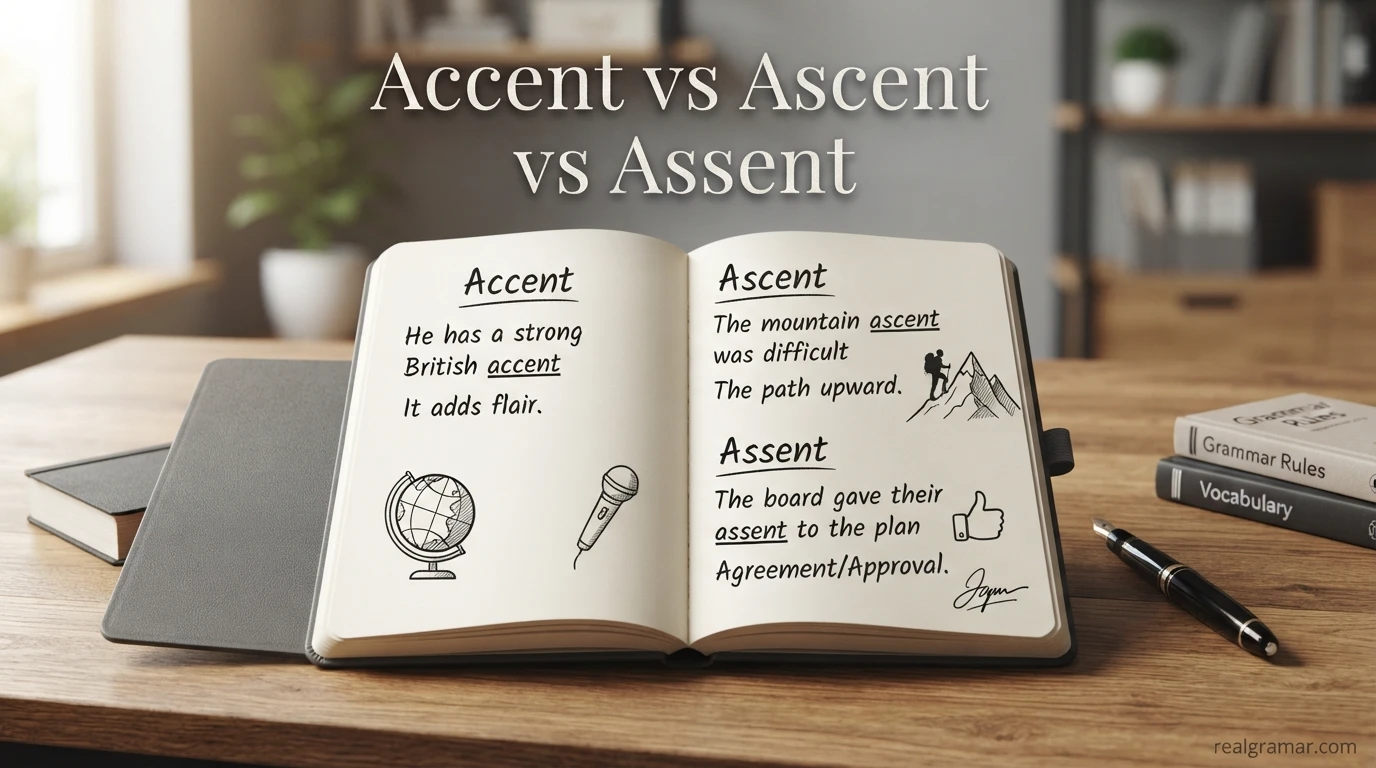
| Accent | AK-sent or ak-SENT | Noun/Verb | A way of pronouncing words; emphasis or importance | She speaks English with a British accent. |
| Ascent | uh-SENT | Noun | A climb, rise, or upward movement | The mountain ascent was challenging. |
| Assent | uh-SENT | Noun/Verb | Agreement or approval | The committee gave its assent to the proposal. |
Although ascent and assent sound almost identical, their meanings are completely different. Meanwhile, accent can sound similar but refers mainly to speech, emphasis, or stress.
What Does Accent Mean?
The word accent has several meanings depending on context. It is commonly used to describe pronunciation, emphasis, or a special feature that makes something noticeable.
Meaning of Accent in Language
The most common meaning of accent is the way a person pronounces words based on their region, culture, or background.
For example:
- A person from Scotland may have a Scottish accent.
- Someone from Australia may have an Australian accent.
- A person learning English may speak with an accent influenced by their native language.
An accent is not a mistake. It is a natural part of language identity and cultural expression.
Sentence Examples of Accent
- Maria speaks English with a gentle Spanish accent.
- His accent immediately revealed that he grew up in another country.
- The actor practiced a French accent for the movie role.
- Different regions often develop unique accents over time.
Accent as Emphasis or Importance
Accent can also mean special attention or importance given to something.
In this sense, the word is connected with focus and expression.
Examples:
- The teacher placed an accent on the importance of honesty.
- The designer added a colorful accent wall to the room.
- The speaker put extra accent on the final sentence.
Here, accent means “special emphasis.”
Accent in Creative Writing and Figurative Language

Writers often use accent metaphorically to highlight emotional or symbolic importance.
Metaphor Examples:
- “Her kindness was the accent that completed her character.”
- “Hope became the accent of his difficult journey.”
These examples do not refer to pronunciation. Instead, accent represents a special quality that makes something stand out.
Poetic Expression Examples:
- “The moonlight added an accent of mystery to the silent forest.”
- “His laughter was the accent of joy in a room full of strangers.”
Using words like accent creatively helps writers develop stronger imagery and emotional depth.
What Does Ascent Mean?
The word ascent refers to movement upward. It comes from the idea of climbing, rising, or increasing.
It is usually used as a noun.
Physical Meaning of Ascent
The most literal meaning of ascent is climbing from a lower position to a higher one.
Sentence Examples:
- The hikers began their ascent before sunrise.
- The mountain ascent required patience and preparation.
- The airplane started its ascent after leaving the runway.
- The steep ascent made the journey difficult.
In these examples, ascent describes upward movement.
Ascent as Progress or Success
In writing and everyday speech, ascent can also describe improvement, achievement, or advancement.
Examples:
- The athlete’s ascent to fame happened quickly.
- Her career ascent inspired many young professionals.
- The company’s rapid ascent surprised competitors.
Here, ascent is not about physically climbing. It represents growth, success, or progress.
Ascent in Figurative Language and Literary Devices
Writers frequently use ascent as a symbol.
An upward journey often represents:
- Personal growth
- Achievement
- Spiritual development
- Hope
- Transformation
Metaphor Examples:
- “His ascent from failure to success was remarkable.”
- “The character’s emotional ascent showed her inner strength.”
Simile Examples:
- “Her confidence grew like an ascent toward a brighter future.”
- “His journey was like a mountain ascent, full of challenges and rewards.”
These examples show how a simple word can become a powerful storytelling tool.
What Does Assent Mean?
The word assent means agreement, approval, or acceptance.
It can be used as both a noun and a verb.
Assent as a Noun
When used as a noun, assent means agreement or approval.
Sentence Examples:
- The plan received the manager’s assent.
- The law passed with the government’s assent.
- The parents gave their assent to the school trip.
Assent as a Verb
As a verb, assent means to agree with something or approve a decision.
Sentence Examples:
- She assented to the terms of the contract.
- The members assented after discussing the proposal.
- He finally assented to the new rules.
Assent in Formal and Professional Writing

Assent is more formal than everyday words like “agree” or “accept.”
You may see it in:
- Legal documents
- Academic writing
- Historical texts
- Official agreements
Examples:
Formal:
- “The board gave its assent to the policy changes.”
Common:
- “The board agreed to the policy changes.”
Both sentences are correct, but the tone is different.
Accent vs Ascent vs Assent: Understanding the Main Differences
The easiest way to remember these words is to connect each one with its main idea:
| Word | Memory Trick | Main Idea |
| Accent | Accent = A voice feature | Sound and emphasis |
| Ascent | Ascent = Ascend upward | Rising or climbing |
| Assent | Assent = Agreement | Saying yes |
A helpful memory technique:
Accent → Voice
Ascent → Upward movement
Assent → Agreement
When to Use Accent, Ascent, and Assent
Use Accent When Talking About:
1. Speech Patterns
Correct:
- She has a beautiful Italian accent.
Incorrect:
- She has a beautiful Italian assent.
2. Emphasis
Correct:
- The author placed an accent on friendship.
Incorrect:
- The author placed an ascent on friendship.
Use Ascent When Talking About:
1. Physical Climbing
Correct:
- Their ascent up the mountain took six hours.
Incorrect:
- Their assent up the mountain took six hours.
2. Growth or Success
Correct:
- The singer’s ascent to popularity was impressive.
Incorrect:
- The singer’s assent to popularity was impressive.
Use Assent When Talking About:
1. Agreement
Correct:
- The committee gave its assent.
Incorrect:
- The committee gave its ascent.
2. Approval
Correct:
- The proposal requires official assent.
Incorrect:
- The proposal requires official accent.
Common Mistakes When Using Accent, Ascent, and Assent
Many English learners confuse these three words because accent, ascent, and assent have similar sounds. However, their meanings belong to completely different categories. Understanding their differences improves grammar accuracy, vocabulary enhancement, and overall writing quality.
Below are some of the most common mistakes and how to correct them.
Mistake 1: Using “Assent” When You Mean “Accent”
Incorrect:
- His French assent was easy to recognize.
Correct:
- His French accent was easy to recognize.
Why?
A person has an accent, not an assent. Accent describes pronunciation or speech style.
More examples:
Incorrect:
- I love your British assent.
Correct:
- I love your British accent.
Incorrect:
- The actor practiced his American assent.
Correct:
- The actor practiced his American accent.
Mistake 2: Confusing “Ascent” With “Assent”
Incorrect:
- The climbers completed their mountain assent.
Correct:
- The climbers completed their mountain ascent.
Why?
A mountain climb is an ascent because it involves upward movement.
More examples:
Incorrect:
- The company’s assent to success was impressive.
Correct:
- The company’s ascent to success was impressive.
The company did not “agree” to success. It rose toward success.
Mistake 3: Using “Accent” for Agreement
Incorrect:
- The government gave its accent to the proposal.
Correct:
- The government gave its assent to the proposal.
Why?
Assent means approval or agreement.
Examples:
- The committee gave its assent to the new rules.
- The organization received public assent for the project.
Accent vs Ascent vs Assent in Different Contexts
Understanding context is one of the best ways to remember these words. The surrounding words usually reveal which term is correct.
Context 1: Talking About People and Speech
When discussing someone’s voice, pronunciation, or communication style, use accent.
Examples:
- Her accent makes her voice sound unique.
- The movie required actors with different accents.
- His accent changed after living abroad for many years.
Creative Writing Example:
A writer might describe a character like this:
“His quiet accent carried stories of distant lands and forgotten memories.”
Here, accent creates a sense of identity and background.
Context 2: Talking About Movement and Progress
When describing climbing, improvement, or advancement, use ascent.
Examples:
- The hikers prepared for their difficult ascent.
- The athlete’s ascent in the rankings was unexpected.
- Her professional ascent reflected years of dedication.
Creative Writing Example:
“The hero’s ascent from loneliness to confidence became the heart of the story.”
Here, ascent is symbolic. It represents emotional growth rather than physical climbing.
Context 3: Talking About Agreement and Approval
When describing acceptance, permission, or agreement, use assent.
Examples:
- The project cannot begin without official assent.
- The members gave their assent after reviewing the details.
- The agreement received unanimous assent.
Creative Writing Example:
“The king’s silent assent changed the future of the entire kingdom.”
This creates a formal or historical tone.
Tone Differences: Accent, Ascent, and Assent
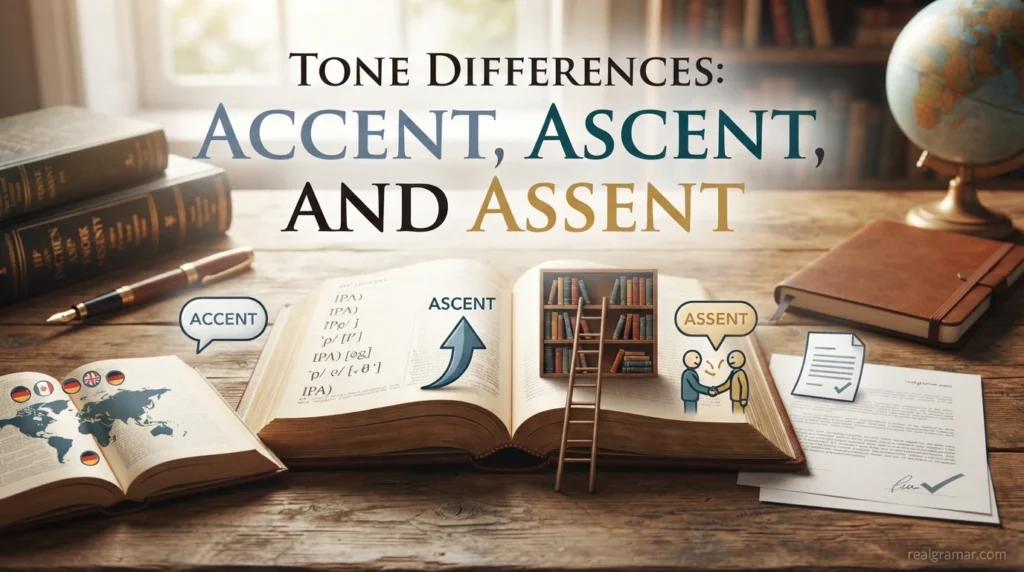
Word choice affects the tone of writing. Choosing the right word makes your message clearer and more professional.
Accent: Personal and Descriptive Tone
Accent often creates a human, cultural, or expressive feeling.
Examples:
- Her warm accent reminded him of home.
- The author added an accent of humor to the story.
Common tones:
- Personal
- Emotional
- Cultural
- Descriptive
Ascent: Inspirational and Achievement-Based Tone
Ascent often creates a feeling of progress, ambition, and success.
Examples:
- His ascent from beginner to expert inspired everyone.
- The team celebrated its ascent to the championship.
Common tones:
- Motivational
- Inspirational
- Triumphant
- Reflective
Assent: Formal and Professional Tone
Assent sounds more official and is common in serious contexts.
Examples:
- The agreement requires the president’s assent.
- The committee expressed its assent to the proposal.
Common tones:
- Formal
- Legal
- Academic
- Professional
Accent, Ascent, and Assent in Creative Writing
Strong writers understand that words carry emotional meaning beyond dictionary definitions. These words can become powerful tools for storytelling, poetry, and descriptive language.
Using Accent in Creative Writing
Accent can reveal:
- Character background
- Personality
- Culture
- Emotional state
Example:
“Her soft accent filled the room like a familiar song from another time.”
This sentence uses a simile to create emotional imagery.
Another example:
“His accent was a bridge between two worlds.”
This metaphor suggests connection and identity.
Using Ascent in Creative Writing
Ascent is especially useful when writing about transformation.
It can symbolize:
- Overcoming challenges
- Personal growth
- Dreams
- Success
Example:
“Every failure became another step in his ascent toward greatness.”
The word creates an image of climbing toward achievement.
Another example:
“Her journey was an endless ascent through mountains of doubt and valleys of fear.”
This uses figurative language to represent emotional struggles.
Using Assent in Creative Writing
Assent works well in formal, historical, or dramatic writing.
Example:
“With a single nod of assent, the leader changed the course of history.”
The word creates a serious and powerful atmosphere.
Another example:
“The silence that followed was interpreted as silent assent.”
This creates mystery and tension.
Comparison Examples: Accent, Ascent, and Assent Together
Seeing these words side by side makes the differences easier to understand.
| Sentence | Correct Word | Meaning |
| Her accent showed where she grew up. | Accent | Speech style |
| The climbers began their ascent at dawn. | Ascent | Upward journey |
| The board gave its assent to the plan. | Assent | Agreement |
| His accent made his storytelling memorable. | Accent | Voice feature |
| The company’s ascent surprised investors. | Ascent | Growth |
| The proposal received public assent. | Assent | Approval |
Similar Sound, Different Meaning: A Vocabulary Learning Strategy
Words like accent, ascent, and assent are examples of confusing word groups. Learning them together improves vocabulary retention because your brain remembers differences more effectively through comparison.
A useful strategy:
Step 1: Identify the Root Idea
Ask:
- Is it about speaking? → Accent
- Is it about rising? → Ascent
- Is it about agreeing? → Assent
Step 2: Create Mental Images
Visualization helps memory.
Accent:
Imagine someone speaking with a unique voice.
Ascent:
Imagine climbing a tall mountain.
Assent:
Imagine someone saying “yes” or approving a decision.
Step 3: Practice Sentence Creation
Create your own examples.
For example:
- My grandfather’s accent tells stories about his childhood.
- The mountain ascent tested our courage.
- The team gave assent to the new strategy.
Writing your own sentences strengthens language skills.
Accent vs Ascent vs Assent
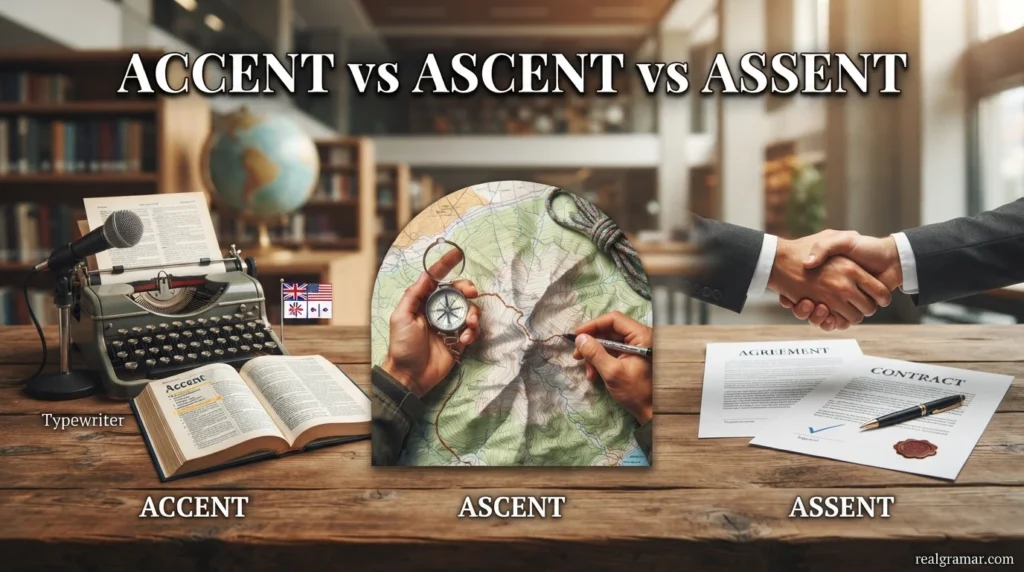
| Feature | Accent | Ascent | Assent |
| Meaning | Speech style or emphasis | Upward movement or growth | Agreement or approval |
| Type | Noun/Verb | Noun | Noun/Verb |
| Common Use | Language and description | Progress and climbing | Formal agreement |
| Related Word | Accentuation | Ascend | Consent |
| Opposite Idea | No accent/emphasis | Descent | Refusal/disagreement |
How These Words Improve Writing Skills
Using precise vocabulary makes writing stronger. Instead of relying on general words like “sound,” “growth,” or “agreement,” these words allow writers to communicate specific ideas.
Compare:
Basic:
- She had a different way of speaking.
Better:
- She had a unique accent.
Basic:
- His career improved quickly.
Better:
- His career ascent happened rapidly.
Basic:
- They agreed with the decision.
Better:
- They gave their assent to the decision.
Precise vocabulary creates clearer images and stronger communication.
Idiom Meaning and Expressions Related to These Words
Although these words are not always used in common idioms, they appear in many meaningful expressions.
Expressions With Accent
“A foreign accent”
Meaning:
A pronunciation style associated with another language or country.
Example:
- He speaks English with a foreign accent.
“Put an accent on something”
Meaning:
To emphasize or highlight something.
Example:
- The teacher put an accent on creativity.
Expressions With Ascent
“Rise and ascent”
Meaning:
Growth, improvement, or advancement.
Example:
- The athlete’s rise and ascent inspired young players.
“Steep ascent”
Meaning:
A difficult climb or challenging progress.
Example:
- Building a successful business can be a steep ascent.
Expressions With Assent
“Give assent”
Meaning:
To approve or agree.
Example:
- The committee gave assent to the proposal.
“Without assent”
Meaning:
Without permission or approval.
Example:
- The decision was made without public assent.
Practical Exercise: Choose the Correct Word
Fill in the blanks with accent, ascent, or assent.
- The singer’s unique ______ made her voice recognizable.
- The hikers started their difficult ______ early in the morning.
- The organization needed official ______ before beginning the project.
- His career ______ continued after years of hard work.
- She spoke English with a noticeable regional ______.
- The committee finally gave its ______ to the agreement.
Answers:
- Accent
- Ascent
- Assent
- Ascent
- Accent
- Assent
Advanced Writing Applications of Accent, Ascent, and Assent
Understanding individual word meanings is important, but mastering vocabulary requires knowing how words function in real communication. Writers, students, and English learners can improve their expression by using these words in the right situations.
Whether you are writing an essay, a story, a poem, a speech, or a professional document, choosing accurate words strengthens your message.
Using Accent, Ascent, and Assent in Academic Writing

Academic writing values precision. Instead of using vague words, writers should select terms that communicate exact meanings.
Accent in Academic Writing
In academic contexts, accent often appears in discussions about:
- Language learning
- Sociolinguistics
- Communication
- Cultural identity
Examples:
- Researchers study how regional accents influence communication.
- A person’s accent can reflect geographical and cultural history.
- Language learners often work on reducing pronunciation difficulties while maintaining their natural accent.
Here, accent provides a specific meaning that cannot be replaced by a general word like “voice.”
Ascent in Academic Writing
Ascent is often used when discussing:
- Historical development
- Career progress
- Economic growth
- Scientific advancement
Examples:
- The country experienced a rapid economic ascent.
- The scientist’s ascent in the academic world was remarkable.
- The article explores humanity’s technological ascent.
The word adds a sense of movement and progress.
Assent in Academic Writing
Assent is useful in formal discussions involving:
- Policies
- Agreements
- Research participation
- Official decisions
Examples:
- Participants provided informed assent before joining the study.
- The proposal received institutional assent.
- The agreement required the assent of all members.
Because assent has a formal tone, it works well in professional writing.
Using These Words in Speeches and Presentations
Public speakers rely on powerful vocabulary to influence audiences. The right word can create clarity and emotional impact.
Speech Example Using Accent
“Every culture has its own accent, its own voice, and its own story.”
This sentence uses accent symbolically to represent identity.
Speech Example Using Ascent
“Success is not a single moment; it is a continuous ascent built through dedication.”
Here, ascent creates a motivational image.
Speech Example Using Assent
“Progress begins when communities give their assent to positive change.”
This creates a formal and persuasive tone.
Accent, Ascent, and Assent in Poetry and Creative Expression
Poetry often depends on words with multiple layers of meaning. These three terms can create symbolic images when used creatively.
Poetic Expression With Accent
Example:
“The river whispered with an accent of forgotten dreams.”
Meaning:
The river is not literally speaking. The word accent adds a unique emotional quality.
Poetic Expression With Ascent
Example:
“My soul began its ascent beyond the shadows of yesterday.”
Meaning:
Ascent represents emotional and spiritual growth.
Poetic Expression With Assent
Example:
“The stars offered silent assent to the wishes of the night.”
Meaning:
The stars symbolically approve or agree.
Metaphor Examples Using Accent, Ascent, and Assent
Metaphors compare two ideas without using “like” or “as.” They are powerful literary devices that create deeper meaning.
Accent Metaphors
- Her kindness was the accent of her personality.
- Hope became the accent of his darkest days.
- Creativity was the accent that made his work unforgettable.
Meaning:
Accent represents a special feature that enhances something.
Ascent Metaphors
- Life is an endless ascent toward wisdom.
- Knowledge is the ascent that lifts humanity higher.
- Her confidence was an ascent from fear to freedom.
Meaning:
Ascent represents improvement and transformation.
Assent Metaphors
- His smile was an unspoken assent.
- The peaceful silence became the world’s assent to change.
Meaning:
Assent represents approval or acceptance.
Simile Examples Using Related Ideas
Similes compare things using “like” or “as.”
Accent Similes
- Her voice flowed like a melody with a beautiful accent.
- His accent was like a familiar song from home.
Ascent Similes
- His progress was like an ascent up a challenging mountain.
- Her journey was as difficult as a steep ascent.
Assent Similes
- Their agreement came like a quiet assent after years of discussion.
- His nod was as clear as an official assent.
How to Avoid Confusing Similar-Sounding Words
Many English learners struggle with homophones because pronunciation alone cannot reveal meaning.
Here are practical strategies:
1. Look at the Context
Ask what the sentence is describing.
Is it:
- A person’s speech? → Accent
- A climb or improvement? → Ascent
- Agreement or permission? → Assent
2. Check the Surrounding Words
Certain words commonly appear with each term.
Often Used With Accent:
- Regional accent
- Foreign accent
- Strong accent
- Put emphasis/accent on
Words Often Used With Ascent:
- Mountain ascent
- Rapid ascent
- Career ascent
- Steep ascent
Words Often Used With Assent:
- Give assent
- Receive assent
- Official assent
- Mutual assent
3. Learn Word Families
Understanding related words makes vocabulary easier.
Accent Family:
- Accent
- Accentuate
- Accentuation
Example:
- The writer accentuated the emotional moment.
Ascent Family:
- Ascend
- Ascending
- Ascension
Example:
- The airplane began ascending.
Assent Family:
- Assent
- Consent
- Agree
- Approval
Example:
- The manager consented to the request.
Final Practice Exercise
Choose the correct word.
Exercise 1
- The actor learned a new ______ for the role.
- The company’s ______ in the global market was impressive.
- The parents gave their ______ for the school activity.
- The mountain’s ______ required special equipment.
- The speaker placed an ______ on teamwork.
Exercise 2: Rewrite Using Precise Vocabulary
Replace the underlined phrases with accent, ascent, or assent.
- Her way of speaking showed her cultural background.
- His journey toward success inspired millions.
- The officials approved the new policy.
Answers:
- Her accent showed her cultural background.
- His ascent toward success inspired millions.
- The officials gave their assent to the new policy.
FAQs
1. What is the difference between accent, ascent, and assent?
Accent refers to pronunciation, speech style, or emphasis. Ascent means upward movement, climbing, or progress. Assent means agreement, approval, or acceptance.
A simple memory trick:
- Accent = voice
- Ascent = rise
- Assent = yes
2. Are ascent and assent pronounced the same?
Yes, in many varieties of English, ascent and assent are pronounced the same way. They are homophones, meaning they sound alike but have different meanings and spellings.
Examples:
- The mountain ascent was difficult.
- The proposal received assent.
The context tells you which word is correct.
3. Can accent have a meaning besides pronunciation?
Yes. Accent can also mean emphasis or a special feature that makes something noticeable.
Examples:
- The designer added a colorful accent to the room.
- The teacher placed an accent on creativity.
4. Is assent the same as agreement?
Yes, but assent is usually more formal. In everyday conversation, people often say “agree” instead.
Examples:
Casual:
- She agreed with the decision.
Formal:
- She gave her assent to the decision.
5. How can I remember the difference between these words?
Use visual associations:
- Accent → Imagine someone speaking.
- Ascent → Imagine climbing a mountain.
- Assent → Imagine someone saying “yes.”
Connecting words with images makes vocabulary easier to remember.
Conclusion
An accent adds identity and expression to speech. It can reveal culture, personality, and background while also representing emphasis in writing. An ascent represents movement upward, whether through a physical climb, personal growth, or professional success. An assent expresses agreement, approval, and acceptance, especially in formal situations.
These words also demonstrate the beauty of language. A single term can move beyond its dictionary definition and become a powerful tool for creative writing, figurative language, and poetic expression.
By practicing sentence examples, studying comparison tables, and paying attention to context, you can avoid common mistakes and develop stronger vocabulary skills. Precise word choice makes essays clearer, stories more engaging, and conversations more meaningful.
Language is not only about knowing words—it is about knowing how and when to use them. When you understand subtle differences between similar words, your communication becomes more effective, expressive, and memorable.
